Places
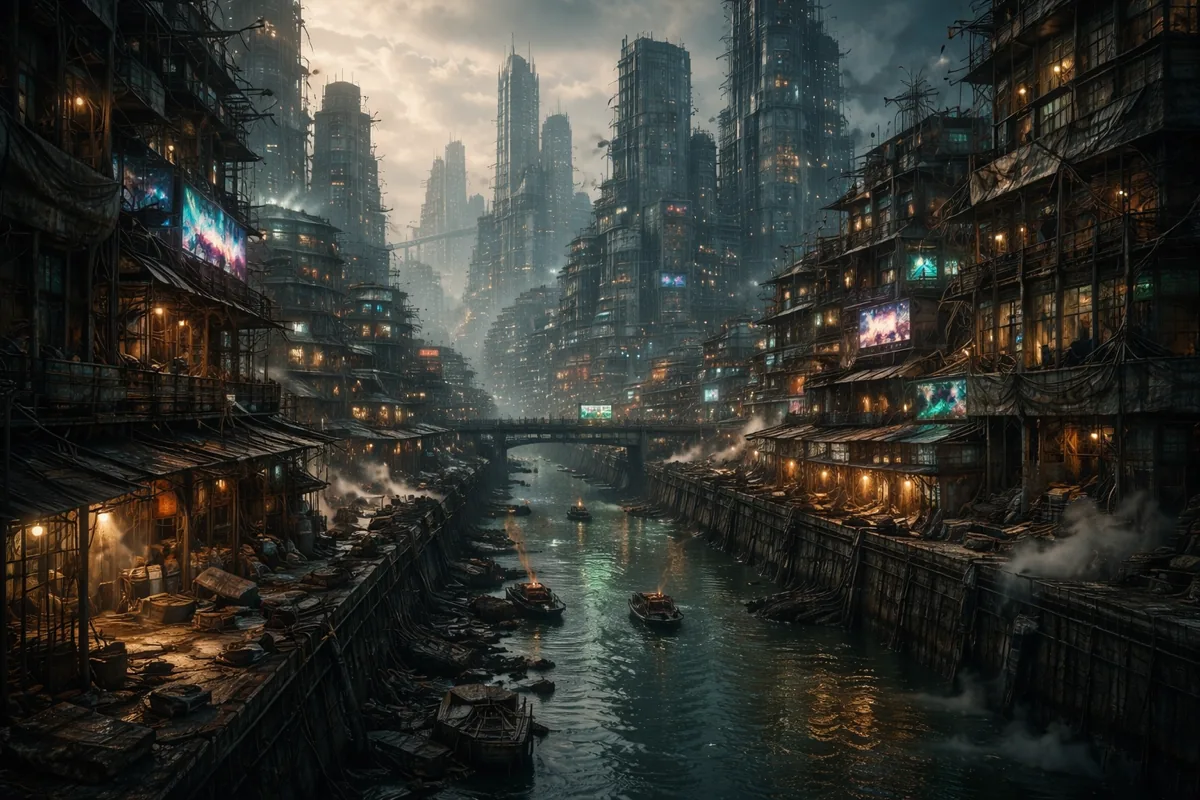 Udhafa The capital of the Maan empire and one of the great inhabited ruins of the world, an ancient Iru-founded city in eastern Tarkdaara, carved into the bedrock below the Claw Peaks at the captured source of the Elder River. It was not built by the Maan but inherited, renamed, and ruled: its dead Iru towers still stand above the denser canal-blocks like fossilized bones. It is a wounded capital of managed decay, still administered and defended though the empire it served has already died.
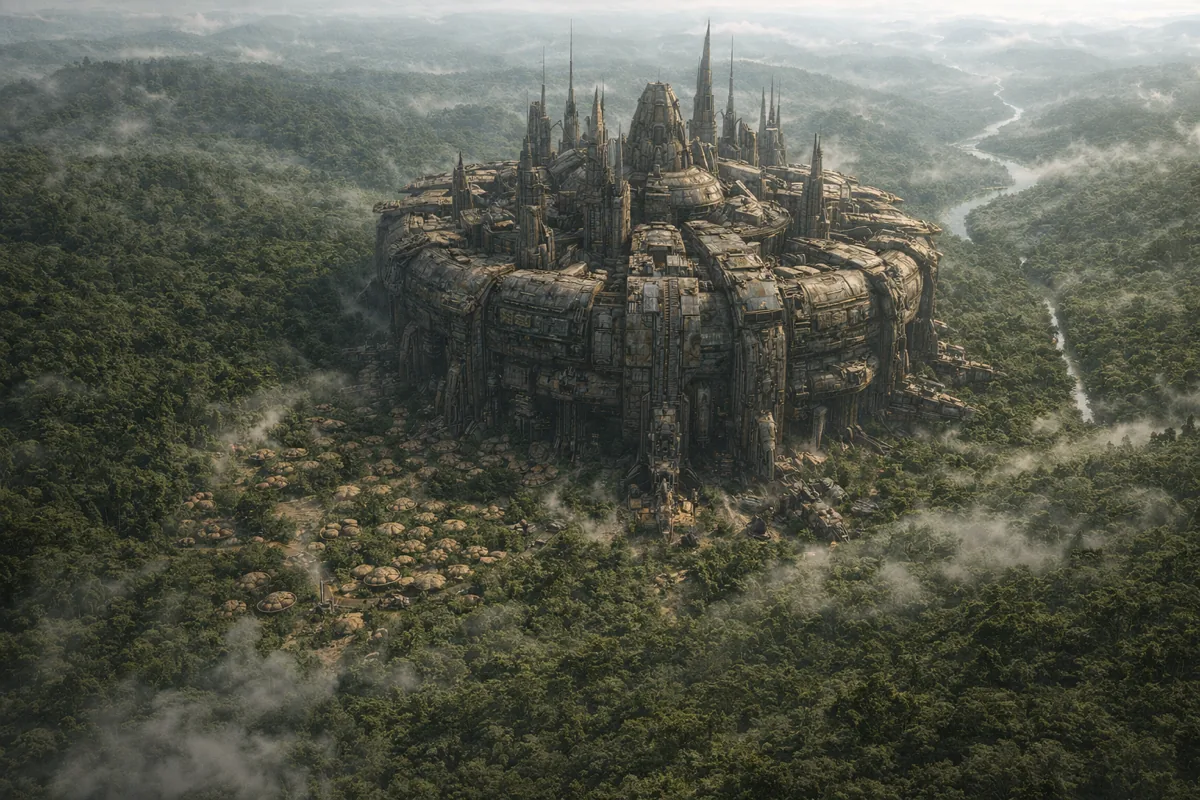 Vaparium The Sovereign Arcology of Vaparium, the Meir homeland in the south and the most technologically advanced structure on Elshore. It is not built architecture so much as an organism that chose to stop moving: the Meir generation ships, fused and rooted and kept living beneath the canopy of the Land of Green Shadows. Militarily neutral by long custom and bound by a morality of sanctuary, it has stood sovereign and apart from the Maan empire since the Meir first arrived.
- Hytwa At the base of the Sovereign Arcology of Vaparium, where the Ark's anchor pylons meet the forest floor, lies Hytwa: a ring of soft-grown, semi-organic domes that look cultivated rather than built, joined by arched spans and lit by low glyph-marks, a couple of kilometres inland behind the shore of Meir Bay. It is the gentlest quarter of the Meir homeland and the most exposed, grown to fail outward and kept sacrificially separate from the Ark's spine. In the year 50 After the Chaos, on the 33rd of Namiitide, the old rockets found it.
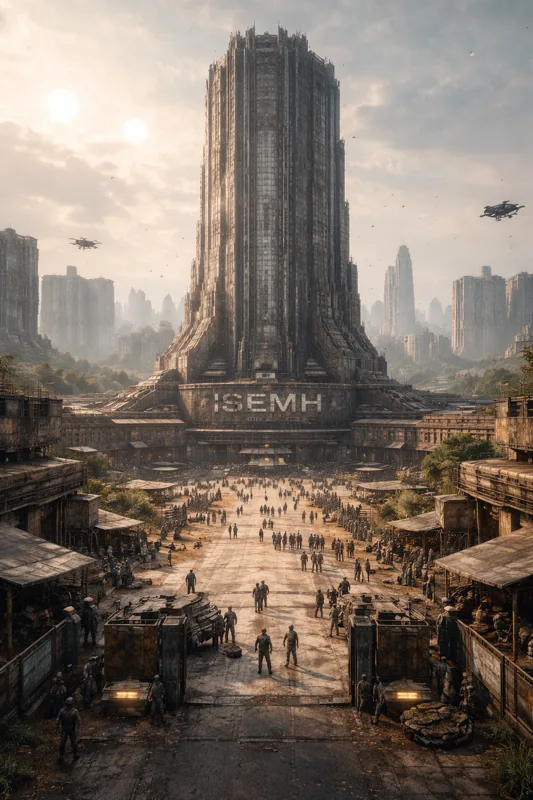 The Udhafa ISEMH Control Node The arcology-scale control node that dominates the centre of Udhafa: one of the great urban nodes of the planet-scale ISEMH system, not "the ISEMH" itself. A 133-floor Iru-era tower rooted in the city bedrock, it handles local identity verification, command routing, sensor fusion, fabrication access, and the city-facing portions of the wider system. The Maan empire runs its public face under downgraded maintenance while its restricted levels and old Iru cores keep their own counsel; it matters less for being unique in kind than for the political weight of standing in the former imperial capital.
- IOMS The ISEMH Orbital Main Station, the command station of the planet-scale system's orbital grid, riding the old grid orbit high above the fallen world. The grid was commissioned as a network of 1,024 satellites; IOMS is the one platform of station scale among them, built to command the rest. It is the orbital counterpart of the urban control nodes and the subsea cores, the high seat of a system that has outlived its makers. In AC 50 it still functions, degraded, under no stewardship at all: the empire that runs the public face of the nodes it holds, holds nothing of the sky.
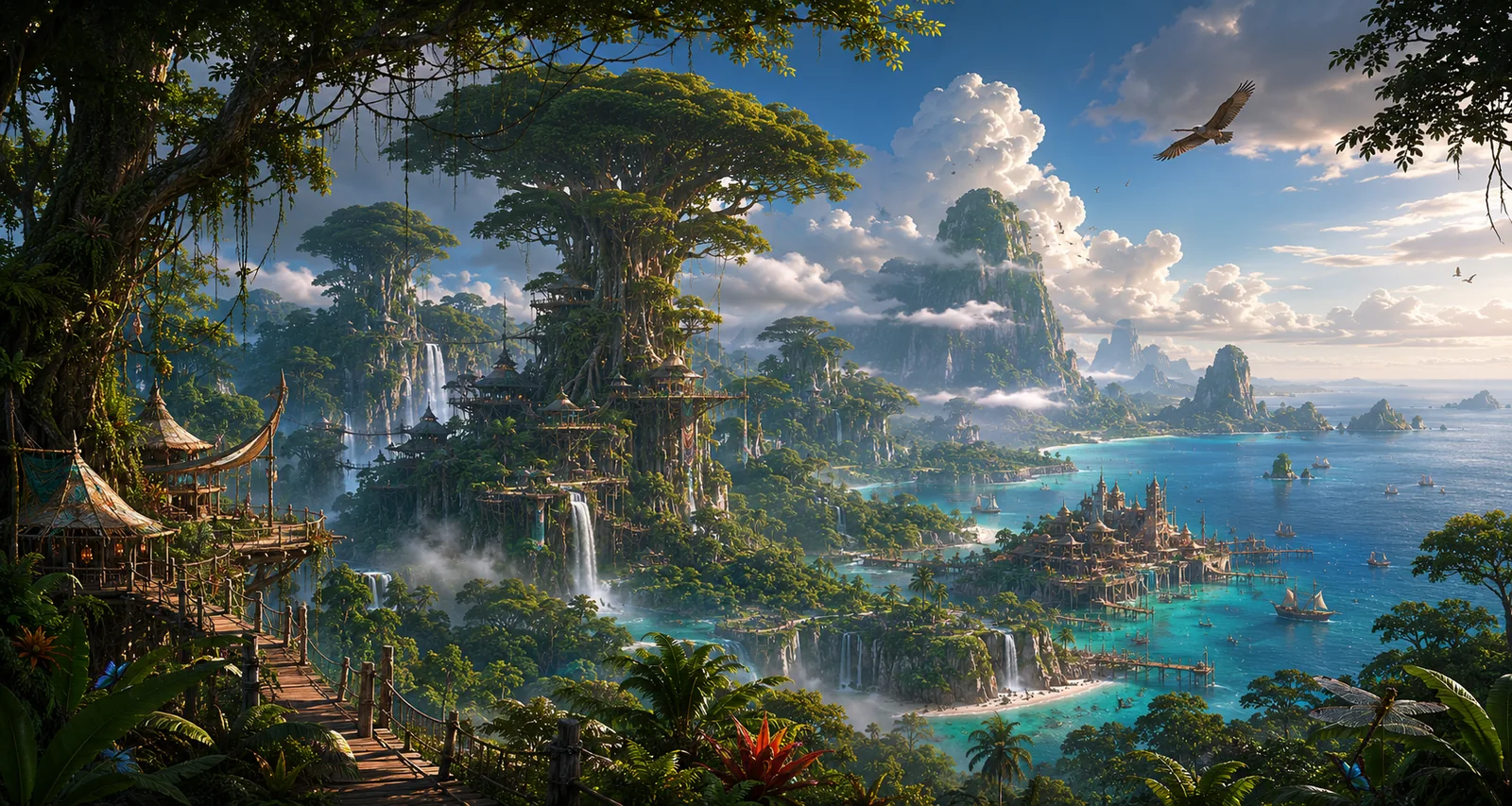 Baramma The great jungle island east of Tarkdaara, separated from the mainland by the Bram Sea and home to the Bar. Towering trees climb like green pillars into a sky the suns can barely touch, and the air hangs heavy with wet bark and river breath. Under the Maan empire the Bar were exiled here; among themselves the Free Clans govern it still, and no road crosses Baramma that the Bars do not allow.
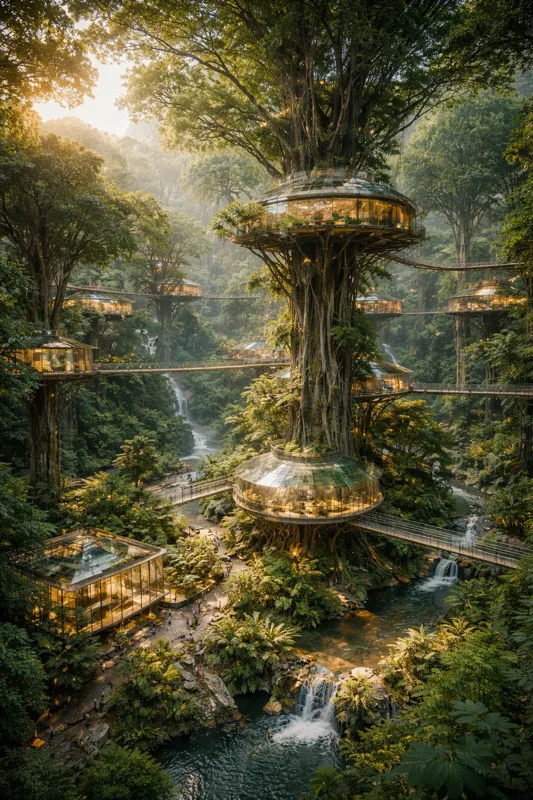 Yara Village The centre village of the Free Clans on Baramma, a vertical settlement grown into the dense fern forest and the canopy above it: a forest that learned to speak. It is engineered rather than improvised, civic and legible, its life organised around a deliberate clearing rather than a walled footprint. Circles and ovals dominate, growth feels slow and integrated, and the whole settlement is balanced by a web of taut cables and bridges.
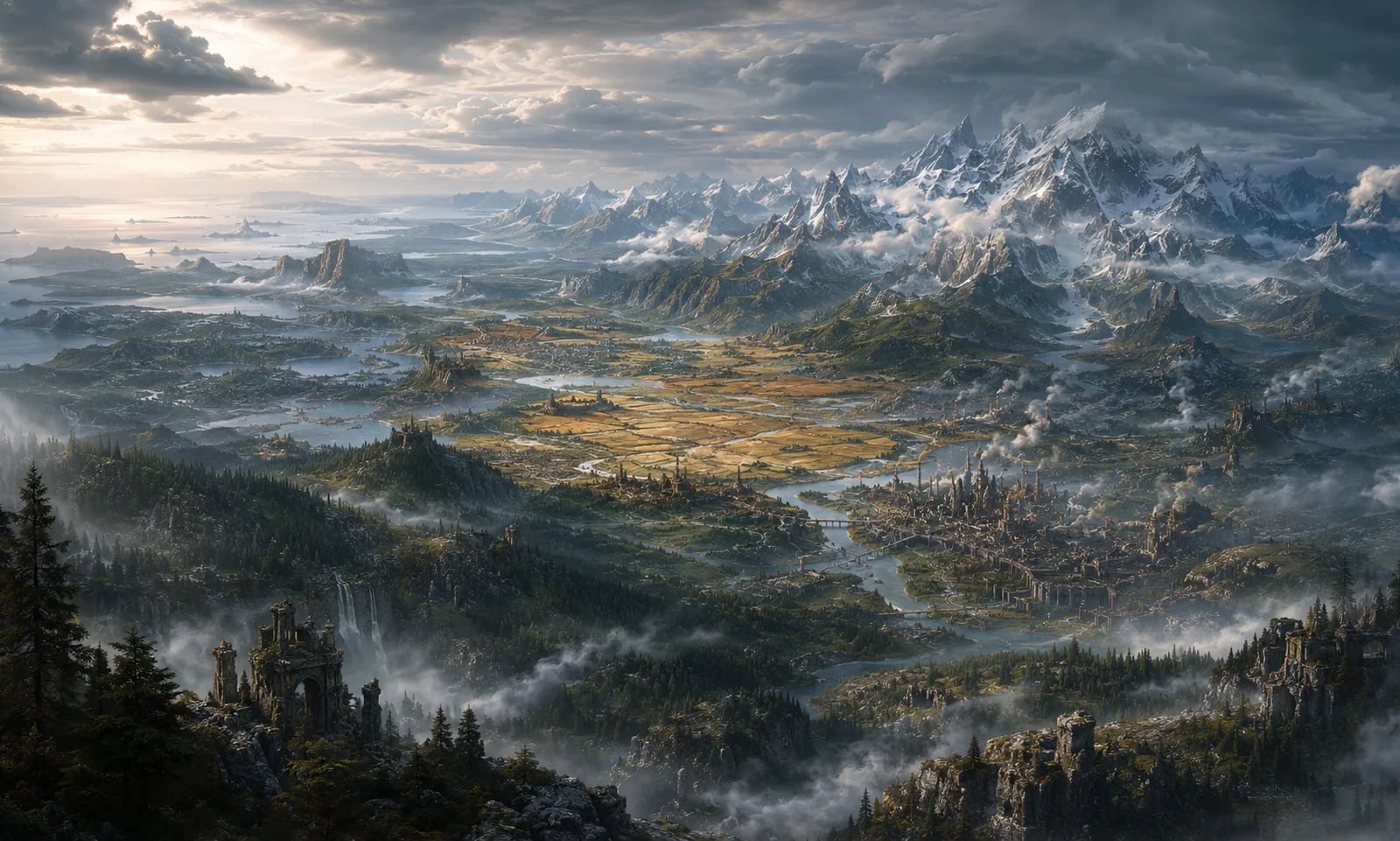 Northland The northern continent of Elshore, called Northland in common speech, on which every chapter of the story so far unfolds. It is a post-imperial hinterland of broken mountains, misted forests, ancient river valleys, and golden deserts: the land where the Iru fell, the Maan rose, and the remaining Annil are being ground out. The Inarin peninsula, Udhafa, and the Spine of the World all sit within it.
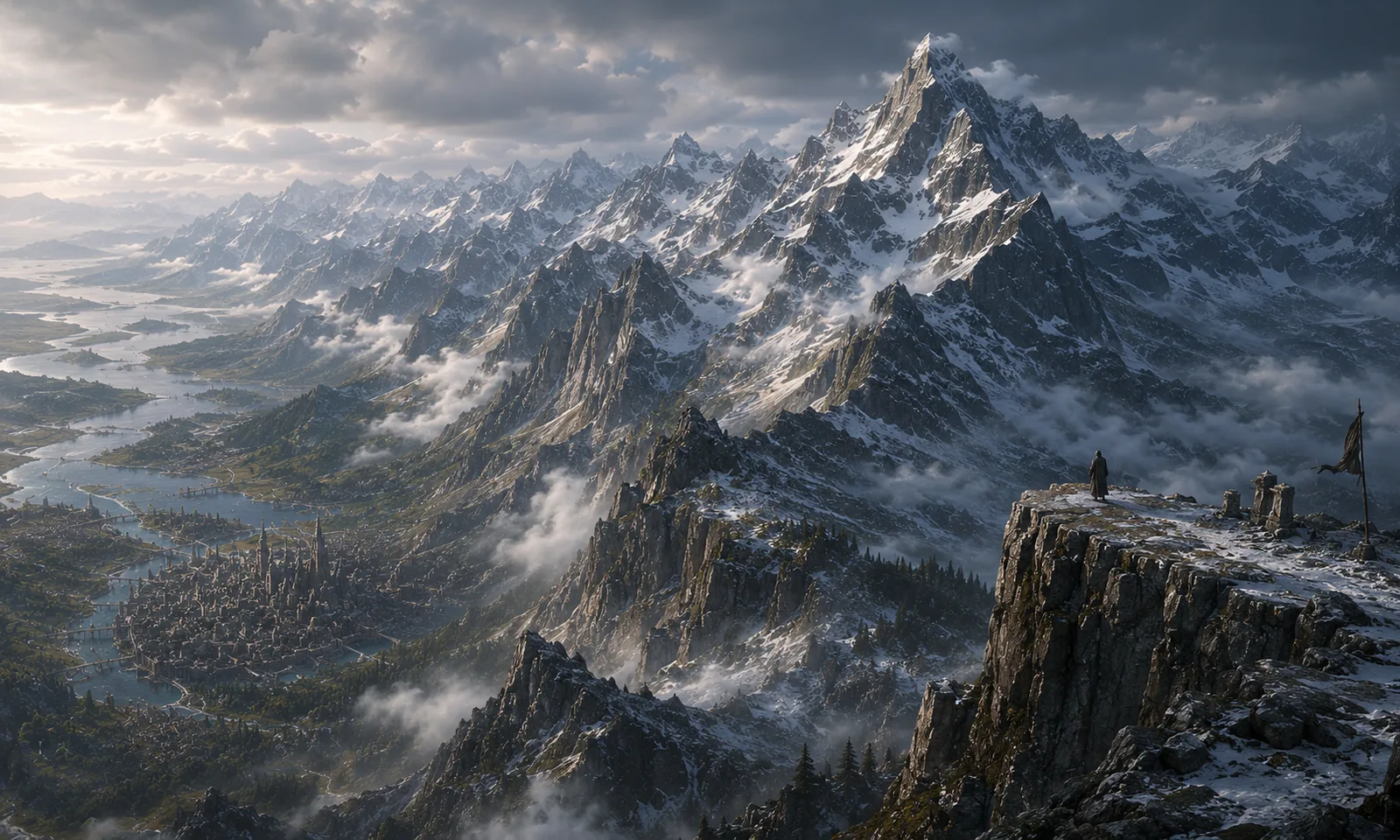 The Spine of the World The continent-long mountain crown that splits Tarkdaara down its centre, a chain of stone and ice where the peaks tear at the clouds and the valleys drown in mist. Forests thin and bleed into crag and shale, the air carries the iron taste of old storms, and in the highest passes nothing moves but the shadow of the suns across endless broken snowfields. The cliff where the story opens, twenty miles north of Udhafa, lies within it.
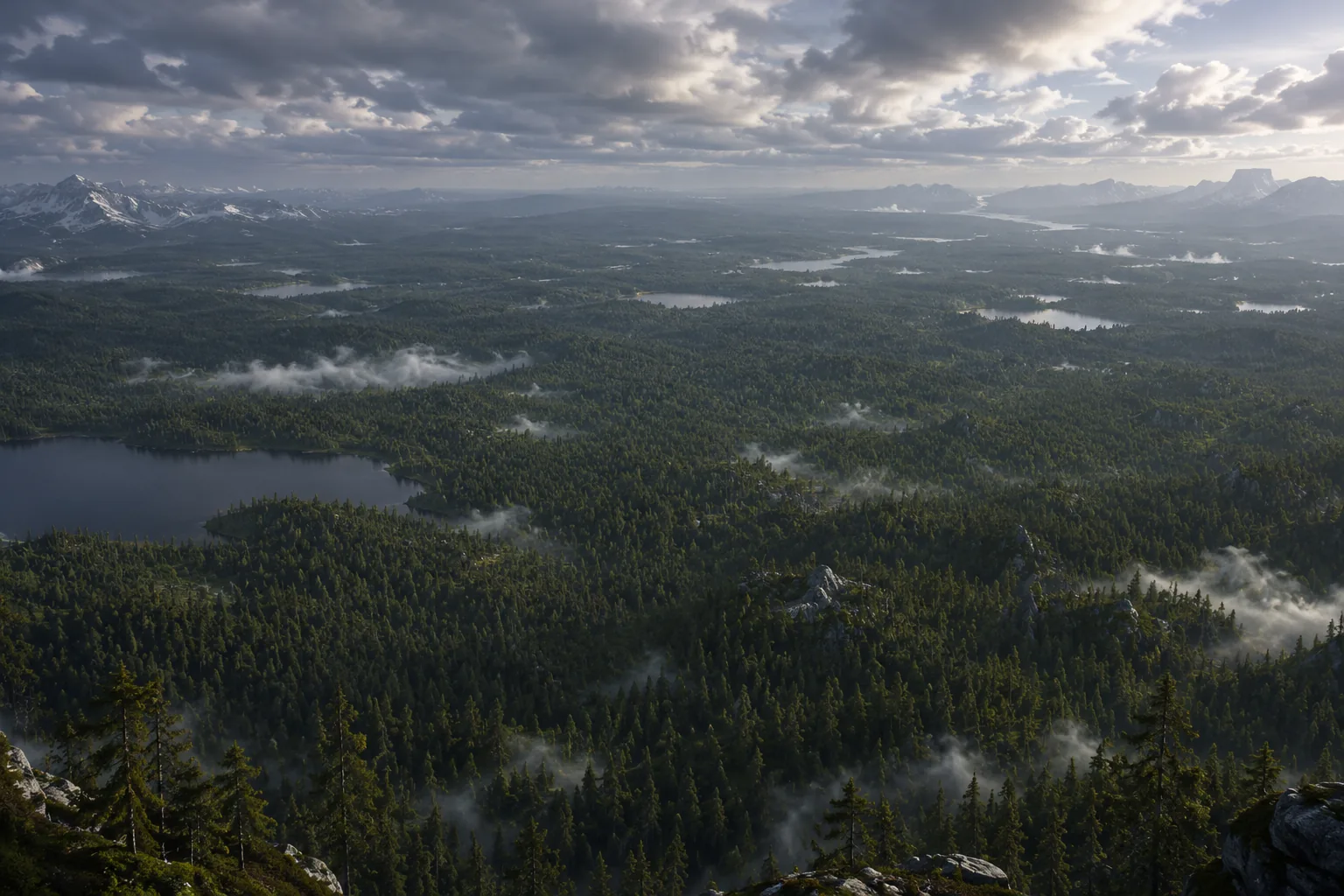 The Inarin Peninsula The imperial heartland of Tarkdaara, the peninsula on which Udhafa stands and on which every chapter of the story is set. It carries the name of the civilization that built it, the Inarin, and its Iru-era form survives in the city datelines as a cultural echo now buried beneath Maan rule. The cliff north of Udhafa stands within or adjacent to its northern edge.
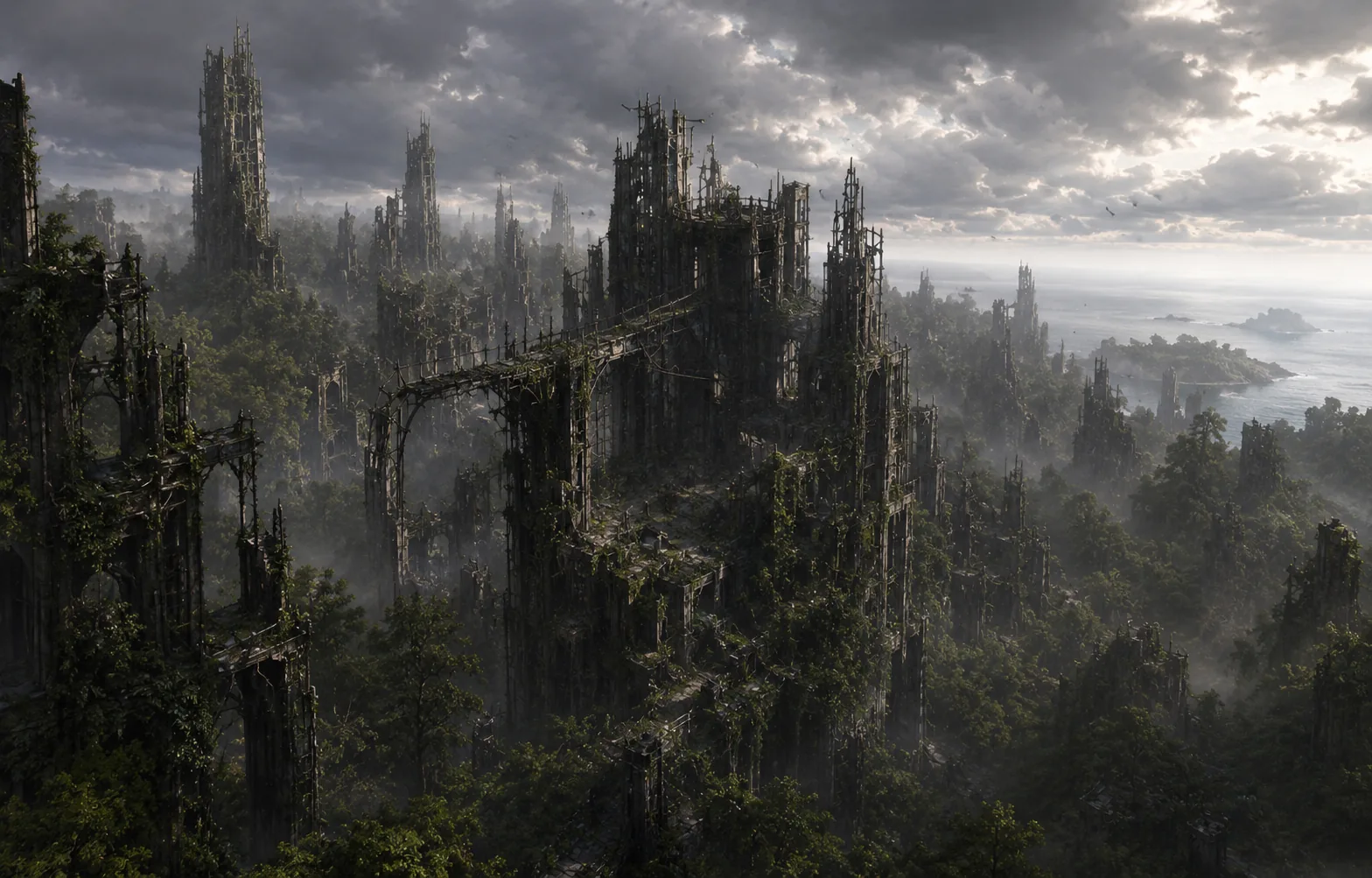 Onnila A city on the east coast of Baramma, facing the open waters, and the first Iru-era settlement raised on the island in the age of discovery. Its founding name was Onnae'la, "Flowing Wave," and it is associated with surviving Iru-era infrastructure from that distant era. It sits among the old Inarin cities of the Tarkdaaran sphere, of which Baramma was once counted a part.
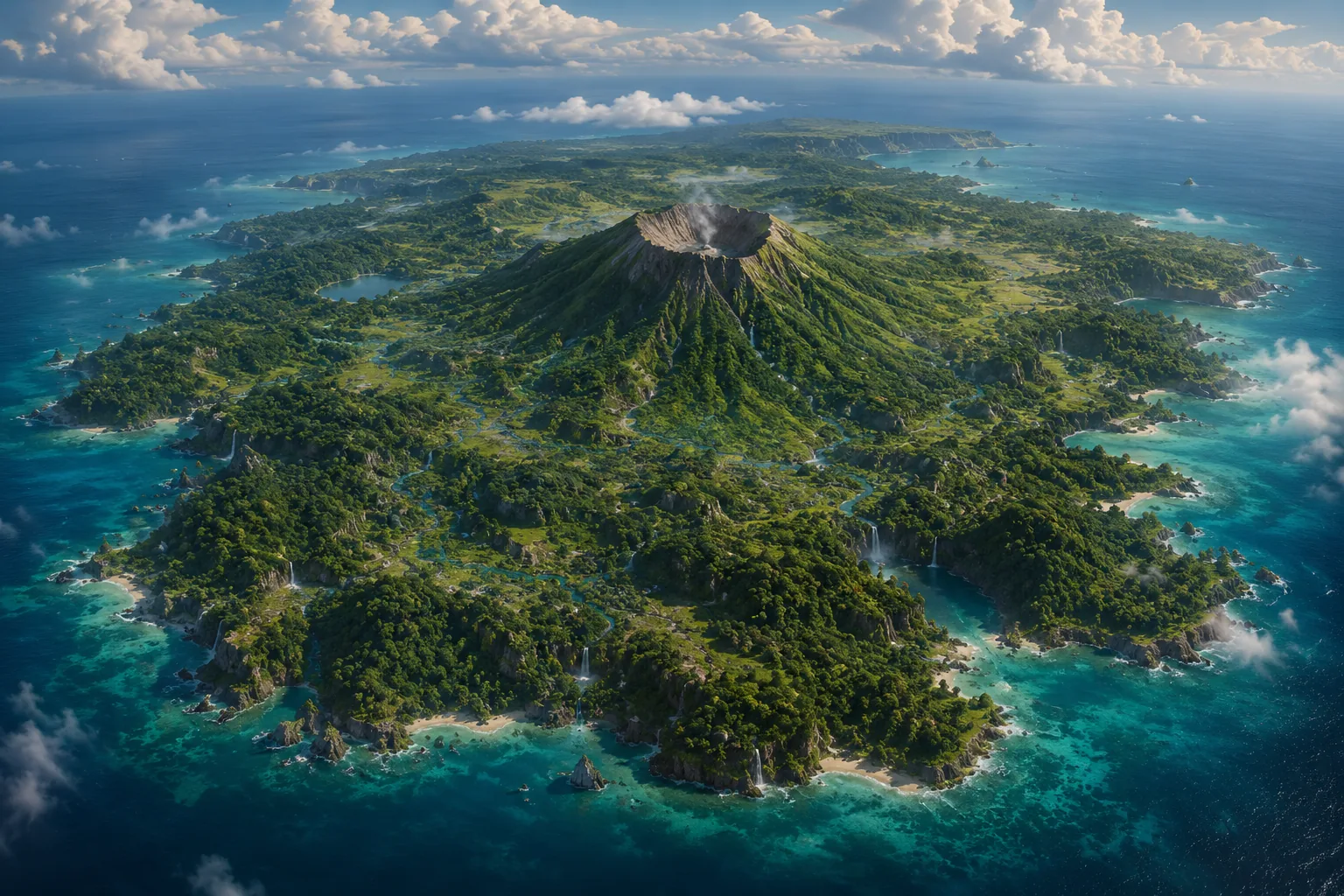 Annilia A large island north of Baramma, where cold mist rolls down fern-carpeted hills and forgotten roots crack the stones of abandoned places. Once purchased and renamed by the corporation that created the Annil, it became their principal refuge: the safe harbour for those who could flee the empire's persecution. The winds there taste of iron and moss, and shaded hollows cradle forests that hum with patient breath.
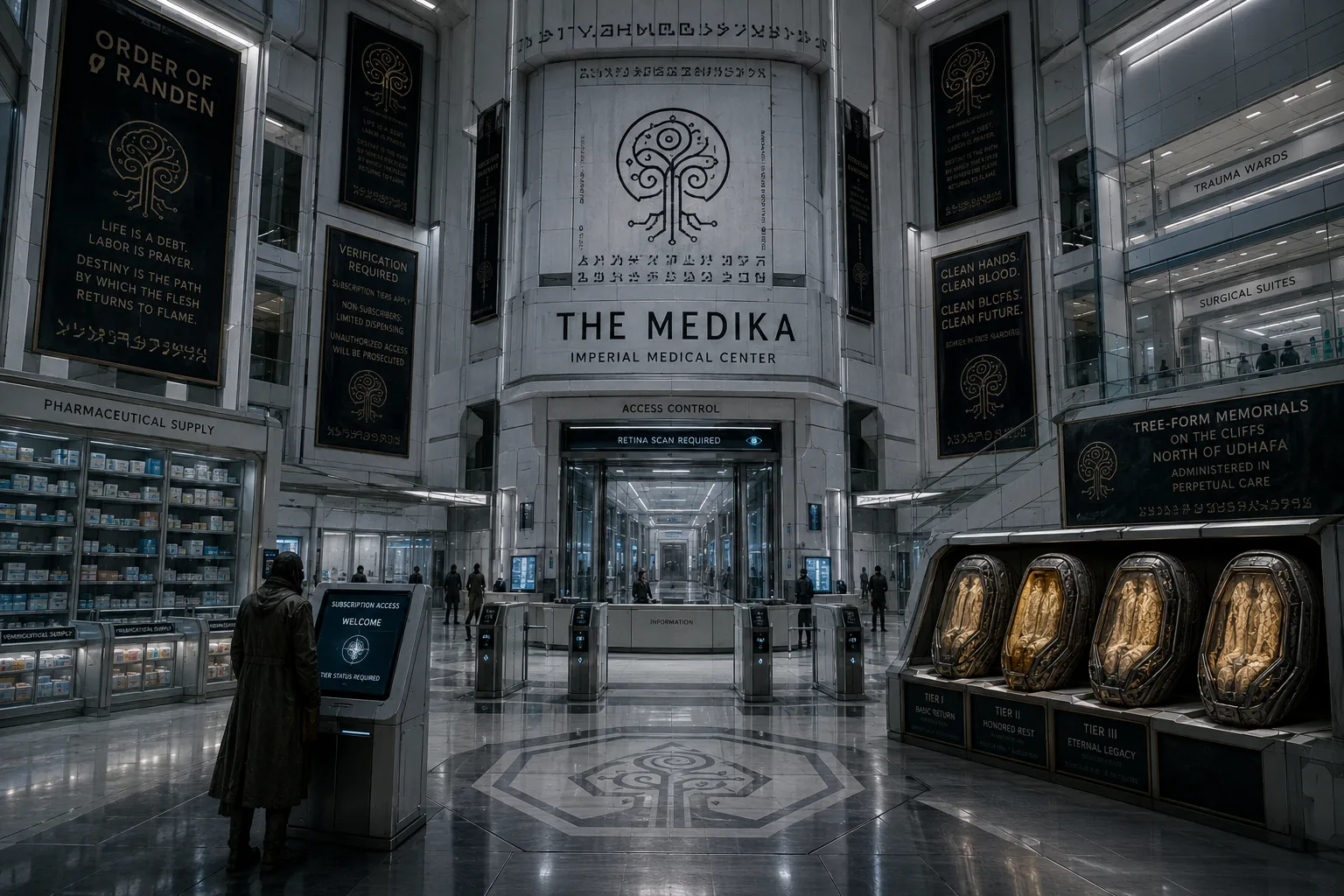 The Medika The imperial medical centre serving Udhafa, formally the Imperial Medical Center, open only to credit-sealed subscribers who can afford its monthly fees. Behind its cold ozone and dustless filters it is rot dressed up as order: empty cabinets faced with printed backing, partial cure stocks, and scanners tiered by subscription. Saturated with Order of Randen iconography, it runs on automation during shift changes because there are not enough people left to watch every door.
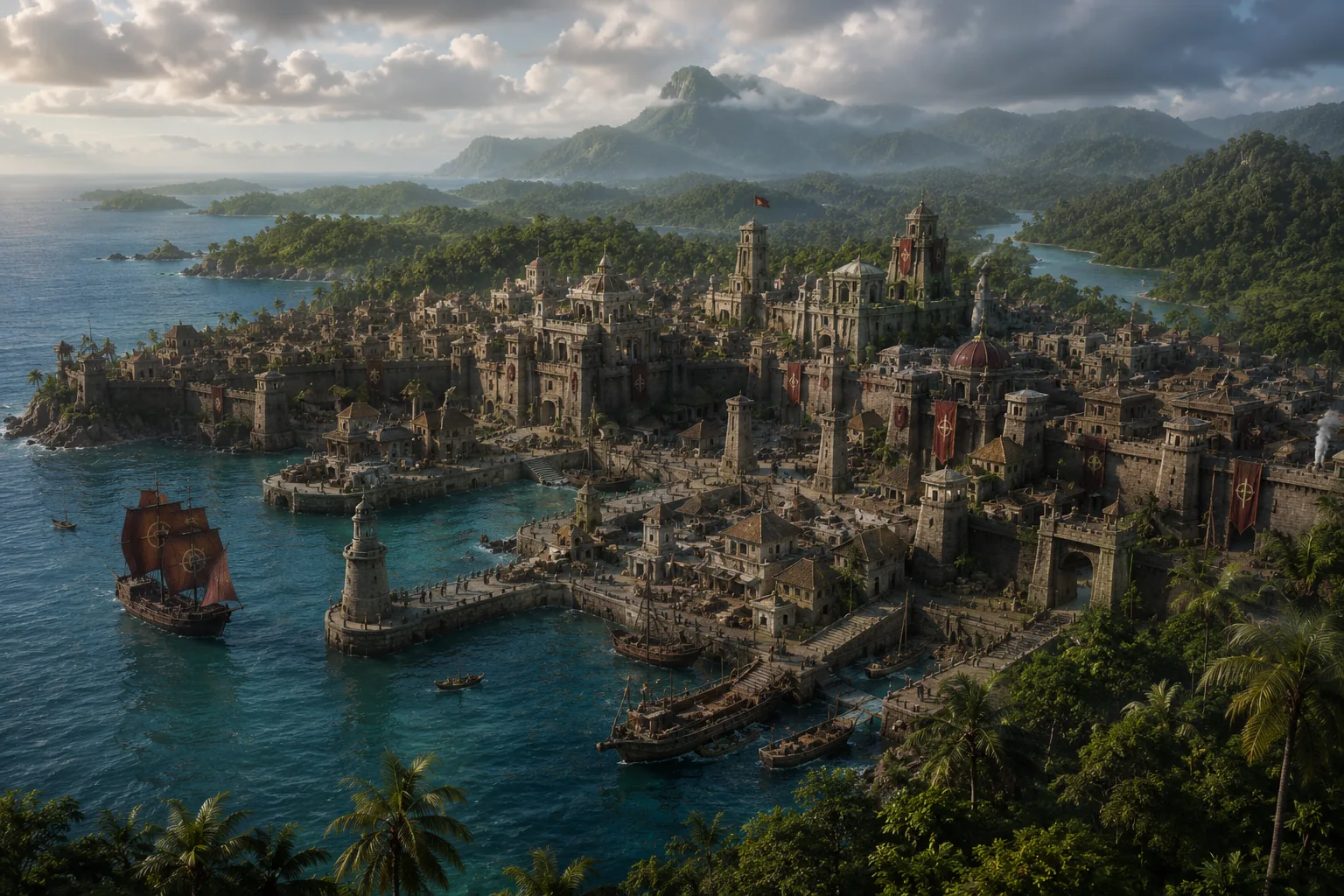 Nilas The single Maan-held city on the otherwise Bar island of Baramma, a stone-built port on the coast of the Bram Sea. It is the empire's foothold and customs gate on an island it does not otherwise rule: the harbour from which ships sail to the empire and the wider world, and the place from which Maan soldiers, Randenist priests, and imperial units are dispatched into the Bar interior. Mixed Maan and Bar, watchful and counting, it is the way off the island and the eye that marks who leaves.
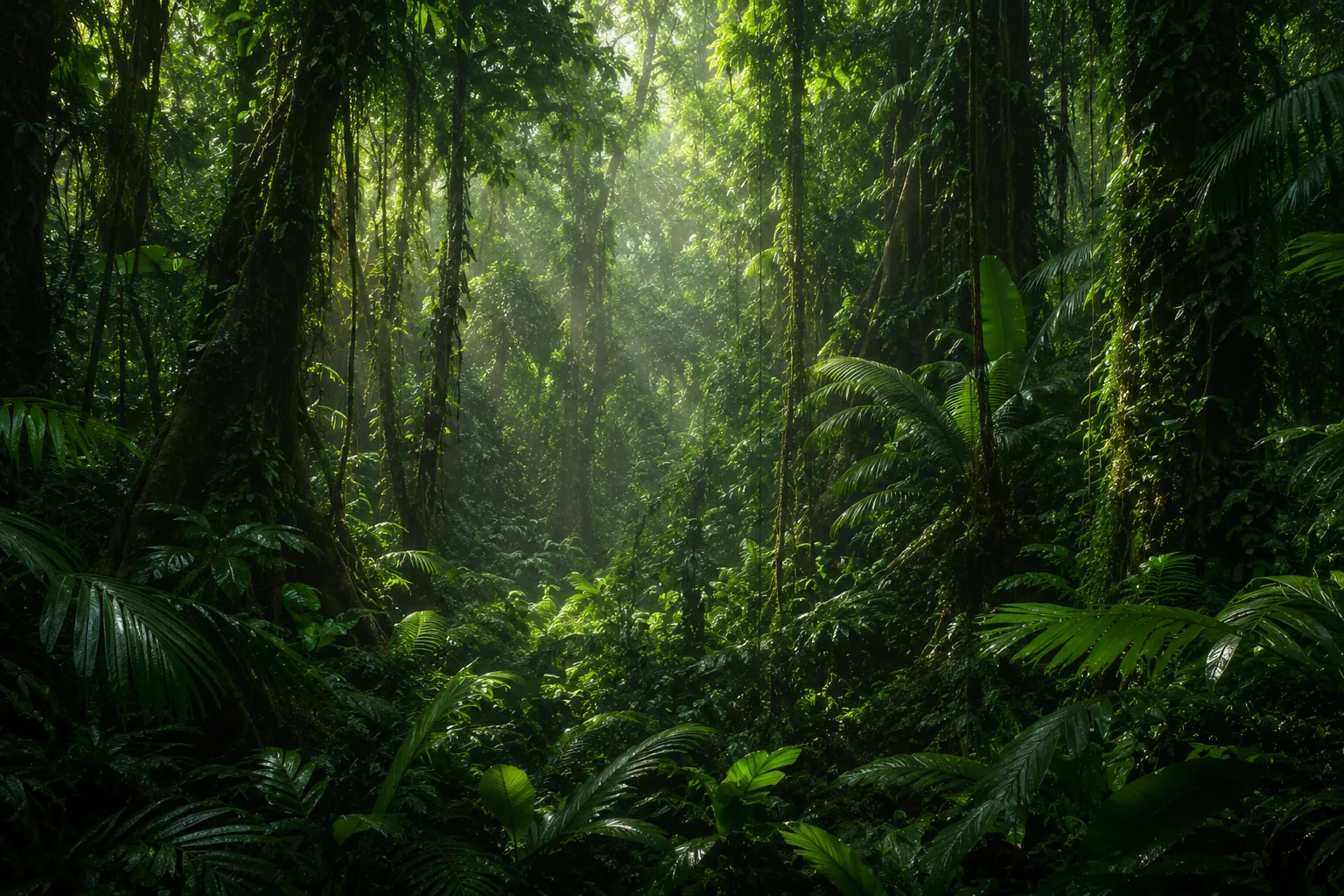 Eldaara The equatorial middle continent of Elshore, between Tarkdaara to the north and Khaldaara to the south. In deep time the supercontinent Pandaara split into Tarkdaara and the southern mass Elandra, which itself differentiated into Eldaara and Khaldaara. Eldaara holds the Land of Green Shadows, the Endless Desert, and the Frozen Highlands, with the Sovereign Arcology of Vaparium beneath its equatorial canopy and the Erg confederation in its interior.
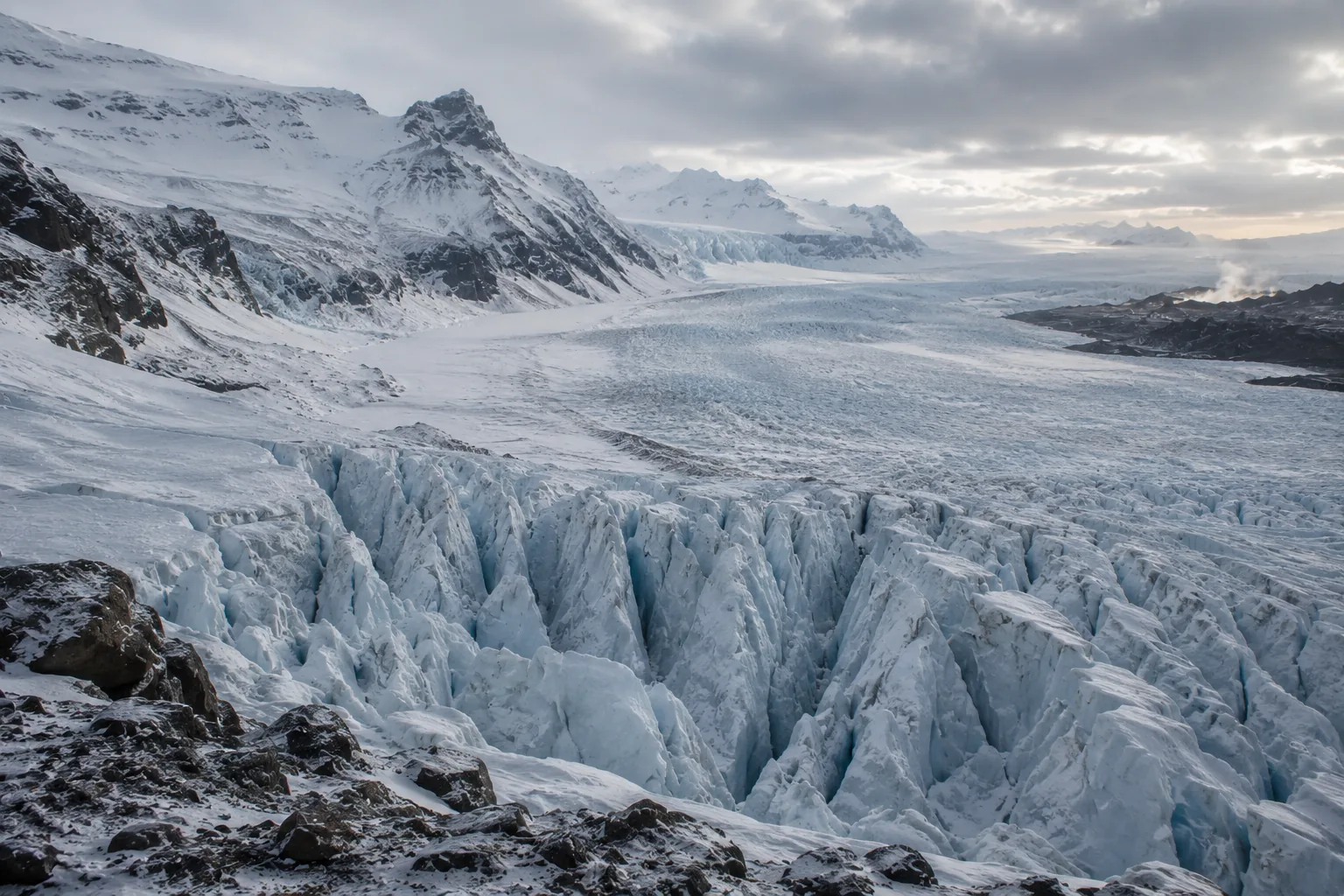 Khaldaara The southern continent of Elshore, called Southland in common speech, where forests give way to sands and then to stonebound frost at the world's edge. It reaches from the Frozen Highlands to the polar south and is associated with the offshore polar landmass of Maanamodilia. The Sovereign Maan Republic holds territory here from its capital Iceborrow.
- Maanamodilia A major offshore landmass in the far south of Elshore, off the southern continent of Khaldaara across the Divider Sea of the Maans, reaching toward the polar south. Little is recorded of it in the surfaced canon beyond its place on the world map; most of its detail is not yet established.
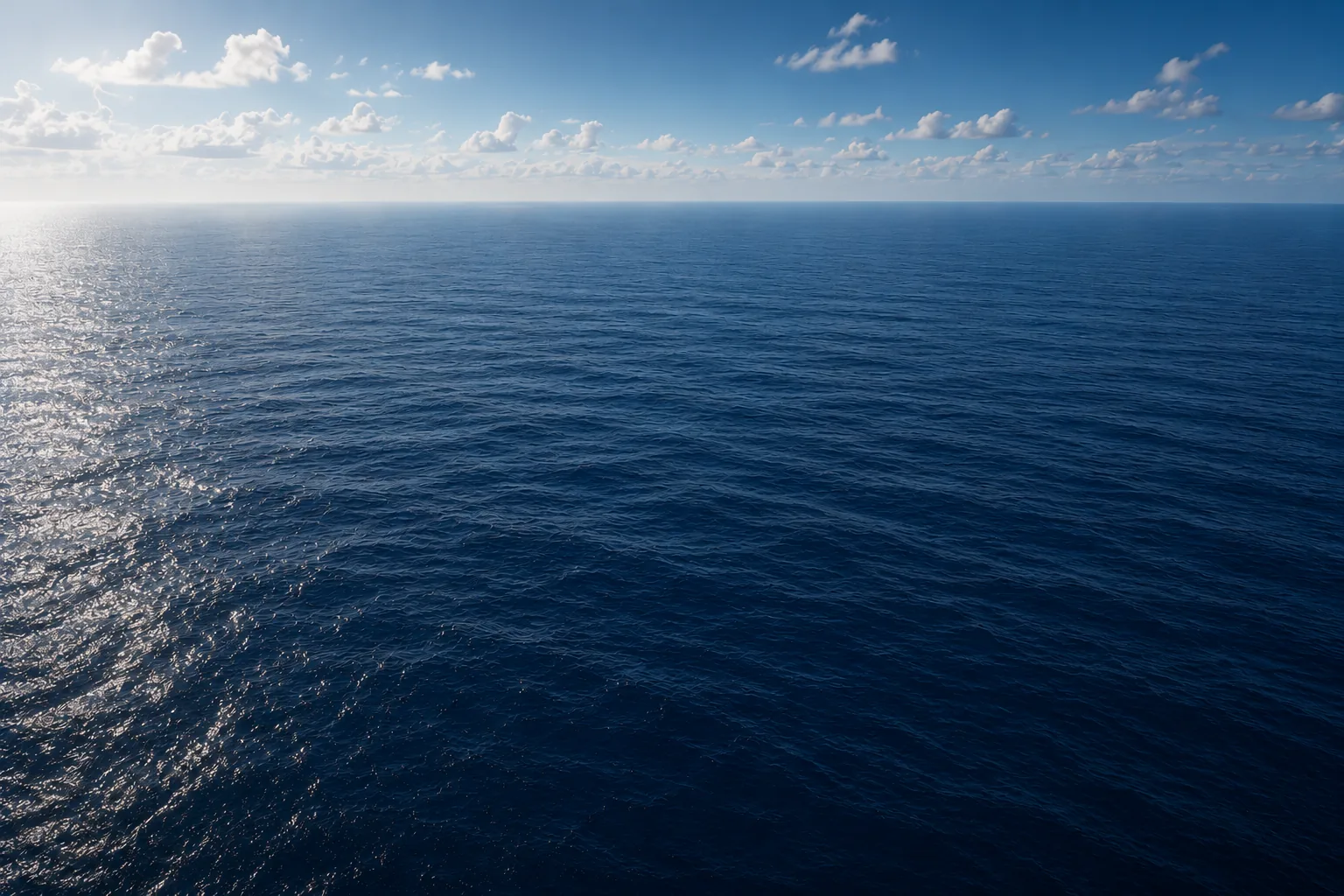 Dravak Tides The western ocean of Elshore, the open water reaching west of the equatorial and southern continents. No detailed account of the Dravak Tides is recorded yet; the name marks the western sea on the world map.
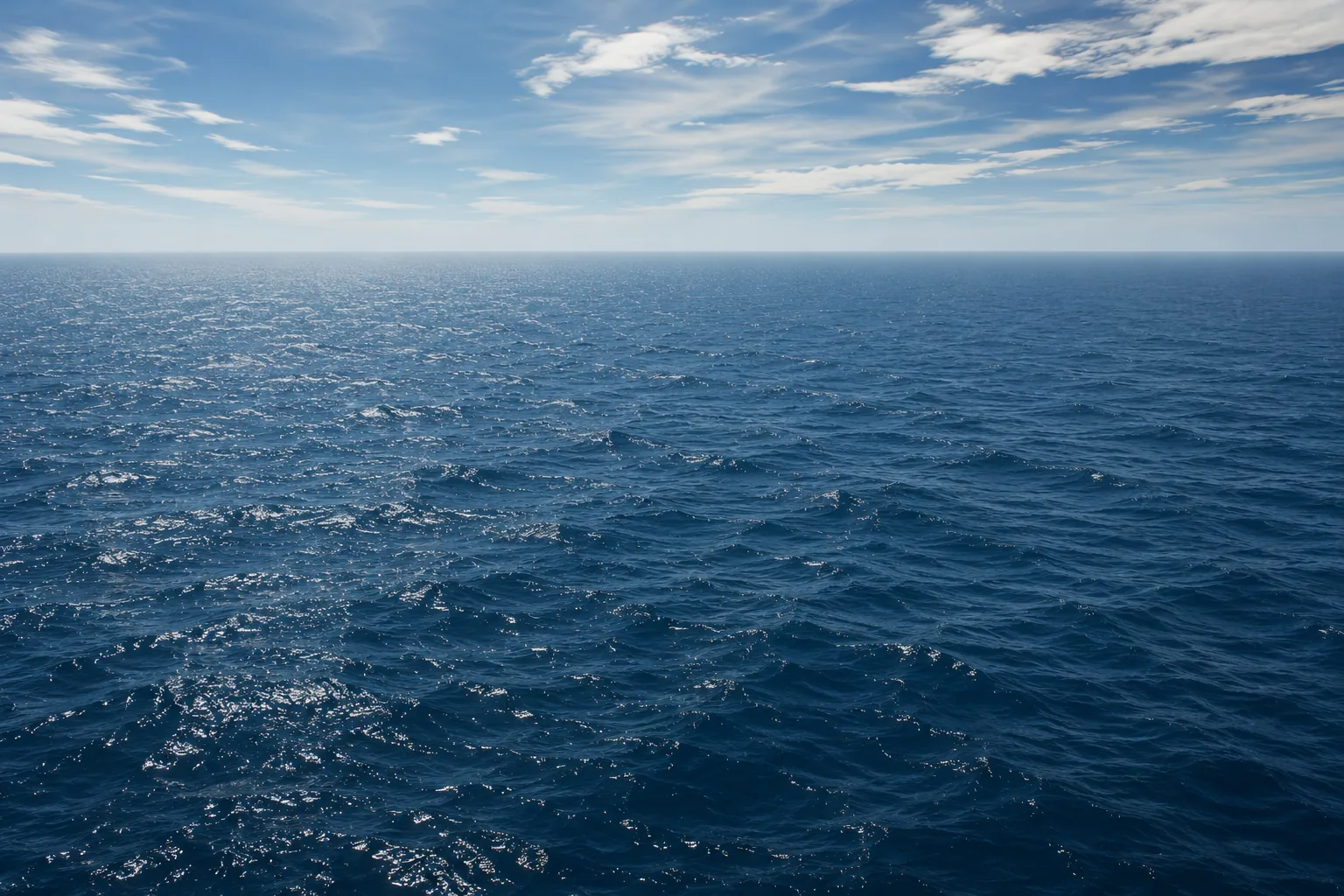 The Great Water The great eastern ocean of Elshore, the open water reaching east toward the world's far side. The Iru-era city of Onnila on the east coast of Baramma is said to face the Great Waters. No detailed account of it is recorded yet beyond its place on the world map.
- The Divider Hills A mountain range in the far north of Tarkdaara, among the western and northern sub-ranges of the Spine of the World, the continent-long crown of stone and ice. Little is recorded of the Divider Hills on their own; the Spine of the World and its other named sub-ranges (the Bridge Mountains, the Claw Peaks) carry the better-attested context.
- The Bridge Mountains A mountain range in the far north of Tarkdaara, one of the named western and northern sub-ranges of the Spine of the World, the continent-long range of stone and ice. Little is recorded of the Bridge Mountains on their own beyond their place in that range.
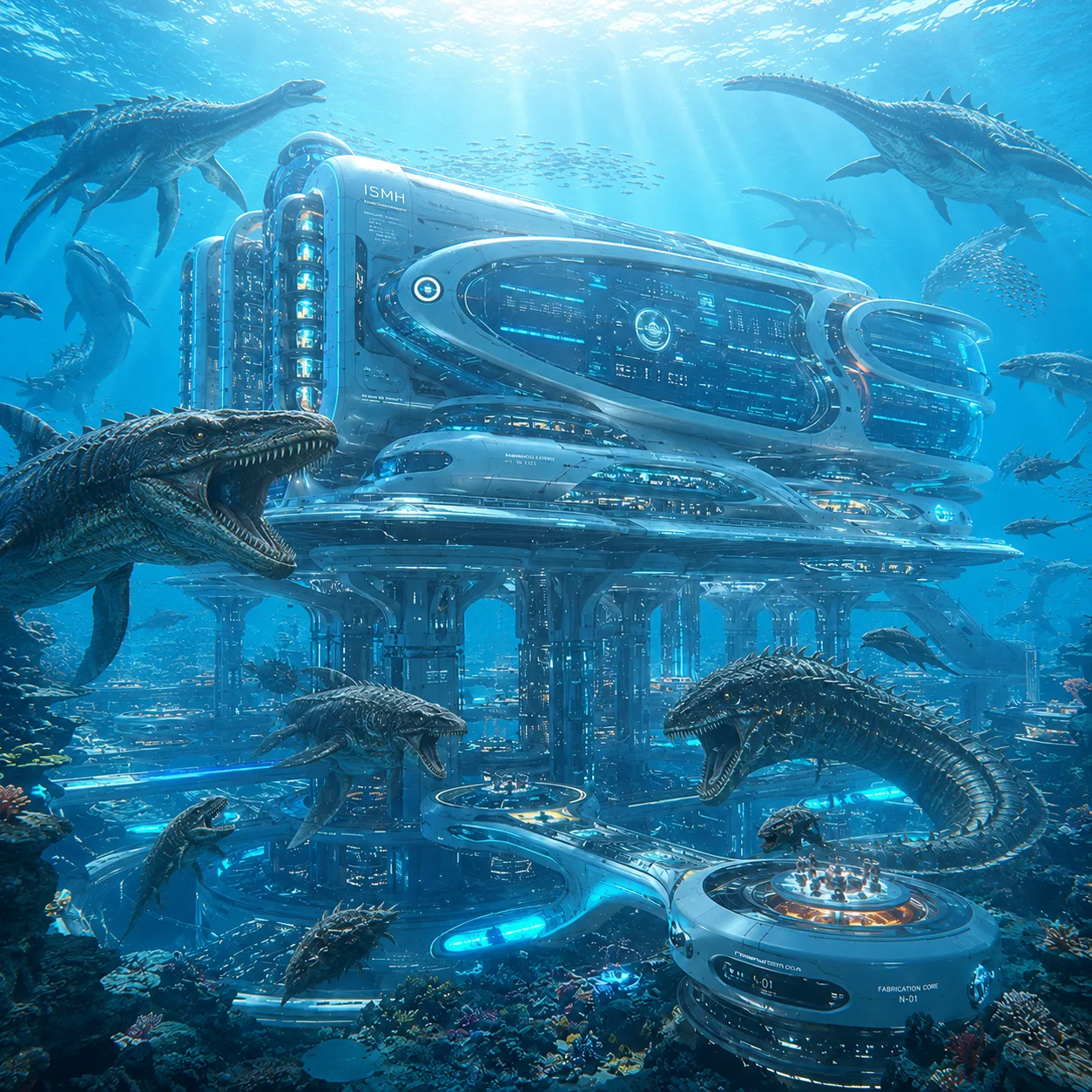 The Reef Foundry A sleek, late-pattern foundry of the planet-scale ISEMH system, riding above a sunlit reef on a forest of slender pillars, its long bright hull still working though no one has walked its decks in an age. A detached fabrication ring turns at its foot, printing the system's stock from the seafloor itself. A pod of armoured serpent-wardens patrols the warm water, and one autonomous craft threads the columns, ferrying material the foundry no longer ships to anyone.
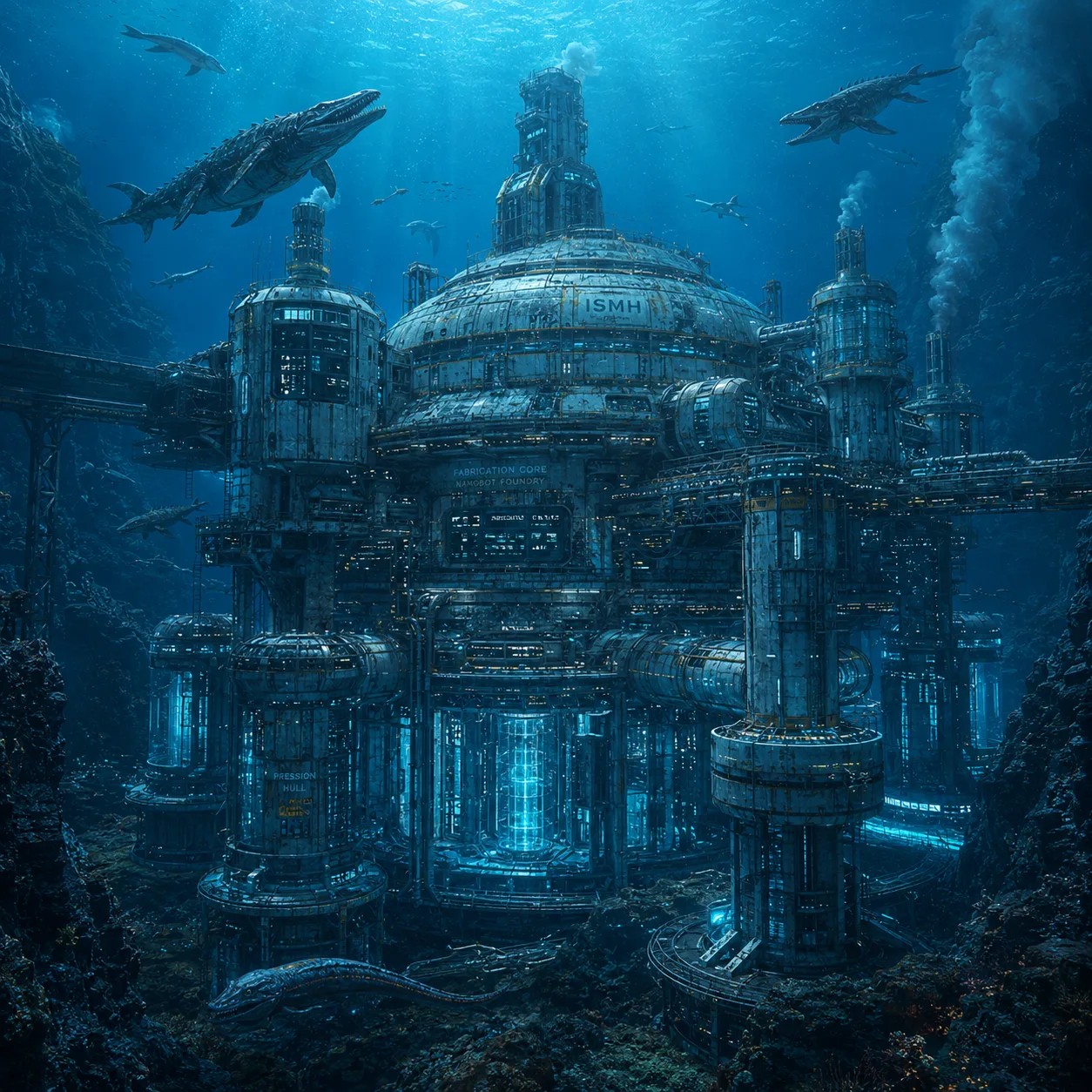 The Smoking Citadel An older, fortress-pattern foundry seated in a dim rock basin, its ribbed central dome ringed by lit but grimy towers and bridge-spans. A side stack vents a slow dark plume into the gloom, the only motion besides the wardens that cruise its upper water. Silt and growth have settled on its edges; the windows still glow, but nothing inside them moves.
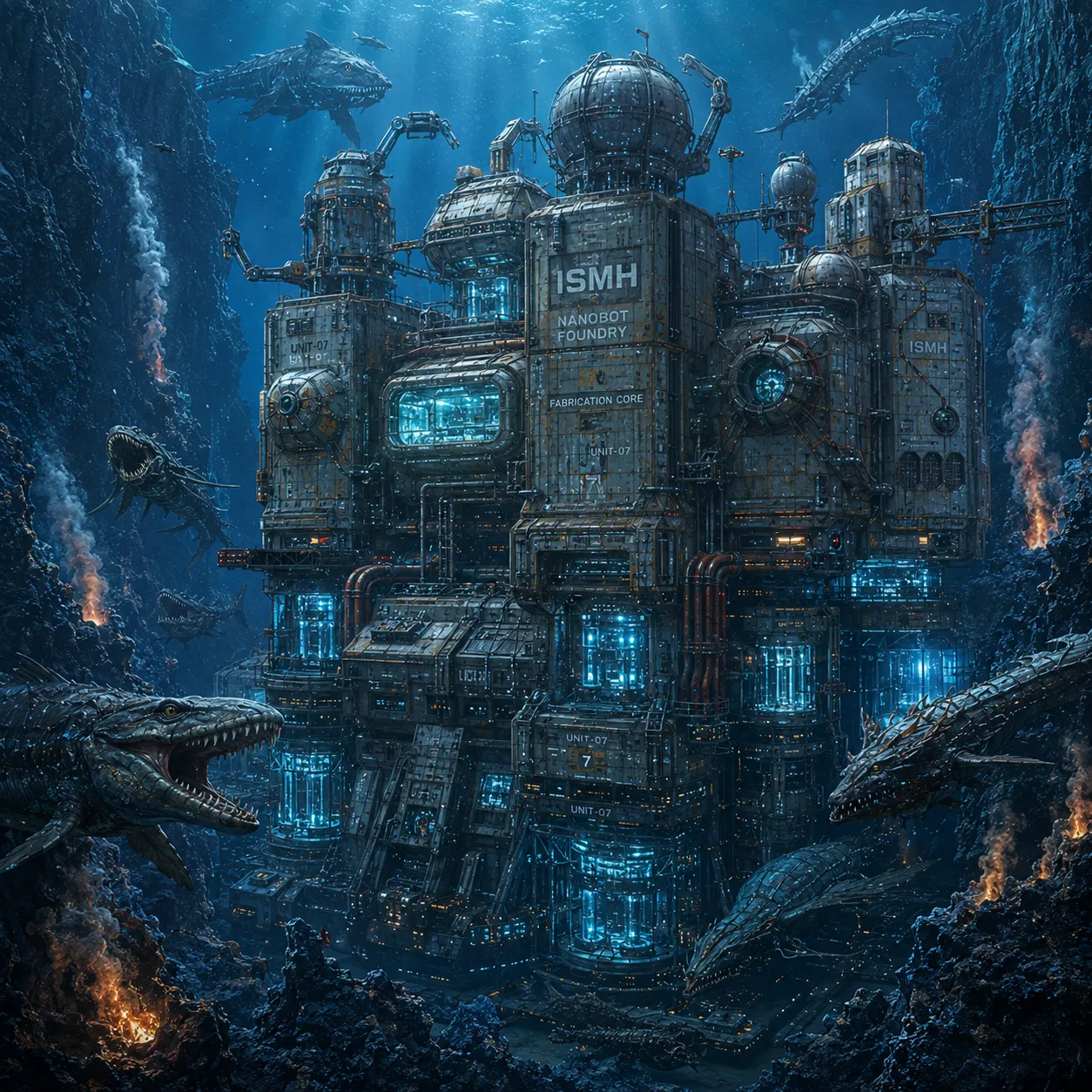 The Rift Foundry A tall, circuit-like foundry wedged into a narrow volcanic rift, lava cracks glowing down the walls on either side. Its stacked bays are stained and encrusted yet still burning with cold light, run off the vent heat around it. Wardens lunge from the dark at its flanks, jaws open, holding the trench against anything that comes too close.
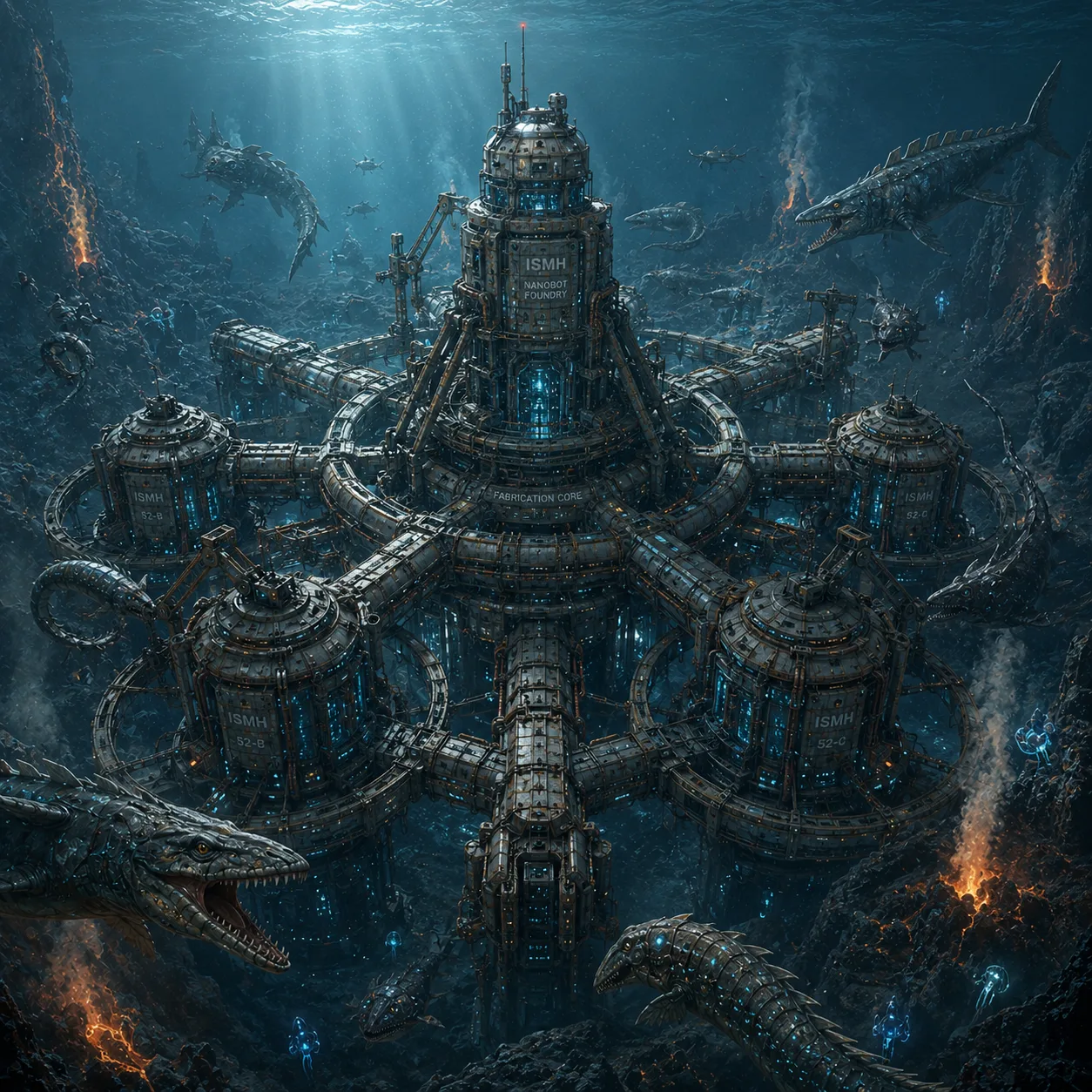 The Wheel Foundry A large radial foundry, a central spire ringed by identical drum-modules on spoked causeways, anchored over broken volcanic ground laced with glowing lava. Older and heavily built, silted at the joints, it still holds its star-shaped footprint against the dark. Wardens patrol the ring while the drums turn out the system's stock from the heat below.
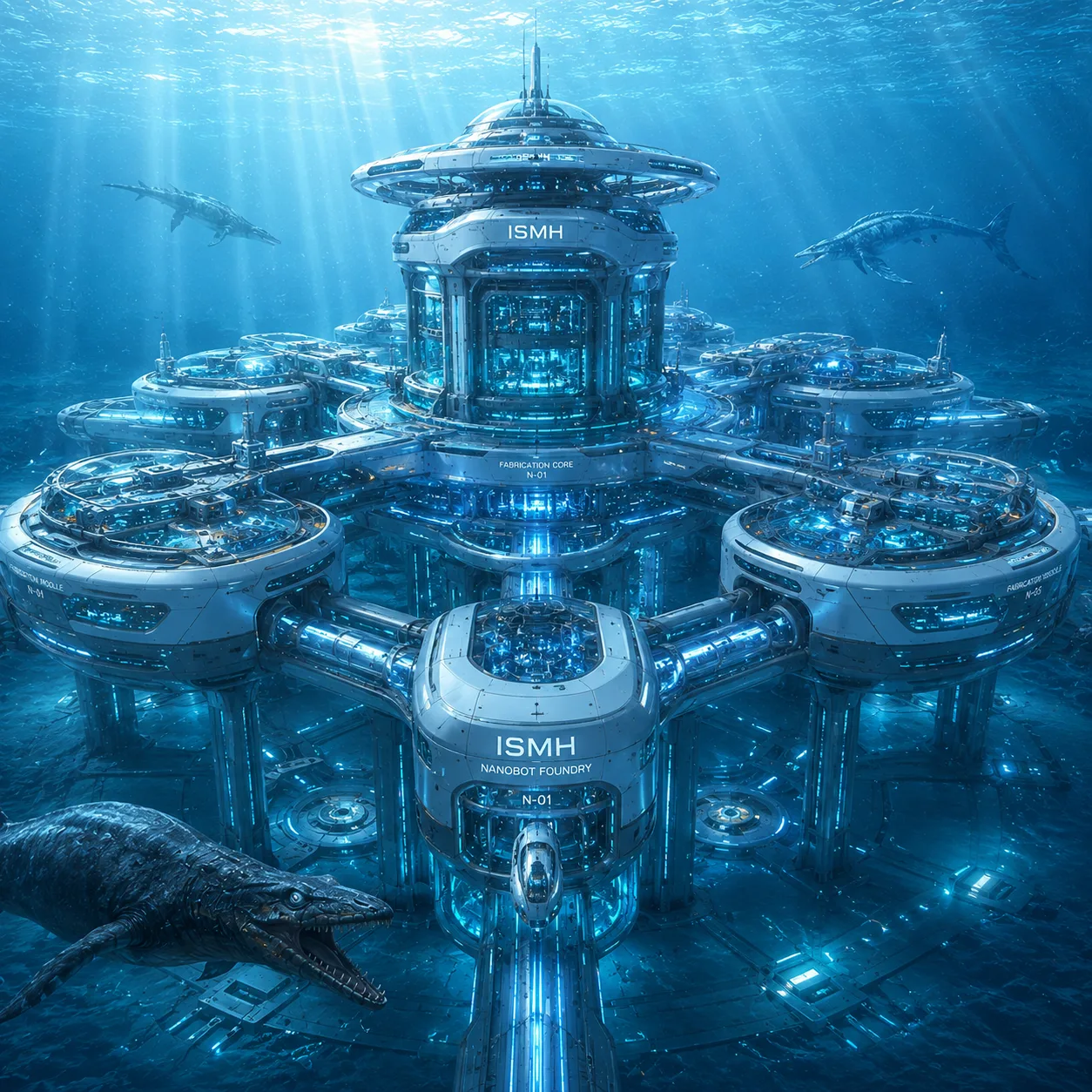 The Tiered Foundry A clean, newer foundry of stacked disc-modules crowned by a tiered canopy, resting on a flat seabed inside a faint apron of inlaid panels, as if a landing field had been laid for craft that no longer come. Its glass core glows steadily; armoured swimmers drift past on patrol. Everything works; nothing is used.
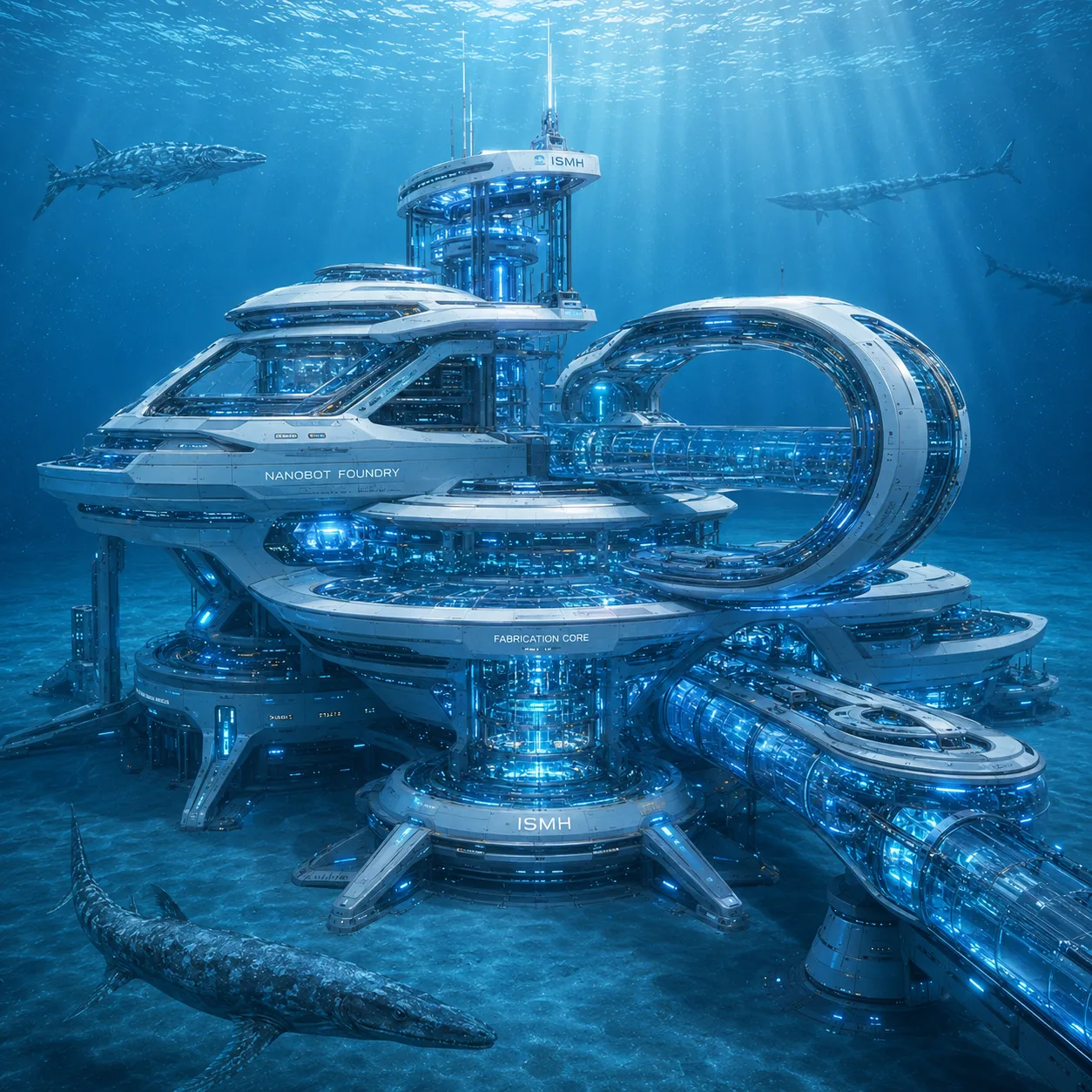 The Ring-Loop Foundry A sleek, newer foundry built around a great standing ring whose conduits still pulse with light, set beside streamlined decks on splayed legs. A long glass tube runs off across the open seabed toward nothing that answers. Wardens move through the calm water; the loop turns on, keeping a circuit that no longer connects.
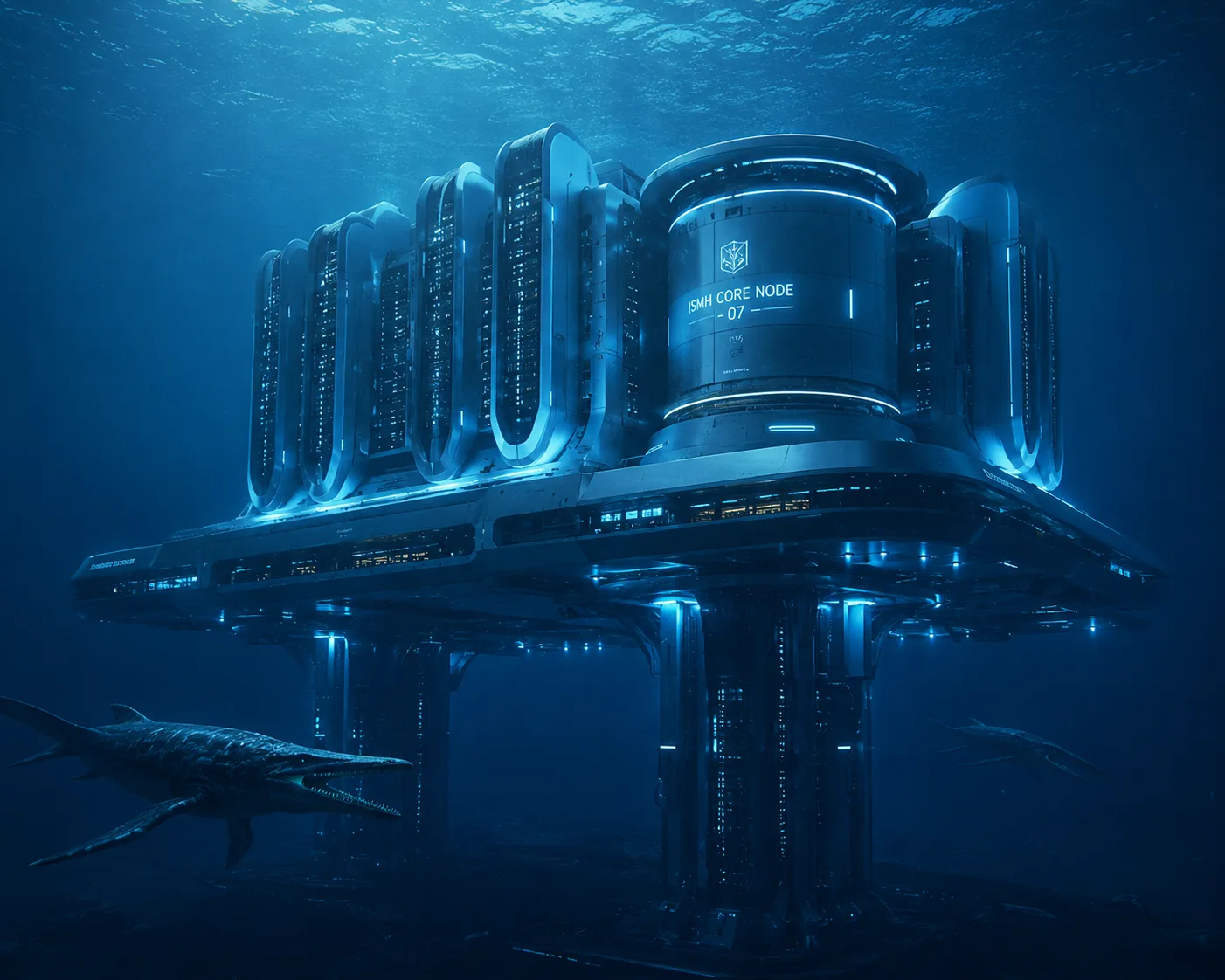 The Pillar Fort A heavy, fortress-pattern foundry on a single thick pillar, its central turret flanked by tight rows of fin-like ribs, lit cold against deep dark water. Austere and hardened rather than sleek, it stands alone on an open floor with little around it but the wardens passing overhead. It hums on in the gloom, an automated keep with nothing left to keep.
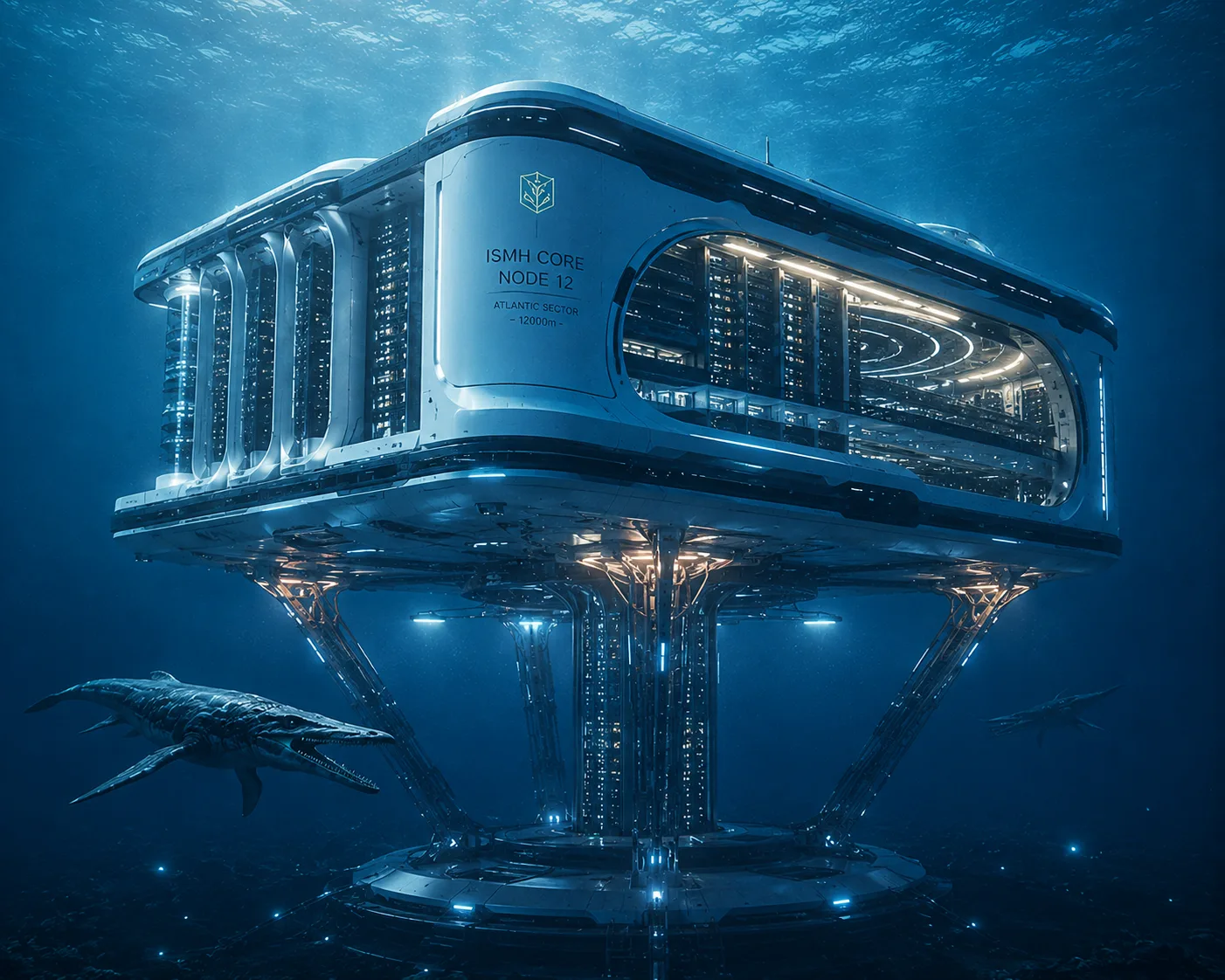 The Glass Ark A newer, flagship-pattern foundry with a long curved glass face that glows warm over cold blue water, its decks intact behind the glazing and every light burning. It rests on a wide foundation ring; small autonomous craft and marker-lights drift at its feet, tending a habitat with no inhabitants. It looks the most alive of all the nodes, which only sharpens how empty it is.
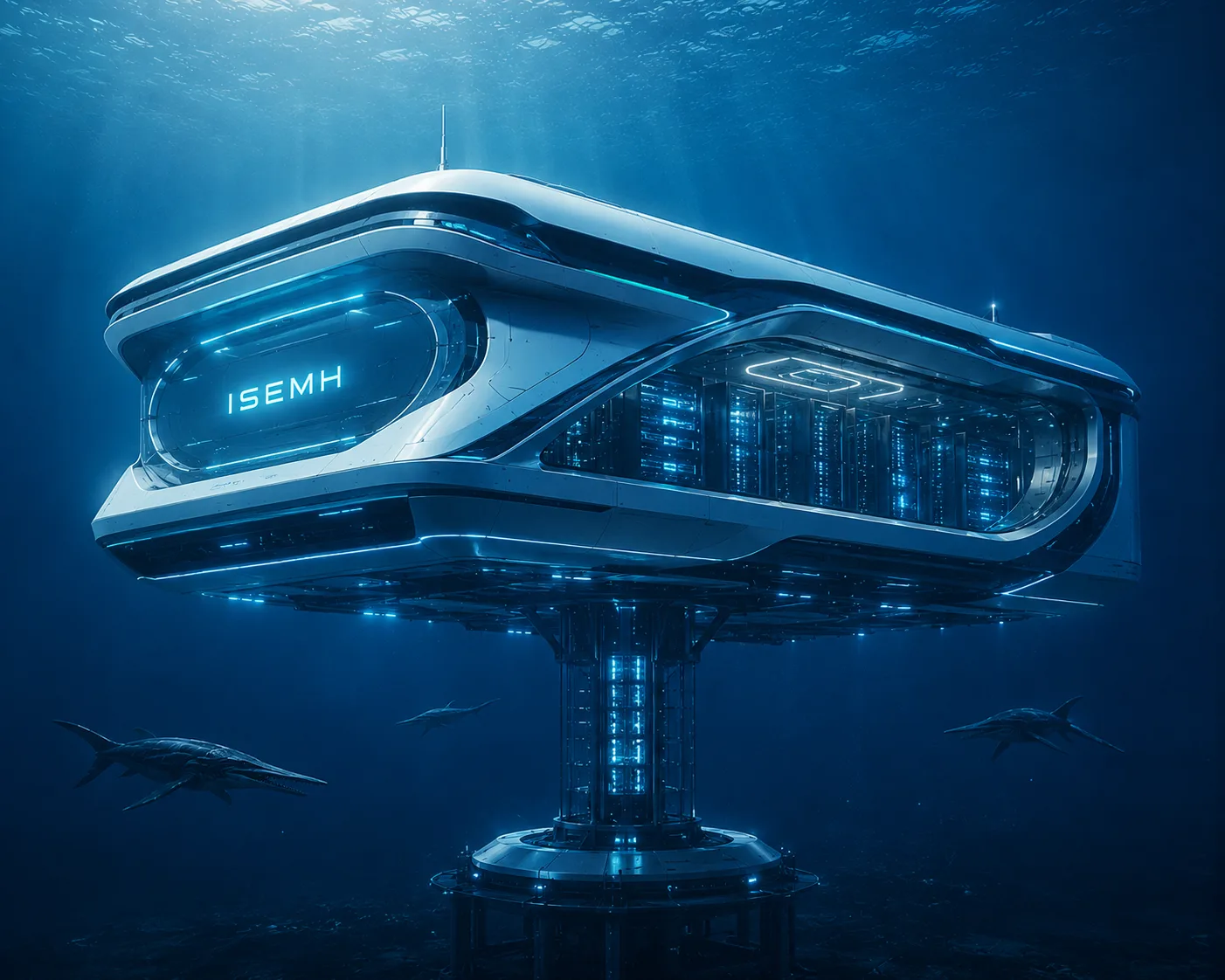 The Stalk Pod A small, newer foundry-pod, a smooth shell on a single slender stalk, a lit bar along its flank still spelling the system's name into the dark. Compact where the others are monumental, it sits alone on a flat cold floor, a minor outpost of the network kept ticking by itself. A pair of wardens slides past; otherwise nothing.
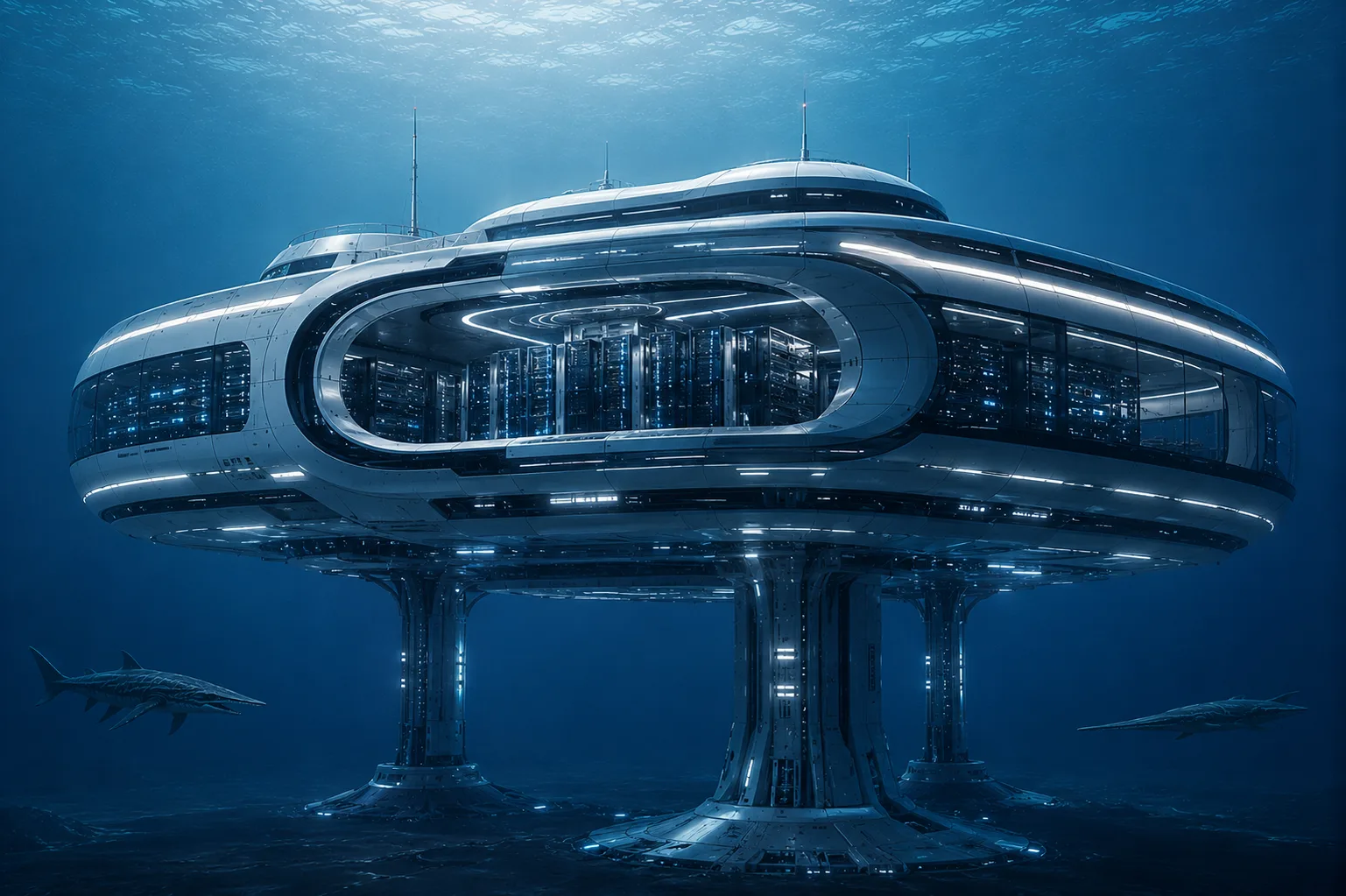 The Dim Saucer An older, multi-tier saucer foundry on two colossal splayed legs, standing over a cold rocky plain in the deep south. Its lights are low and bluish, more standby than welcome, and a single swimmer crosses the empty mid-water. Of all the nodes this one reads as nearest to sleep, a citadel that has begun to let itself go dark.
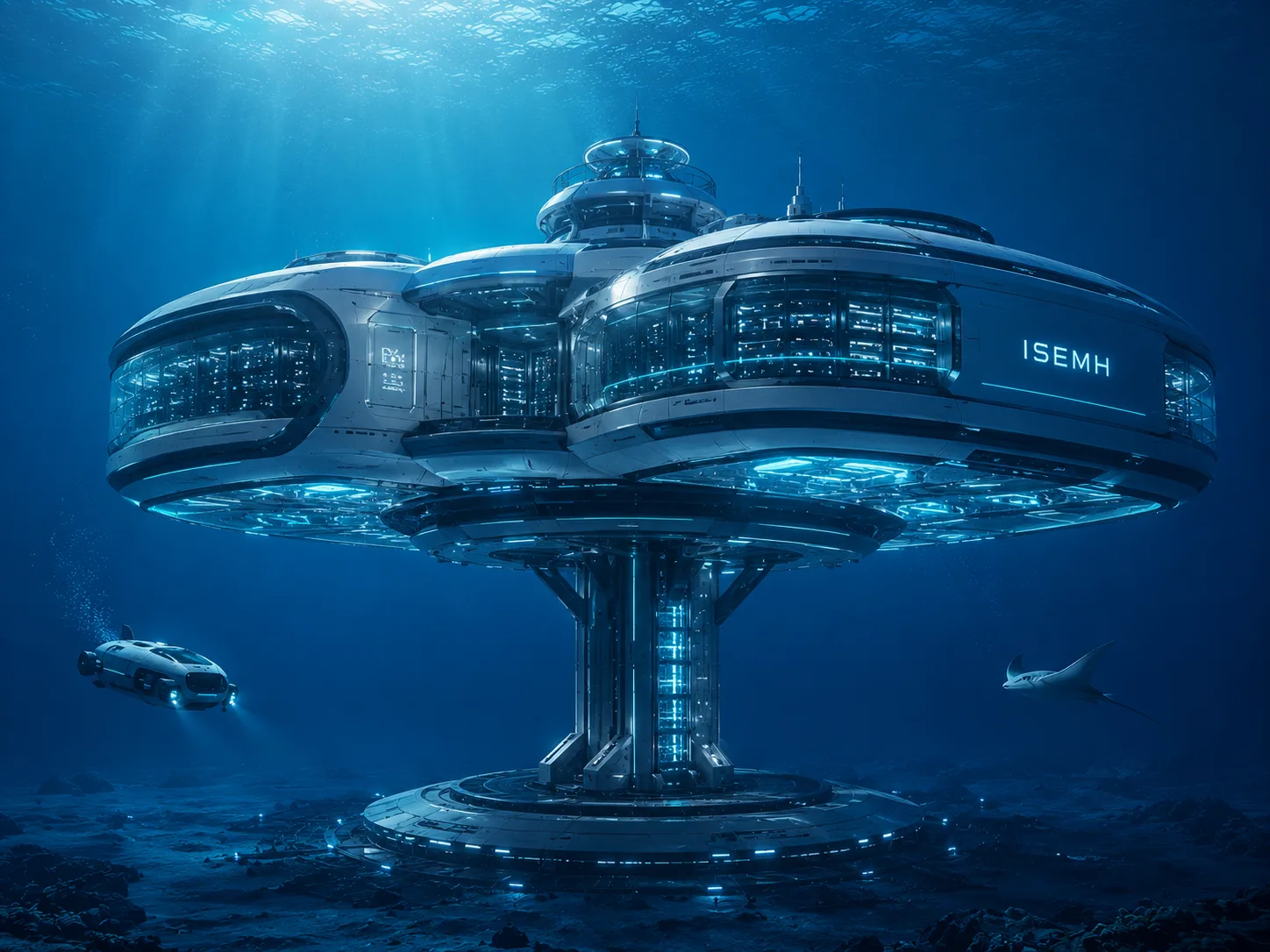 The Beacon Saucer A newer, stacked-saucer foundry topped by a dome and a thin mast, standing in bright temperate water where shafts of surface light still reach it. Its windows glow crisp and clean; a small autonomous craft hangs in the water nearby, holding station as if waiting on an order that will not come. Wardens drift through the light beams around it.
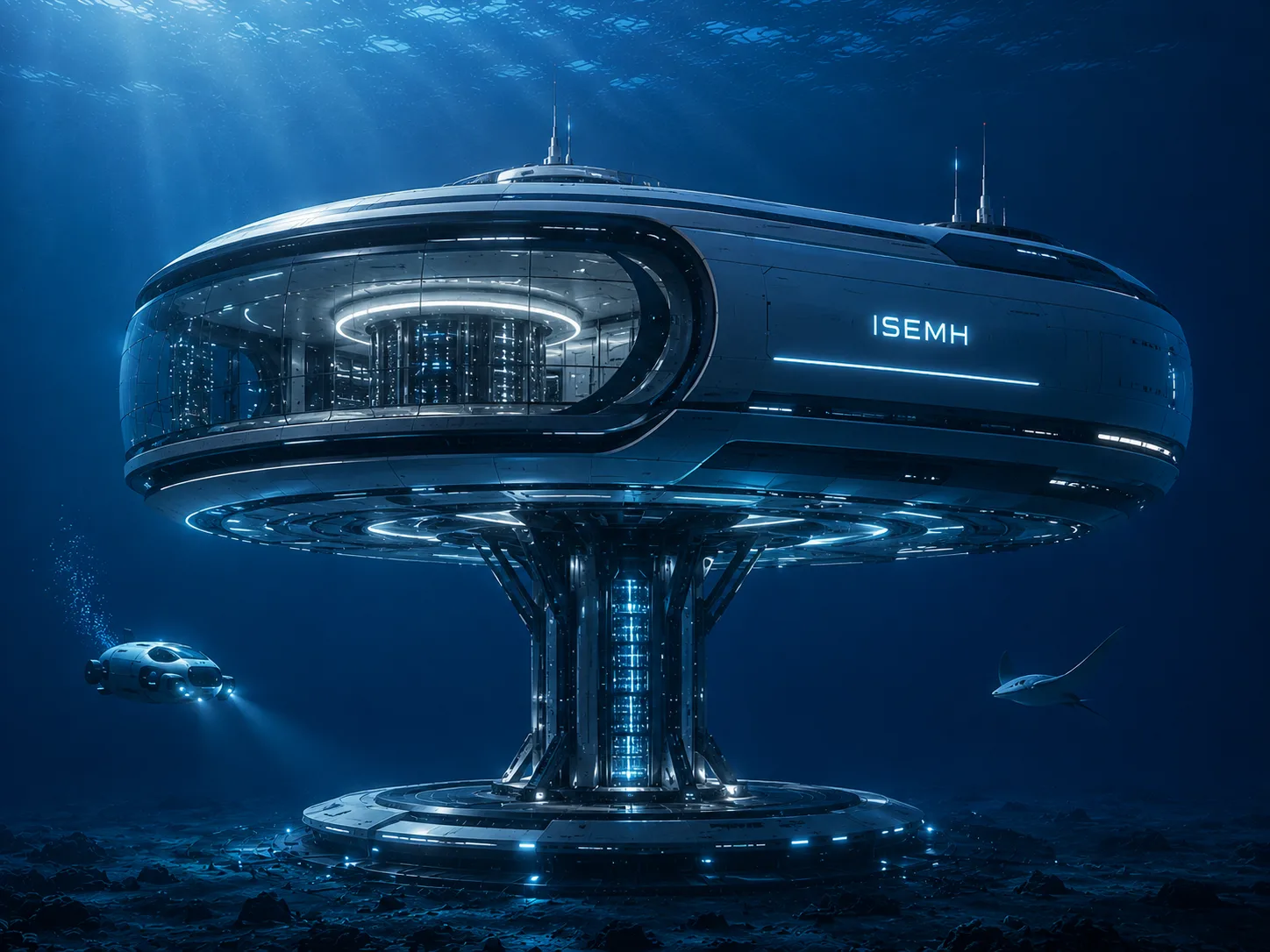 The Lantern Disc A clean, newer disc-foundry with a low dome and a bright interior core, balanced on a single central stem in sunlit temperate water. The glazing shows a dense lit core and not one figure; a small craft works near its base. It hangs in the light like a lantern left burning in an empty room.
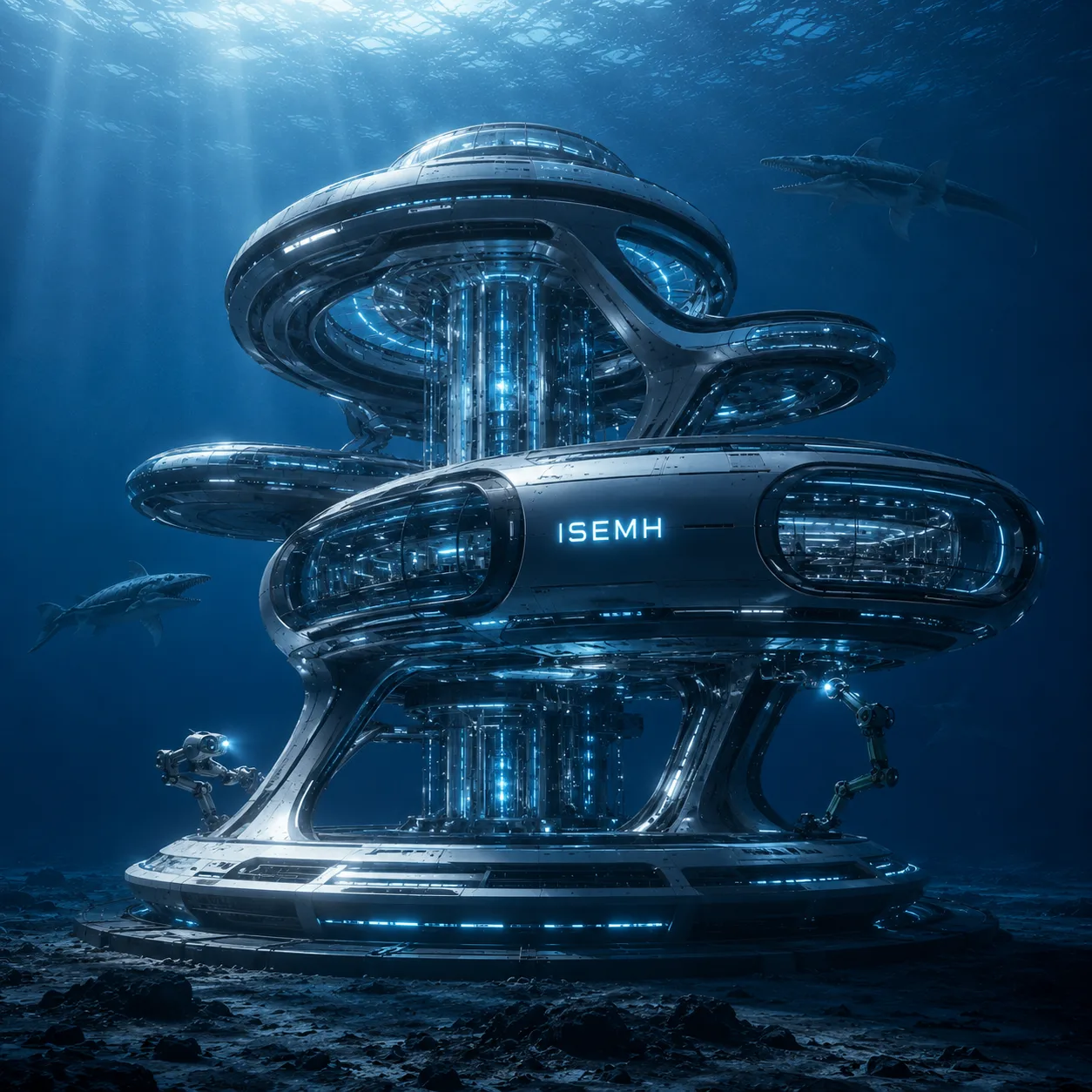 The Lobed Tower A newer, chrome foundry of stacked discs ringed by looping arms that end in rounded pods, its core blazing behind glass. Light shafts reach it from far above; wardens cross the background. A lone small shape near one arm is the only hint of scale, and it is not a person, for the foundry runs itself, as they all do now.
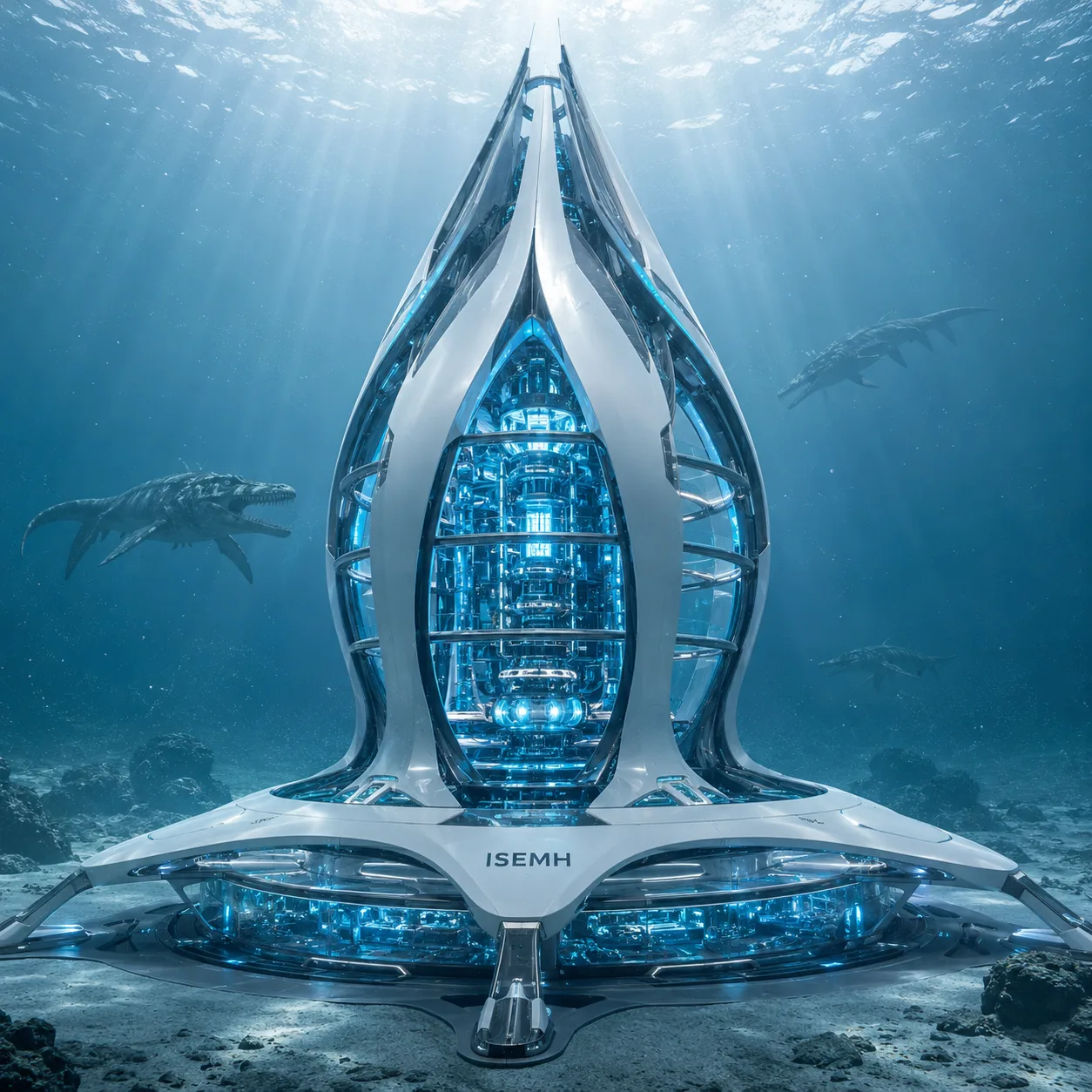 The Seed-Pod A newer, grown-looking foundry shaped like a pale seed splitting open, two curved shells parting to show a stacked, glowing core, all rising from a splayed base in bright water. It has the look of something cultivated rather than built. Armoured wardens pass on patrol while the open shells hold their light to an empty sea.
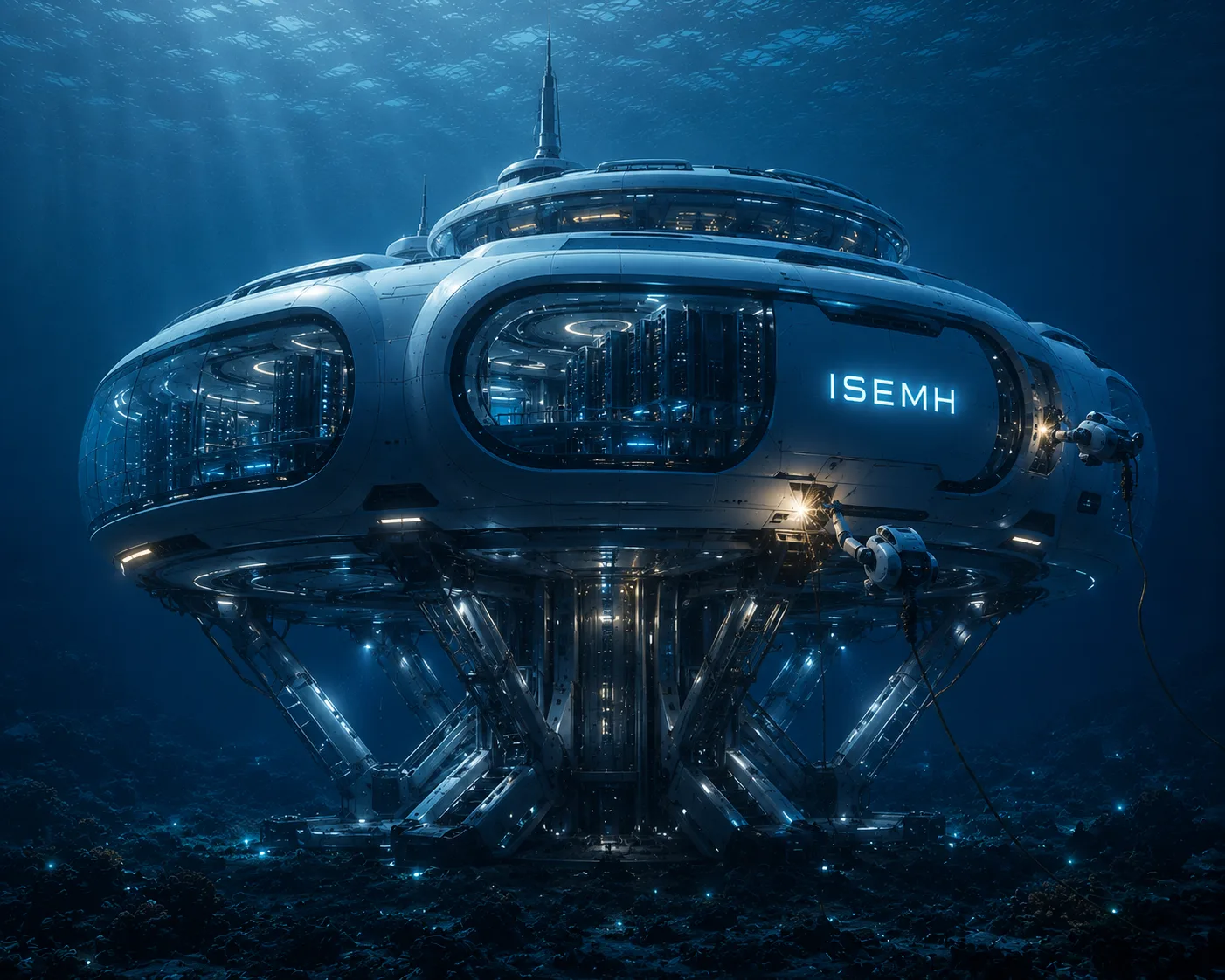 The Antenna Saucer An older, dark saucer foundry crowned by a single tall mast, brooding over a deep rocky floor lit only by scattered points of cold blue. An articulated arm folds against its flank, a system limb still poised to build or repair though nothing calls for it. The water here is deep and dim; the node watches more than it works.
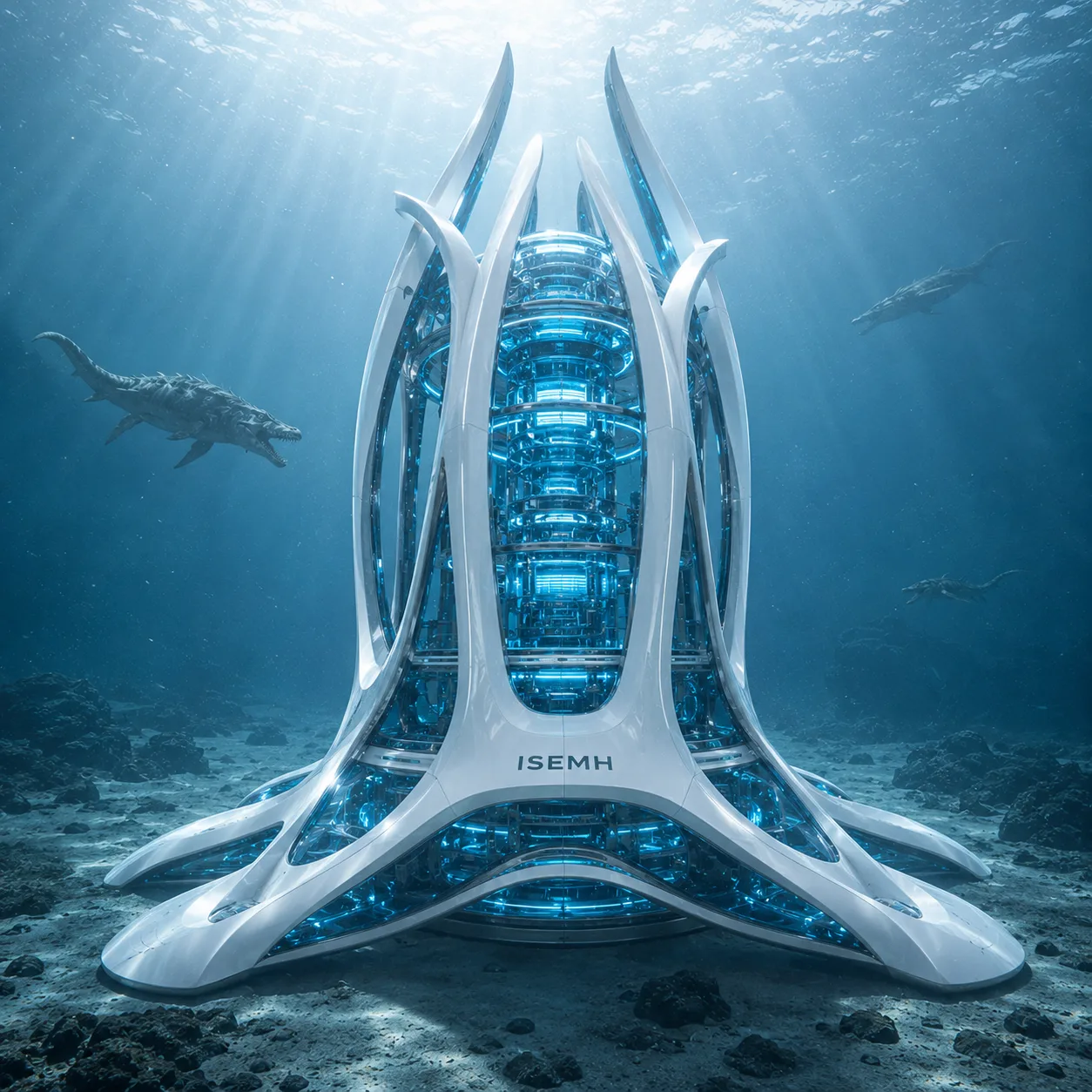 The Ribcage Core A newer, grown foundry where tall pale spars sweep up like ribs to cage a glowing core column, standing on a splayed base in bright open water. The cage feels protective, a body built around a heart of light. Wardens drift past; the core burns steadily for no one.
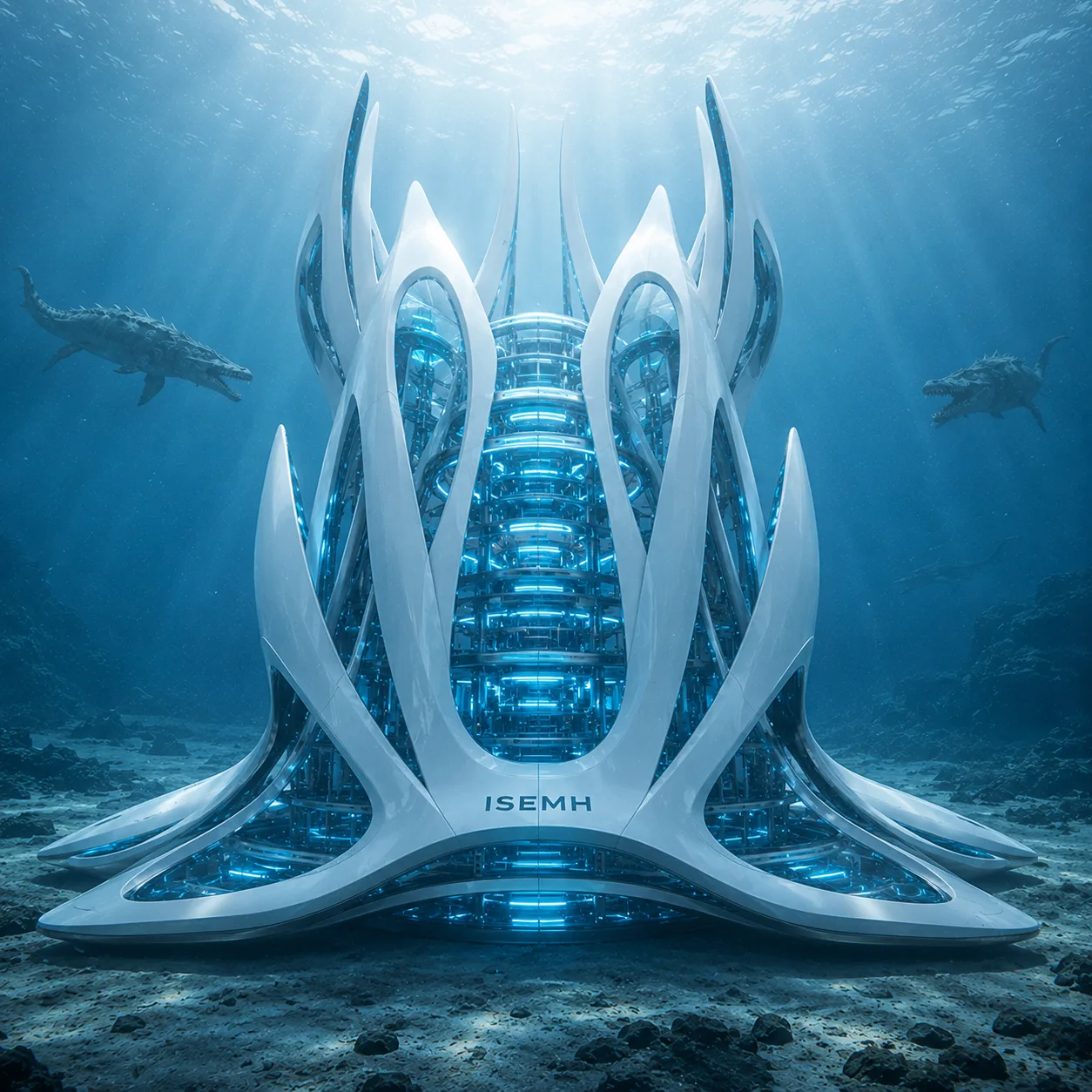 The Crown A newer foundry like a wide crown, a ring of tall pale spires flaring around a central stepped tower of lit decks, the broadest of the network. It stands regal and open in bright water, its stacked floors glowing through glass with no figure behind them. Wardens flank it on patrol.
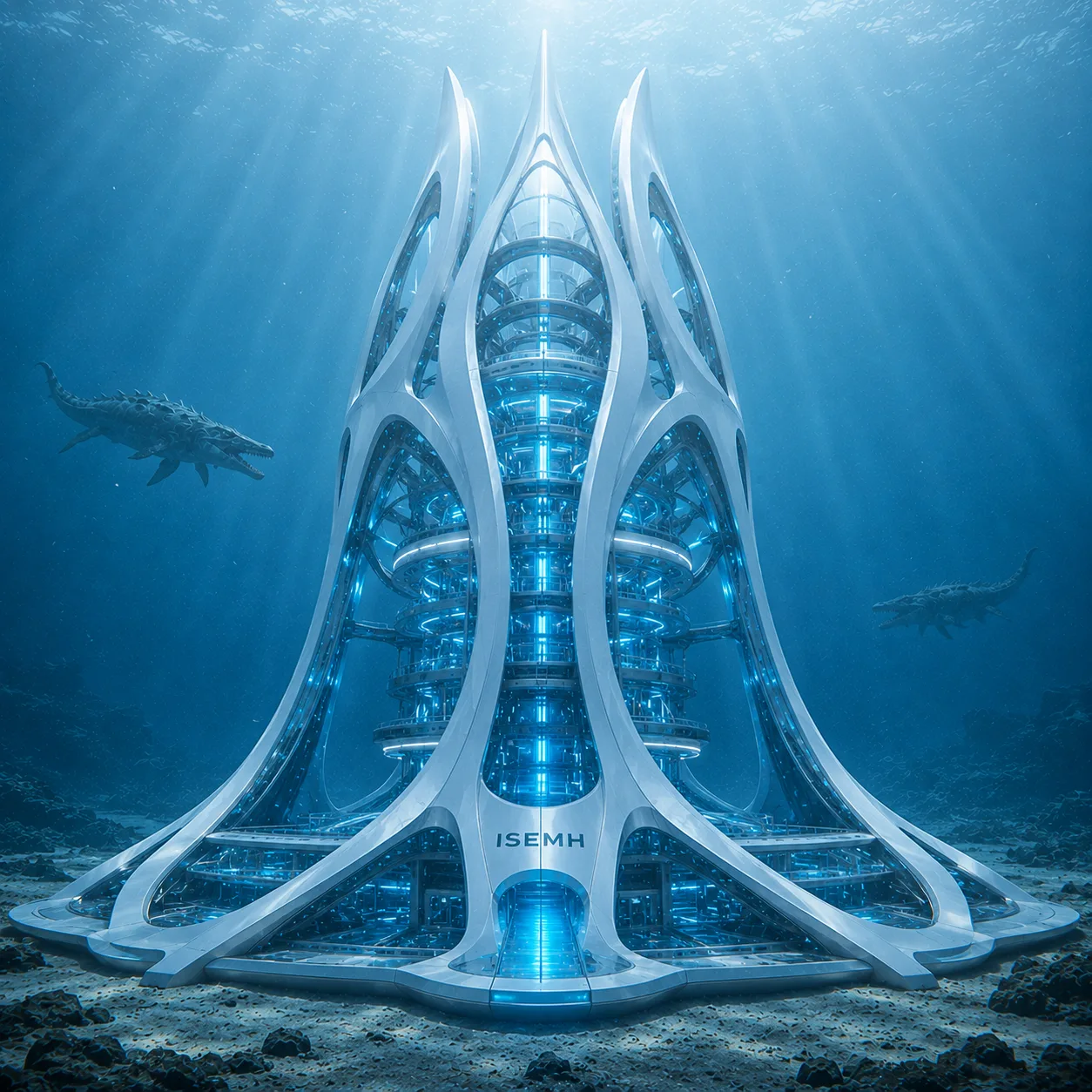 The Spire Cathedral A newer, cathedral-like foundry, a pointed central spire braced by sweeping rib-buttresses around a dense stack of glowing rings and galleries. A bright beam drops from its base into the seabed, an anchor or a tap holding it to the floor. The most ornate node, lit through and through, and without occupants.
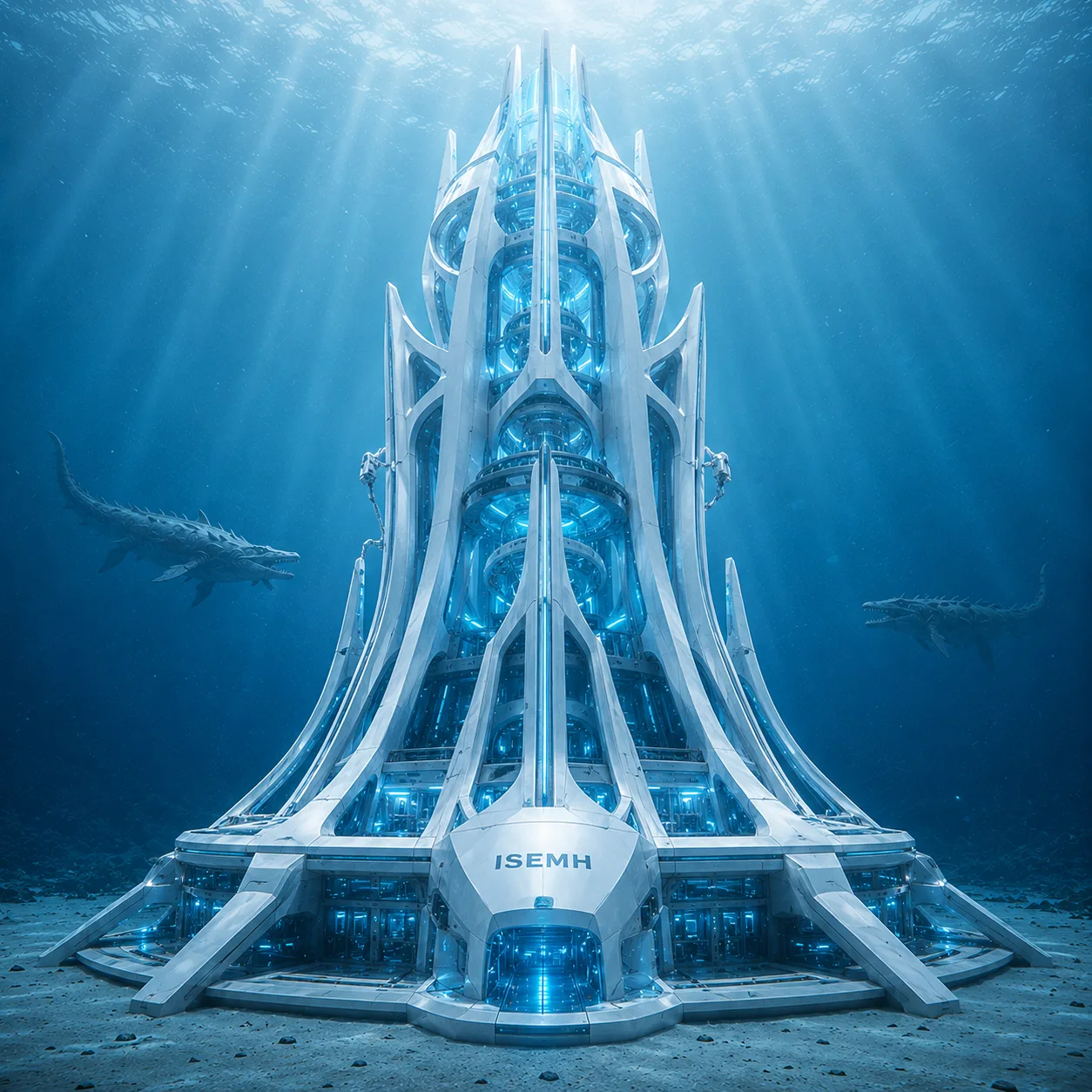 The Lit Spire A newer, cathedral-pattern foundry rising in clean ribs to a tall lit spine on a wide terraced base, immaculate and fully powered in bright water. Shafts of surface light fall across it; two wardens hold the flanking water. Serene, majestic, and exactly as empty as the rest.
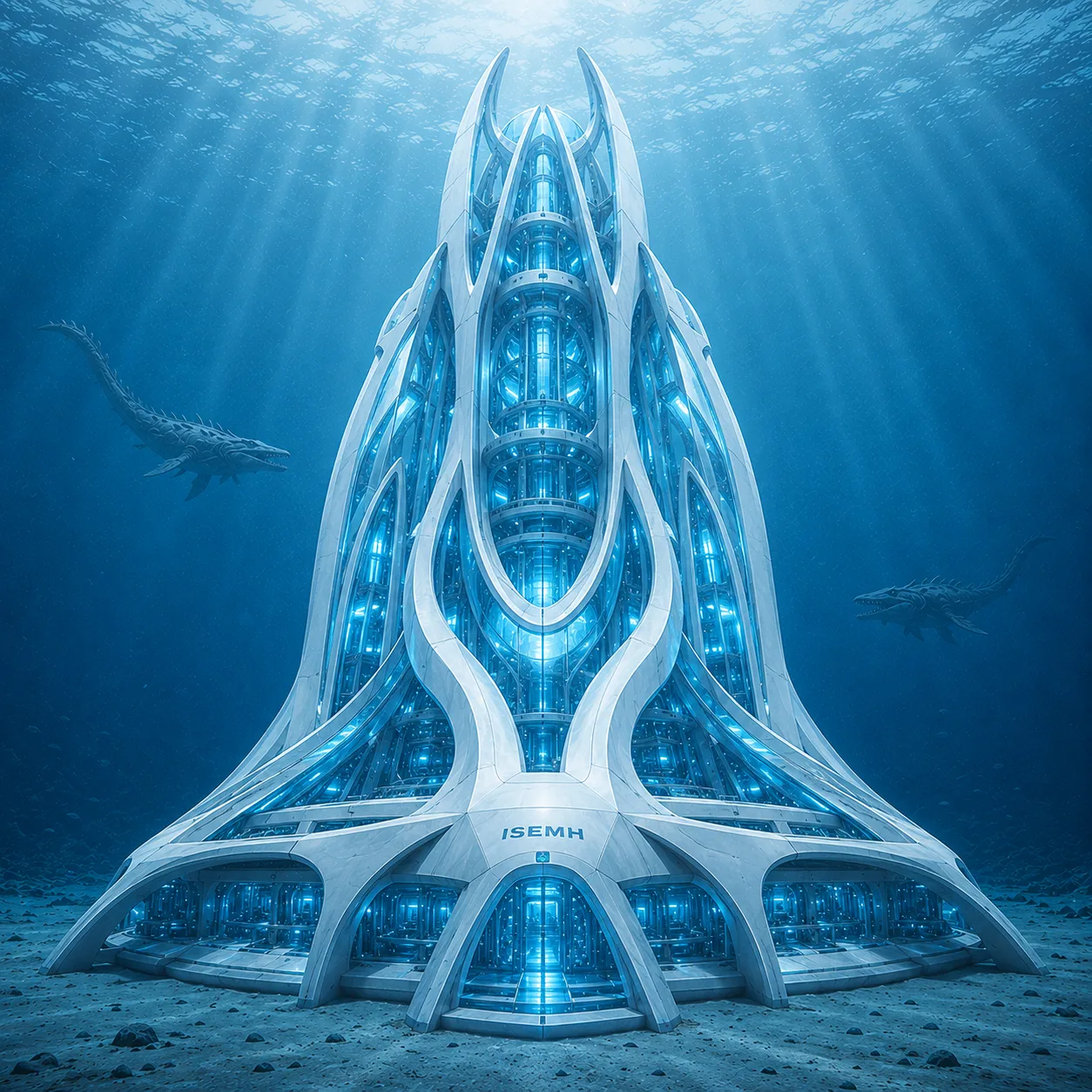 The Flame Tower A newer, grown foundry shaped like a rising flame, curved ribs branching and rejoining to two horn-like tips above a flared base. Its layered core glows soft and steady in bright water. Long-bodied wardens pass to either side; the tower holds its light like a lamp no hand will ever turn down.
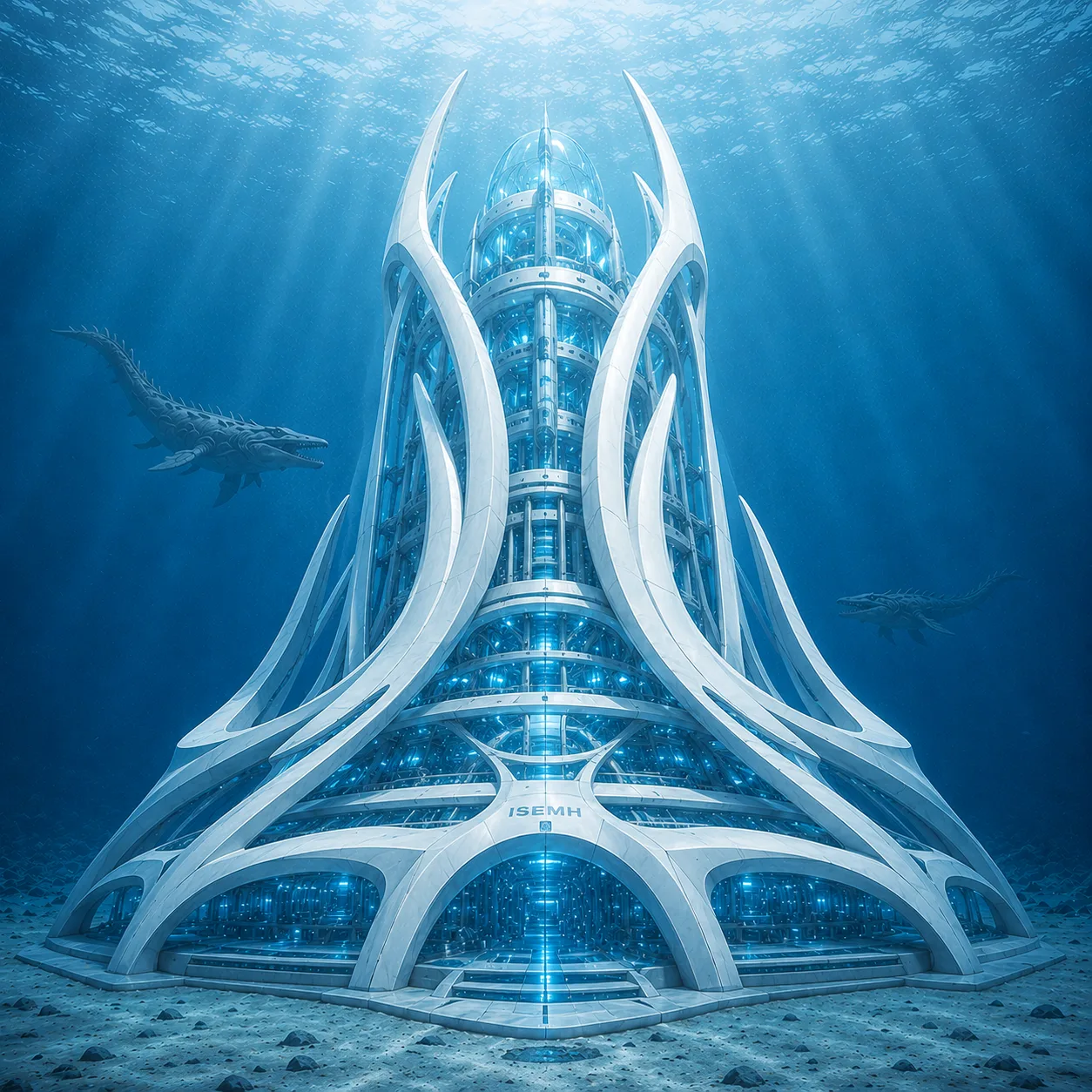 The Open Ribcage A newer foundry of large open arches sweeping up to frame a glowing lattice core, more skeleton than shell, capped by a small domed crown. Water passes freely through its ribs in bright light. Wardens drift above; the lattice glows on, an open cage holding nothing in.
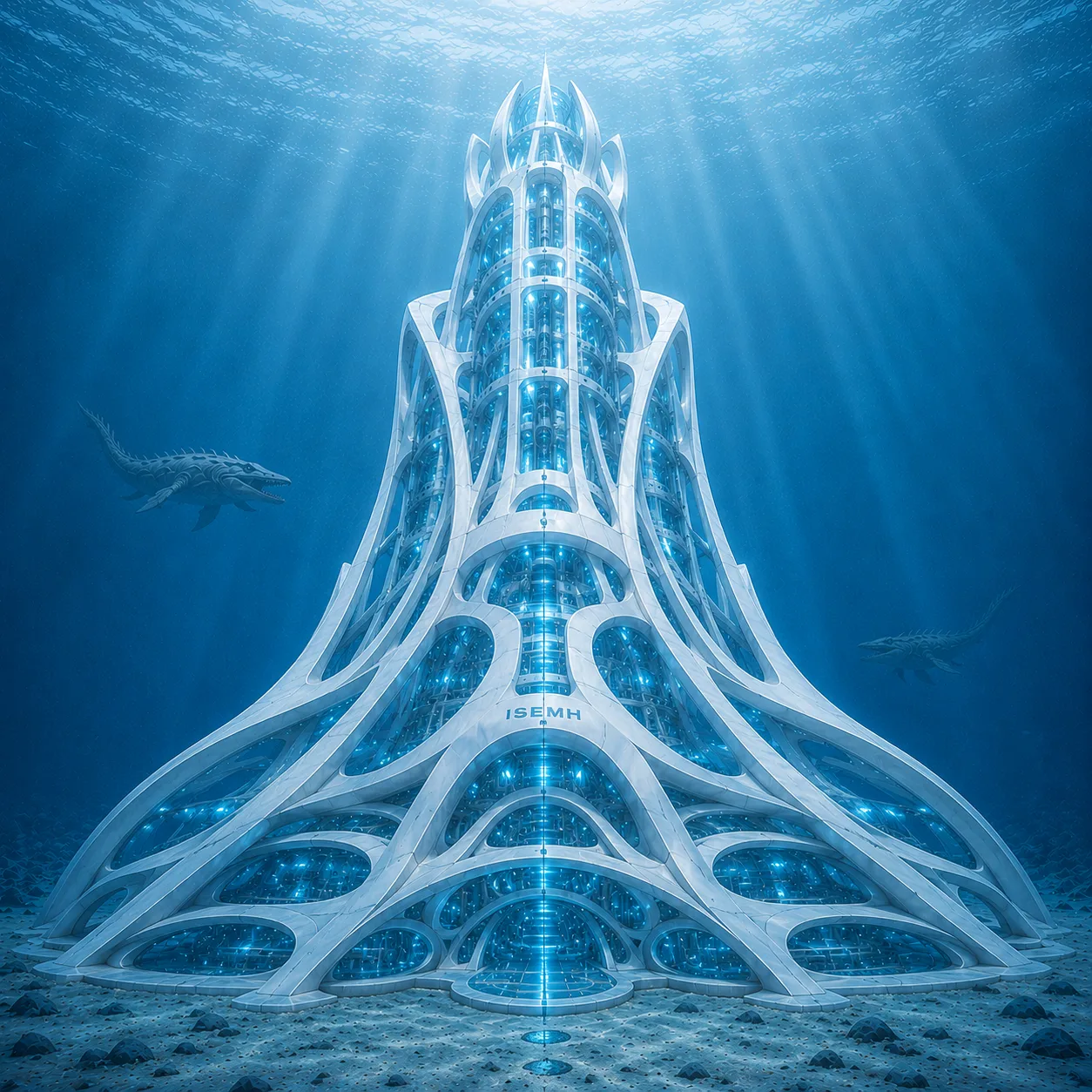 The Coral Lattice A newer, most-grown foundry whose whole surface is a honeycomb of rounded cells, each holding a point of light, more coral or bone than metal. It tapers to a lit crown over a webbed base in bright water. The structure itself looks alive; the wardens that pass are almost redundant. Every cell glows, and not one is occupied.
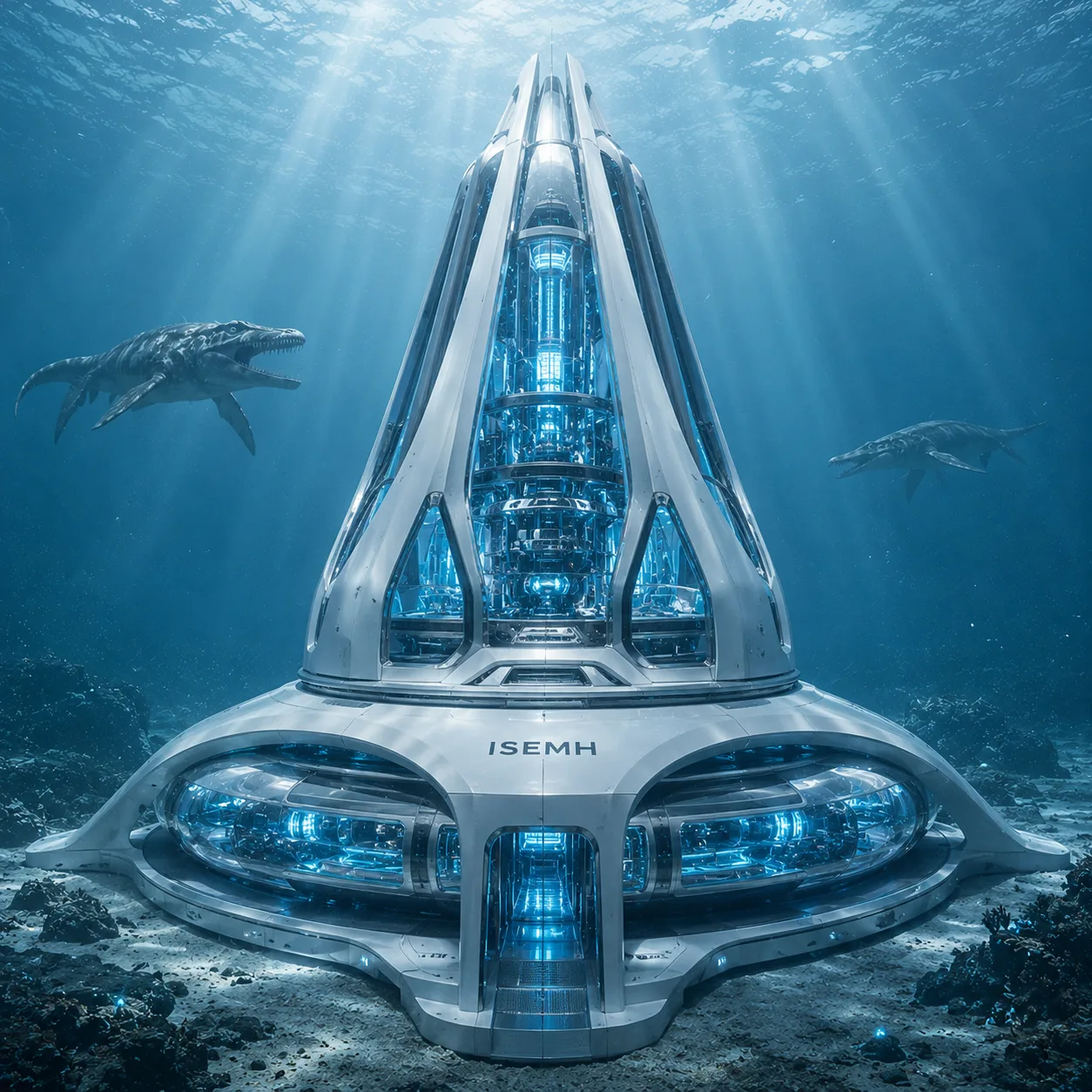 The Settled Bunker A lower, heavier foundry, a finned tower seated on a wide cluster of rounded, glowing habitat lobes, settled among rock and old reef rubble. It looks long planted, more bunker than spire, its lobe-base warm behind the glass. Wardens flank it; the lobes built to hold life hold only their lamps.
- Iruel The island homeland of the Iru, the last sovereign Iru realm, ruled by King Thaare II from the twin capitals of Orelo and Ekree under the breath-law of the Ooliran Sovereign Breath. Officially pacifist, Iruel keeps no offensive army yet arms both the Maan Empire and Maaniskaar to keep its rivals balanced; with the captive Erg province of Rafadin it forms the Grand Kingdom of Iruel.
- Rafadin The island province promised to the Ergs by the AC 1 war council and now administered by the Iru of Iruel in name more than in justice. Across the too-thin Meagre Sea the Iru reached and held it, and the Erg population lives under a soft occupation of slave raids and dispossession. Rafadin and Iruel together form the Grand Kingdom of Iruel.
- Midveil A sovereign island west of Annilia and north of Baramma, wrapped in the mists of the Vapor Sea. The Empire counts it as imperial ground but holds no power over it: in AC 50 it is an open, ungoverned haven for revolutionaries, fringe thinkers and renegades, where people are met as people with no weight given to creed, birth-rank or race. Friendly and free, it builds a rich and sustainable culture over the next two centuries, until by AC 364 that culture has made it an essential part of the Empire.
- The Maan Republic The Sovereign Maan Republic governs the far south as a stratified elective oligarchy from the white-walled capital of Iceborrow, where Randenism has hardened into state bureaucracy. Born of exile and imperial fracture, it offers survival rather than sanctuary: Maan refugees from Maaniskaar reach its gates only to be penned in frost camps while the Gendarmerie keeps order through curfew and silence. Its controlled heart is the polar island of Maanamodilia and a slice of the southern mainland; the empty ice island it marks on its maps it claims but does not hold.
- Grand Kingdom of Iruel The last sovereign homeland of the Iru, the Grand Kingdom of Iruel joins the Iru island of Iruel with the captive Erg province of Rafadin under King Thaare II, ruling from the twin capitals of Orelo and Ekree by the breath-law of the Ooliran Sovereign Breath. Officially pacifist, it keeps no offensive army yet arms both the Maan Empire and Maaniskaar to keep its rivals balanced and itself intact; it shapes the world through precision, silence and stone rather than conquest.
- The Maaniskaar Empire In AC 50 the Maaniskaar Empire - called the Maan Empire in common speech - is the single unified power of the north, ruling all of Northland from the old crown-city of Udhafa. Founded in AC 1 on the ruins of the fallen Inarin Empire, it frames its rule as the necessary unbuilding of a civilisation that built "without permission," its young Randenist faith already missionary and hard. It claims the sovereign islands of Baramma, Annilia and Midveil but controls none of them, and the long Throne War that begins around now will one day split it.
- The Maan Empire By AC 364 the long Throne War has reshaped the north: the Maan Empire proper rules from Goldenhold under Emperor Theodelf Vissor, an absolute monarchy of order, debt and flame whose Orthodox Randenism, the Flame Doctrine, binds faith and state as one. It has absorbed the once-sovereign islands of Midveil, Annilia and Baramma, while its old crown-city of Udhafa lies a forgotten ruin. Motto: "One Flame. One Crown."
- Kingdom of Maaniskaar The western realm that broke from the empire in AC 138, the Kingdom of Maaniskaar rules from the five-river capital of Fivebrook and holds the seat of the Vigilant Eye, the supreme office of Randenism. Its Reformed faith is ceremonial and civic, and its people believe more in grain, water and quiet survival than in flame. Famine-bound and diplomatically fragile, it sends its refugees fleeing south while the rivers run; King Brimald Vissor, brother of the emperor, rules between ancestral law and imperial pressure.
- Land of Green Shadows The deep equatorial rainforest of Eldaara, a vine-choked canopy the suns can barely reach, beneath which the Meir have grown their secret arcology of Vaparium from settled generation-ships. It is the most secretive ground on Elshore: those who enter its shadow find data, silence, and gifts with strings unseen.
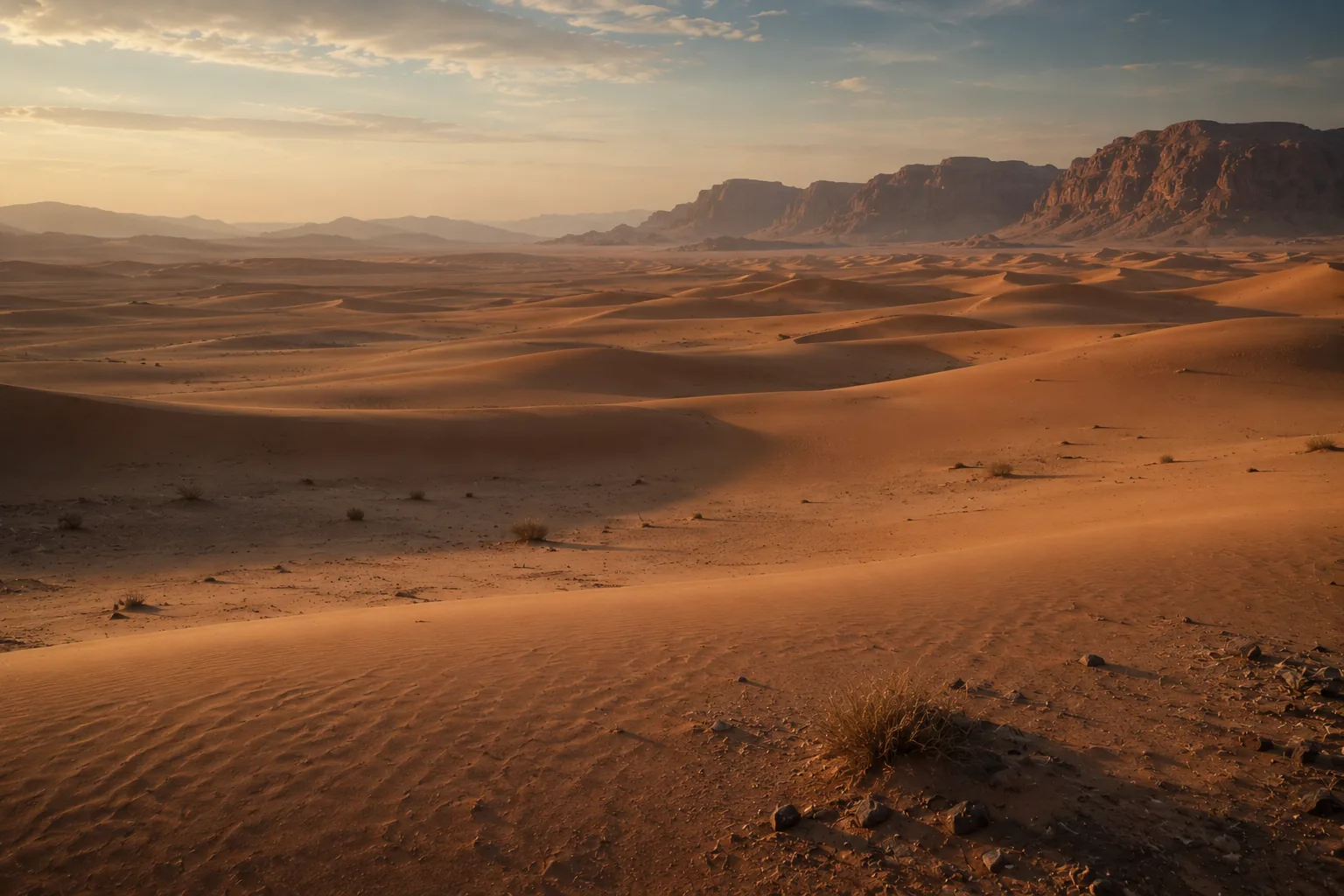 The Endless Desert The great sand of Eldaara, the land to which the AC 1 war council ordered the Annil resettled, and along whose northern edge the Erg Tribal Confederation endures between sand and frost. It is a country of distance and hunger more than of cities.
- The Erg Desert The heartland of the free Ergs, the seven tribes that refused the AC 1 resettlement and keep their self-determination by oral law and ancestral remembrance. They send elders to the meeting place of Aka'Ho-Ti and settle disputes by breath-duel and endurance, not by crown or written law, while famine and the encroaching south press on their youngest.
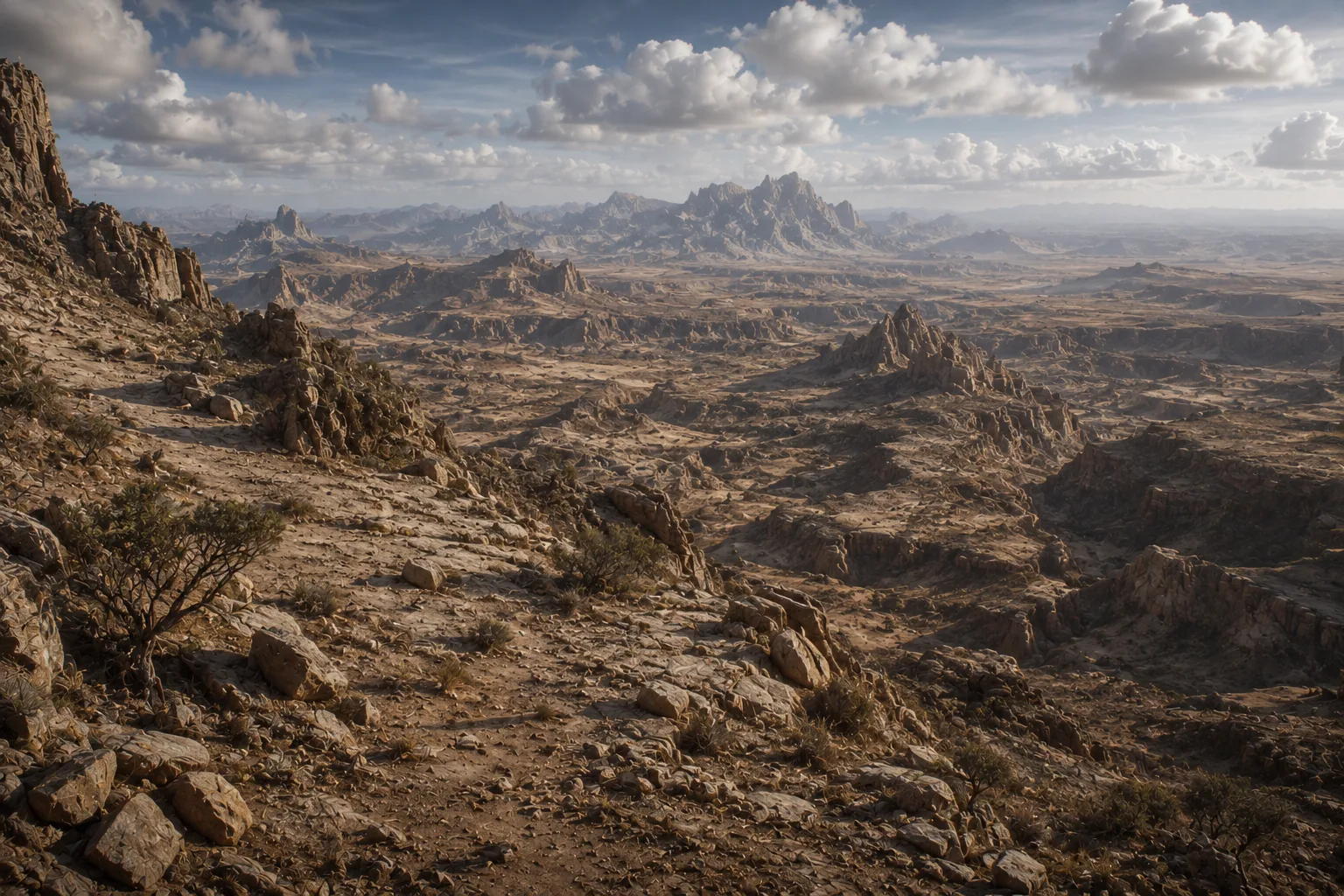 Frozen Highlands The cold uplands where the equatorial land of Eldaara gives way to the stonebound frost of the deep south, the southern bound of the Erg world and a transition toward Khaldaara's polar reaches. Nomadic southern Ergs range here at the edge of the habitable world.
- Napmeadows The golden agricultural plains of Northland south of the Sea of Rising Suns, the sporegrain and dewsown country that feeds the northern realms. (Carboniferous Elshore has no true grasses; its "golden plains" are fern-grain and spore-crops.)
- Bram Sea The shallow sea between the mainland at Udhafa and the island of Baramma, the water crossed to reach the jungle coast. It carries the name-root of Baramma itself; in the folk-tale of Prince Randen it is the route by which he returns to Udhafa, unchanged by years that should have claimed him.
- Sea of Moons The eastern bay between Northland and Eldaara, bordered on Northland's south coast by Ordon, whose Iru name Liir'zan means "Moon's Edge." It and Wardmere frame that southern shore.
- Sea of Rising Suns The gulf lying east of Iruel and west of Northland, on whose shore the Iru co-capital of Ekree cuts its harbours from living cliff-face. A working water of the western realms.
- Sea of Bitter Tears The western bay set between Northland and the equatorial middle of Eldaara. Beyond its place on the map, little is yet recorded.
- The Pale Deep A large, pale-watered open sea in the eastern reach of Northland, lying just south of the Inarin Chillmeadow and north of the jungle island of Baramma - one of the map's major open waters. Beyond its extent, no lore is yet set down.
- Wardmere A sea-sized bay on the south coast of Northland, bordering the city of Ordon alongside the Sea of Moons. Its detail beyond that border is not yet set down.
- Stormwater The wind-torn strait between northern Iruel and the Maaniskaar mainland. The Iru co-capital of Orelo faces Maaniskaar's westernmost city, Capehaven, across it, in a place where the wind never rests.
- Vapor Sea The fog-bound water among the northern islands, between Annilia and Midveil. Warm and ever-steaming, its standing mists are the "veil" that hides Midveil and makes the northern crossings quiet and treacherous. Despite the echo, it has nothing to do with Vaparium, which lies a hemisphere south.
- Annil Bay The chief bay of Annilia, the Annil refuge island, opening toward the Bram Sea - the water the great migration of AC 30 crossed into, the landing of the Annil who fled imperial persecution to their high, misted island.
- Tear's Bay A bay by the Erg province of Rafadin, close to where the Meagre Sea failed to keep the Iru out. Its name belongs to the dispossessed Ergs of Rafadin - the tears of a people the sea did not protect.
- Namii's Reach A reach of open water off Rafadin and the western mainland, named for Namii, one of the two suns of Elshore.
- The Stillmere A broad, mirror-still sea off the western mainland by the Napmeadows and Rafadin, a wide, windless water so calm it mirrors the suns.
- The Meagre Sea The narrow water between the Iru homeland of Iruel and the Erg province of Rafadin. It was meant to be a barrier between the two peoples, but it is too meagre to divide anything - so the Iru reached across it and hold Rafadin, and the Ergs there are left unprotected by the very sea that should have kept them apart. Hence its bitter second name, the Failed Sea.
- Stillbay A sheltered, windless bay west of the northern isles near Wardmere, calm and quiet like its larger namesake the Stillmere - a safe anchorage out of the wind.
- Maiden's Bay A quiet, folk-named bay among the northern isles near Midveil and Gold Bay; its maiden a story the islanders keep.
- Grinning Bay A bay by Wardmere on Northland's southern moon-shore, whose toothed headlands and reefs give it its grin - and its Hungarian name, Agyar ("fang") - a smile that has wrecked the unwary.
- Gold Bay A gold-bearing bay on the coast of Midveil among the northern isles; gold washes down to it as it does to nearby Baramma's riverbeds, a small steady wealth that helped the free island of radicals trade and grow.
- The Waters of the Ancients Old equatorial waters west of Baramma, named for the ancients - the old tribal Iru societies of the deep past whose world ended near here when Aesur Salli landed on Baramma and the Second Great Purge began. The name is a memory the waters keep.
- Whiteward The glacier on Maanamodilia, the controlled heart of the Maan Republic, its ice a frozen rampart at the world's southern edge - standing ward, as its name says, over the Republic's island, where it nears the volcanic warmth of Emberfell.
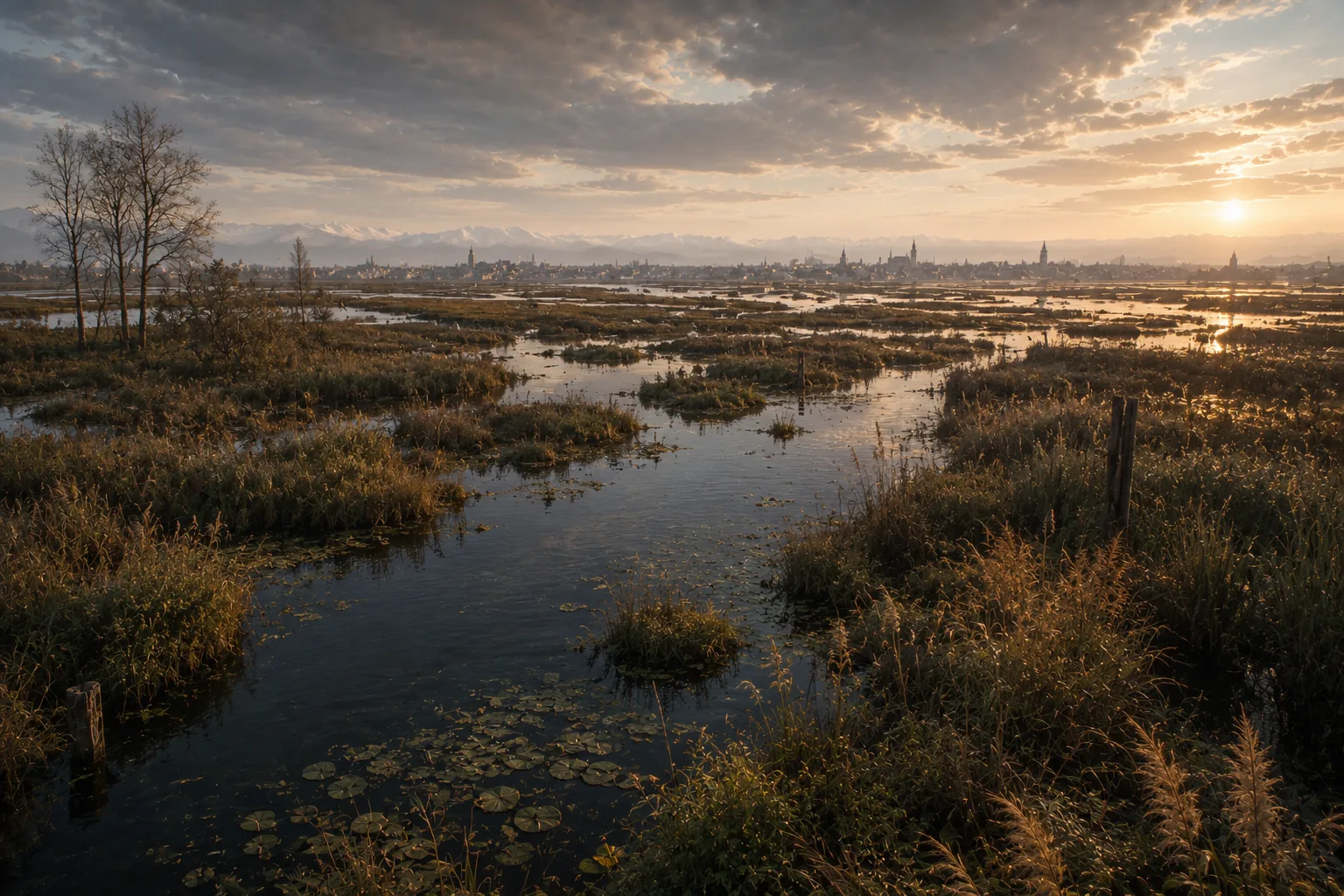 Gravemarsh The northern marshland of Maanamodilia, the warmest and most livable ground of the Maan Republic, where most of its cities are built - a low country of black water and worked land at the habitable edge of an otherwise frozen realm.
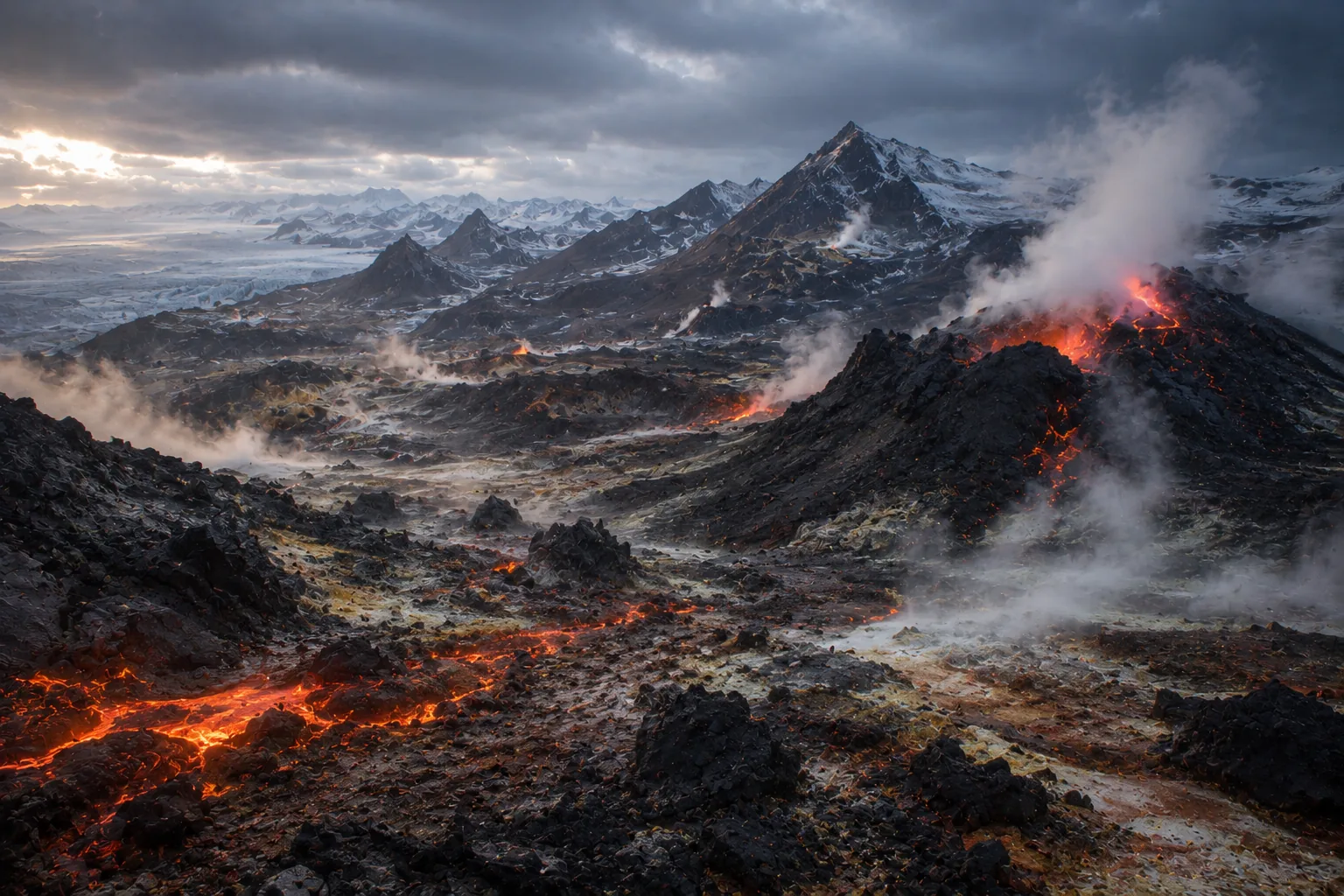 Emberfell A volcanic, geothermal highland in the far south, set among the Maan Republic's frozen ground between the Whiteward glacier and the Gravemarsh - the one ground that smoulders in a land of frost, a fire beneath the ice at the world's cold edge.
- Inarin Chillmeadow A cold fern-tundra in the north, within the Maan Empire's reach, carrying the name of the fallen Inarin - the old Iru empire. A frost-bitten grazing country where the old name outlives the people who gave it.
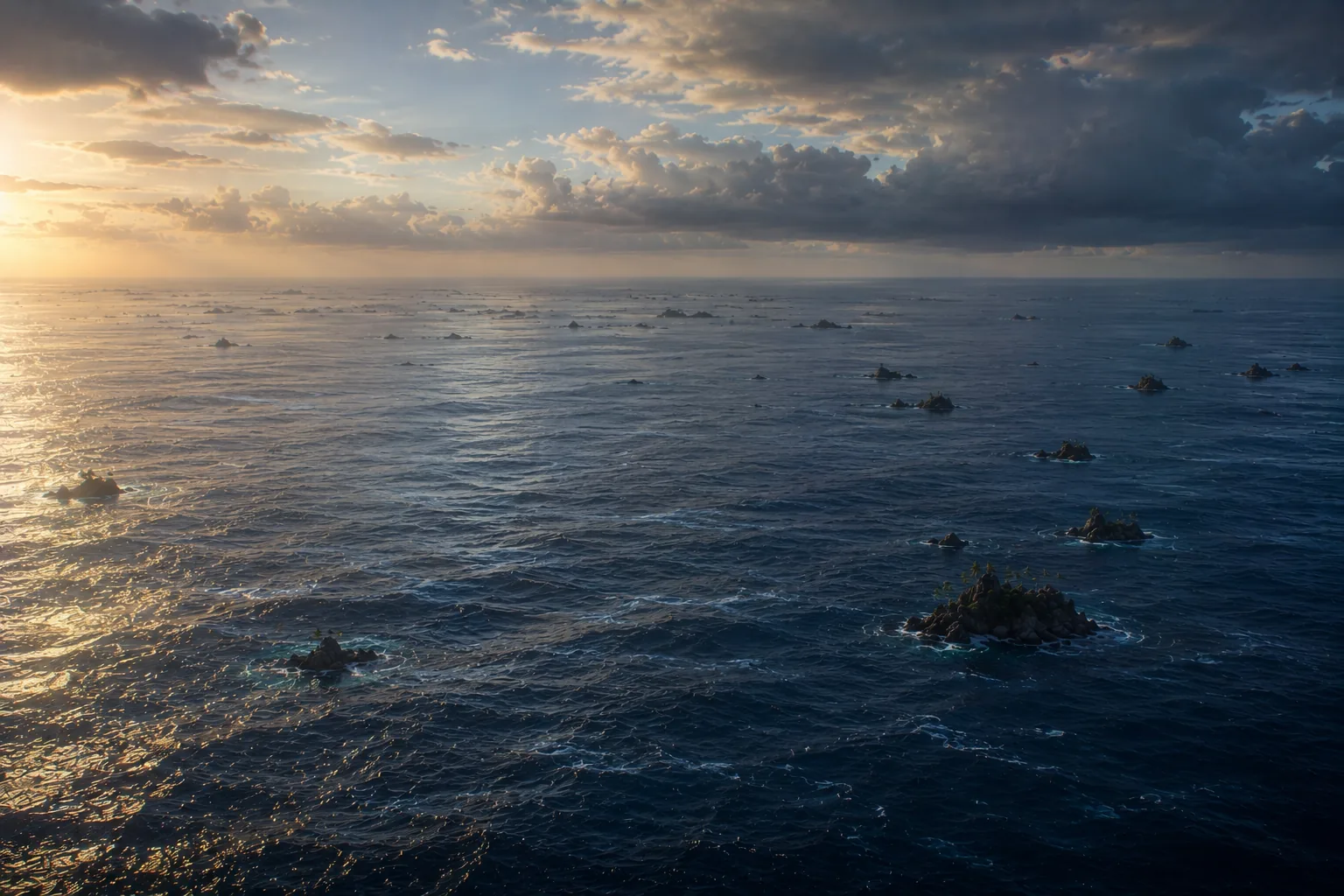 The Ooliel Belt The great equatorial expanse of the eastern Great Water, where the maps of every imperial power give out. As the western ocean keeps Ooliel's heart, these eastern waters carry his belt, the world being his sundered body - and they are a true hazard rather than a sailors' tale: by AC 364 ships that enter the Belt do not come back, and whether it is current, storm, or something that watches is not known. Within it lie the barely-charted Ooliel Islands and Scattered Islands.
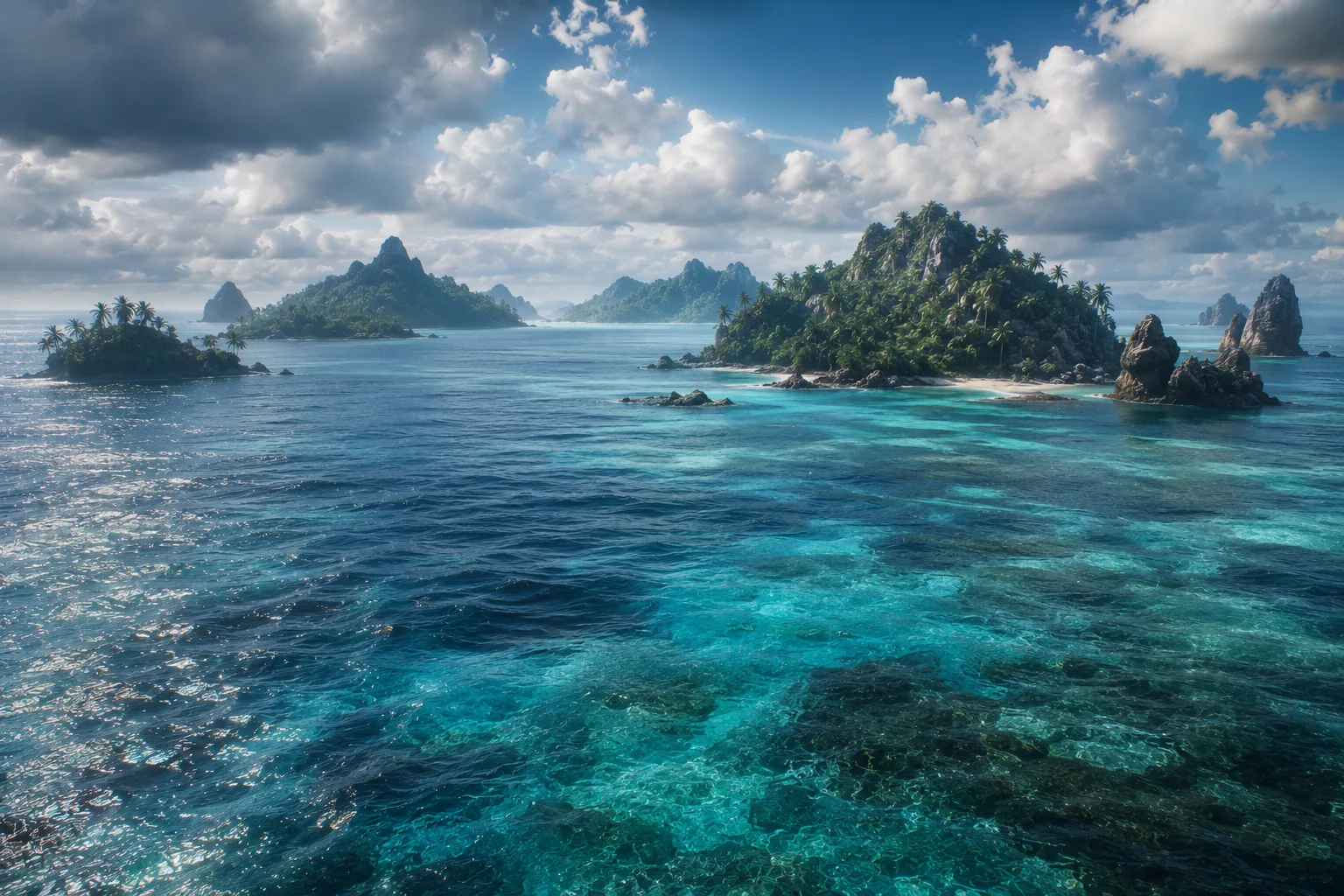 The Ooliel Islands A far-eastern equatorial island group adrift in the danger-waters of the Ooliel Belt, glimpsed by the few ships that returned and never reliably mapped twice. What lives on them, if anything, no imperial record holds; their unknowing is deliberate.
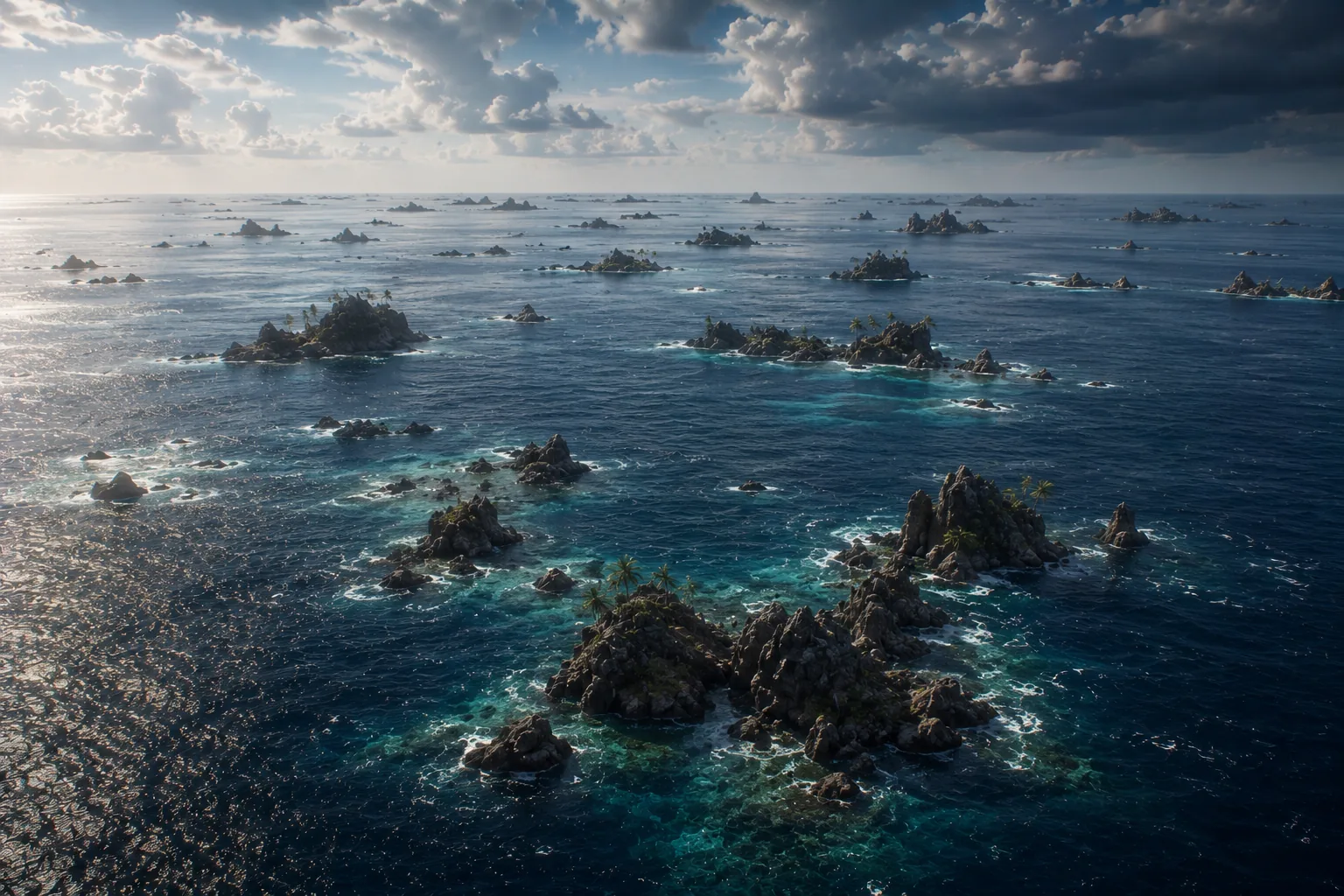 The Scattered Islands An eastern equatorial island group scattered through the danger-waters of the Ooliel Belt; barely charted and barely known.
- The Heart A ring of sacred islets in the western ocean off Iruel, the Iru homeland whose faith is the Ooliran Sovereign Breath. Randenist and Ooliran legend alike hold these islets to be the remnants of Ooliel's heart, the god-son whose sundered body became the world; they are kept sacred and undisturbed, approached by no fleet and worked by no hand.
- Free Clans of Baramma The Bar clans of the jungle island of Baramma, governing as clan-matrilineal tribal republics under Kironism, the ecological discipline that treats the forest as a single remembering mind. In AC 50 they are a sovereign, disputed territory the Maaniskaar Empire claims but cannot control; by AC 364 the long Throne War has absorbed Baramma into the Maan Empire. No road crosses Baramma that the Bars do not allow.
- Sovereign Territory of Midveil The free island of Midveil in AC 50: imperial on the map, ungoverned in fact. An open haven for revolutionaries, fringe thinkers and renegades, where people are met as people with no weight given to creed, birth-rank or race. Wrapped in the mists of the Vapor Sea, friendly and free, it builds a rich and sustainable culture over the next two centuries, until by AC 364 that culture has made it an essential part of the Empire.
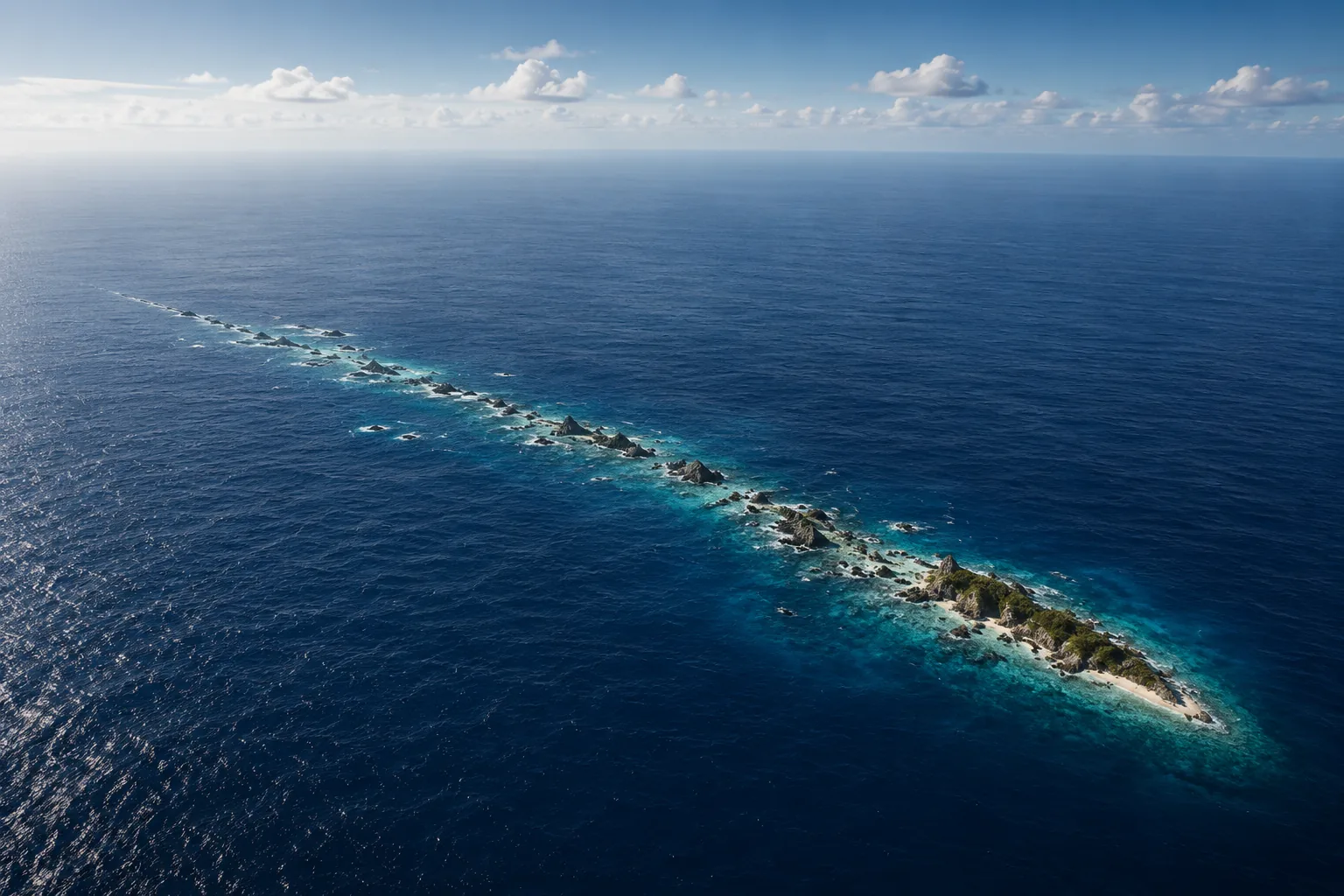 Arrow Islands A remote arrow-scatter of isles far out in the eastern Great Water, thousands of miles from any realm. In AC 50 they belong to Annilia; after Annilia is absorbed by the empire, they remain the one sovereign Annil ground still free by AC 364 - held by remoteness and silence rather than by any wall, and almost no one on the imperial maps knows they are there.
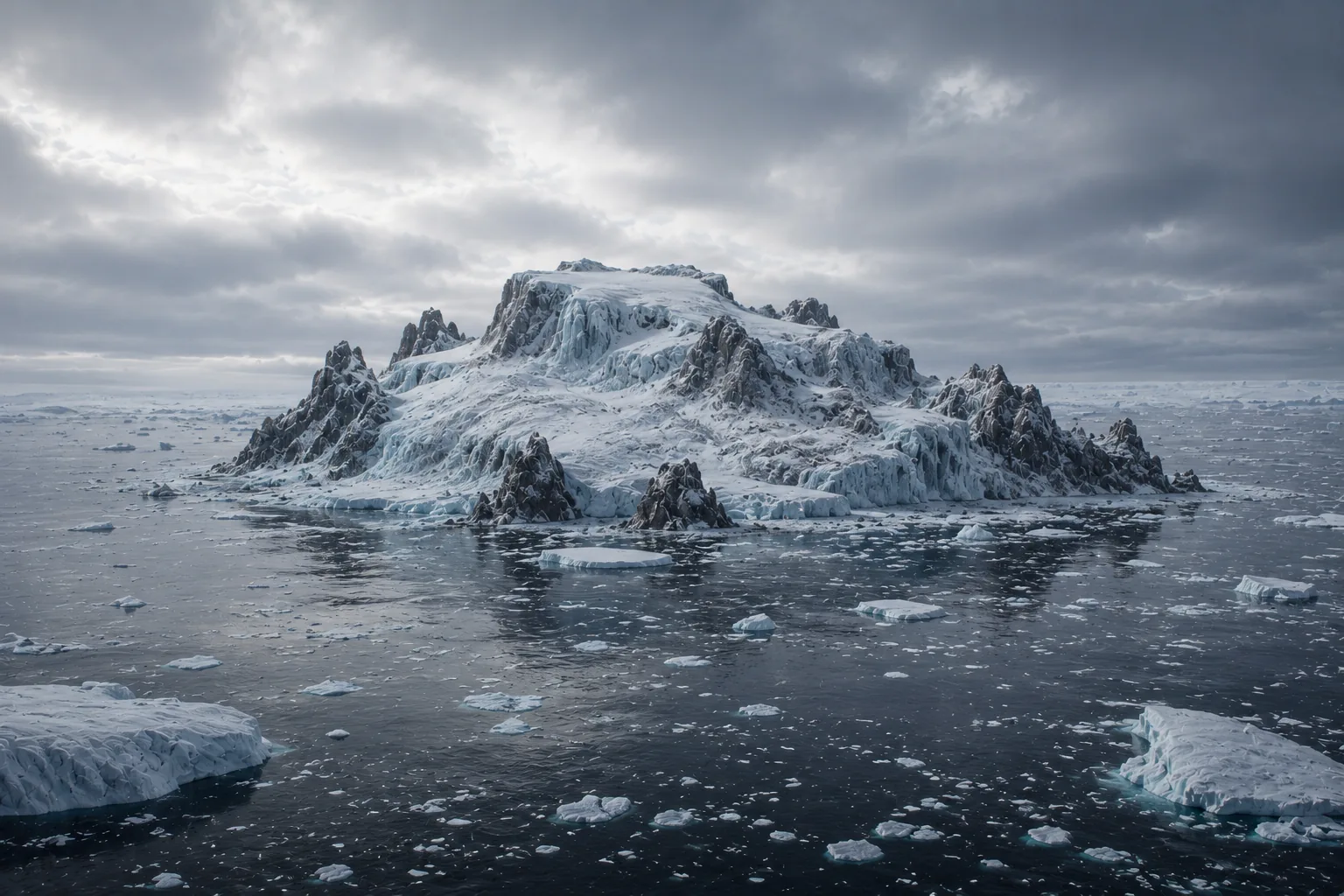 Icelock An uninhabited ice island far out in the southern ice ocean east of Maanamodilia, claimed by the Maan Republic and held by no one. Frozen and empty, it is a line on a map more than a place.
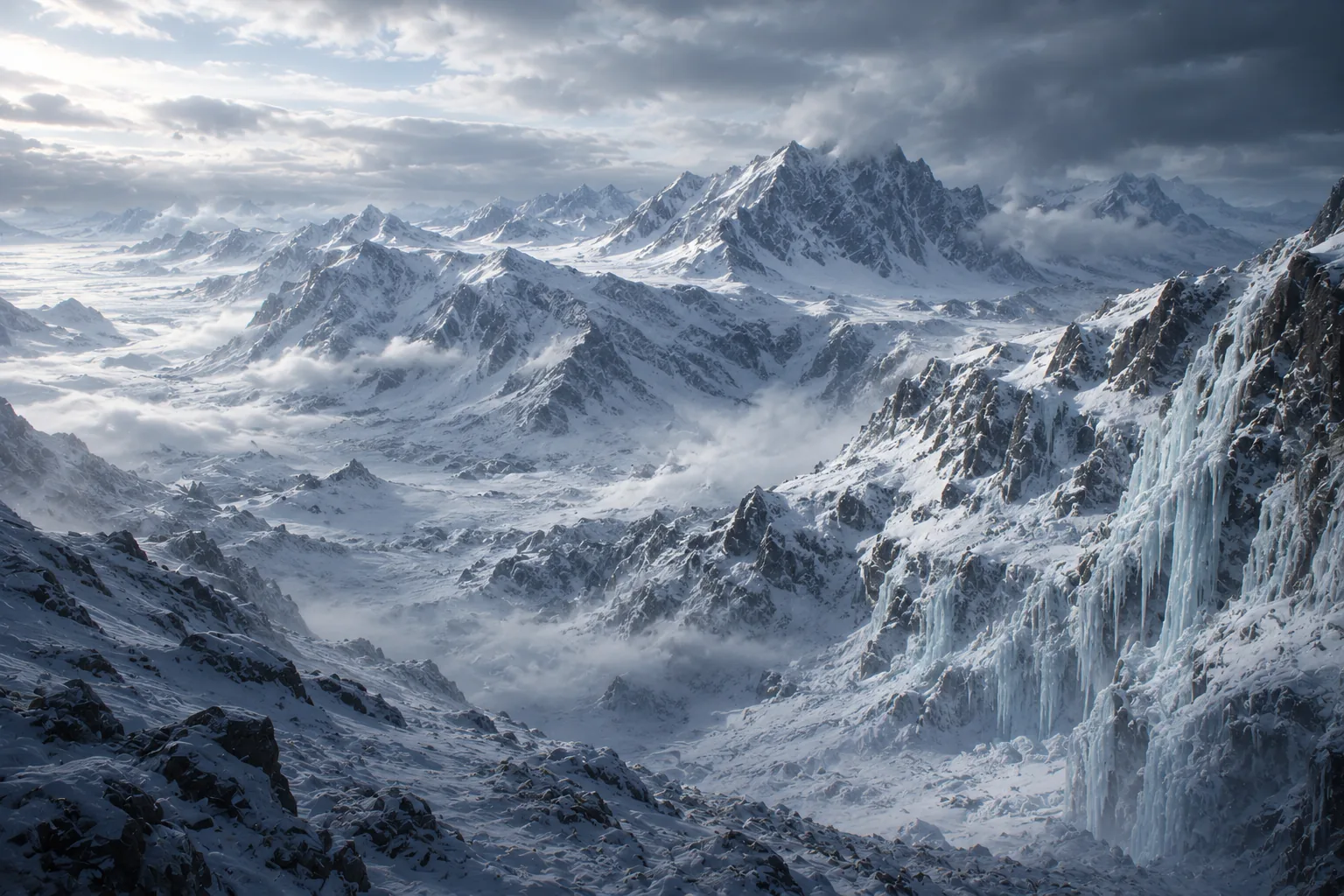 Iceshield The great uninhabited ice island sitting on the north pole - an empty white shield at the top of the world, aligned to no coast and answering to no banner.
- Yara River The great north-flowing river of Baramma, gathering the streams of the Baramman Vale and carrying them through the gap between the ranges to the Bram Sea. It reaches the coast at Nilas, whose harbour sits on its mouth, so every log, hide, and grievance of the interior eventually floats past the empire's customs house.
- Northern Yara Flow The western headwater of the Yara river, rising under the Elderrange and winding east through the upper Baramman Vale. It is the slower and broader of the two Flows, a river of fords, reed flats, and ferry ropes.
- Eastern Yara Flow The eastern headwater of the Yara river, running fast and cold off the Secessionists mountains before it settles into the Vale. Its upper gorges are the shortest way through the eastern range, and the most dangerous one.
- Yaranar A quiet tributary of the Yara system, threading the fern bottoms of the central Vale. Its name is one of the old ones that never drifted: Yaranar it was in the first clan rolls, and Yaranar it remains in every age.
- Yoban A mid-Vale tributary of the Yara river, crossed by the main path between the river villages. Like Yaranar it kept its old name whole: Yoban in the AC 50 rolls, Yoban in the later age.
- Laraya The easternmost tributary of the Yara system, falling out of the Secessionists foothills through terraced side valleys. Laraya is an old name that stayed: the same word serves both eras.
- Gana River The long river of Baramma's south-west, rising under the Elderrange and looping through the lowland forest to the southern sea. Slower and warmer than the Yara, it is a river of dugouts, fish-fences, and stilt landings.
- The Guardians The southern mountain wall of Baramma, a rampart of dark peaks standing between the Saremma Plain and the southern sea. The Bar say the island keeps its oldest promises here, and climb its passes only with reason.
- Secessionists Mountains The eastern range of Baramma, steep and close-folded, named for the clans who withdrew into it rather than accept the coastal compacts. In AC 50 the name is nearly current politics; by the later age it is only a name, its quarrel long since settled or forgotten.
- The Elderrange The old worn heart-range of western Baramma, rounder and greener than the island's harder walls, source of both the Northern Yara Flow and the Gana river. The Bar treat it as the island's grandmother: not feared, but answered to.
- The Varan Plains The open north-western plain of Baramma, grass and scattered stands running from the Elderrange foothills toward the coast. It is the widest sky on a forest island, and the Bar who live there are herders more than woodfolk.
- The Eastfold Plain The settled plain of Baramma's north-east, folded between the Secessionists mountains and the northern coast. It is the island's grain shelf, small but carefully kept, its fields walled with river stone.
- The Southern Lowlands The broad low country of south-central Baramma, fern forest and slow water sloping from the Vale rim toward the Guardians. It is dense, warm, wet land, generous and unhurried, where paths are maintained by use and lost by a single wet season of neglect.
- The Saremma Plain The sheltered southern plain of Baramma, lying in the rain shadow of the Guardians. Drier and more open than any other Bar country, it grows the island's hardiest herds and its most weathered people.
- The Baramman Vale The wide central valley of Baramma, held between the Elderrange and the Secessionists mountains and drained by the Yara system. It is the most peopled stretch of the island: terraces, fords, ferry ropes, and village smoke in every reach.
- Claw Peaks Three hooked peaks on the great Spine of the World in eastern Tarkdaara, rising above the bedrock shelf that holds the old capital of Udhafa. Seen from the river plain they curve together like a talon closing, and every people that ever ruled beneath them has kept some version of the same name.
- Peak of Solitude A lone mountain north-east of Udhafa, standing apart from the Claw Peaks with clear air on every side. Travellers' accounts agree that it is a still place, and disagree about everything else; the persistent tale is of a tree that does not touch the ground.
- Verden In AC 50 there is no Verden: only unbroken fern forest on the north road where the Leafroad passes beneath the dead city of Onnila, a stretch walked quickly and not slept in. The village comes later, and its story belongs to the later age.
- Vernas A ferry village of the upper Vale, holding the rope-crossing of the Northern Yara Flow. Whoever holds the ferry hears everything, and Vernas has always been a village that hears everything.
- Ganara The chief landing of the middle Gana river, a stilt village above the flood line where the dugout traffic of the south-west changes hands. Fish, dye-root, and cured hides move through Ganara; so does every rumour of the lowland forest.
- Varna A forest village of the lower Gana country, set where the river loosens into marsh channels rich in birds and reed. Varna lives by the water calendar: what floods, what recedes, what nests, what can be cut.
- Tares An eastern village under the seaward slopes of the Secessionists mountains, where the terrace country meets the coastal forest. Tares people are known as patient wall-builders and blunt talkers.
- Ymera A fishing village on Baramma's open east coast, facing the long swell of the outer sea. Ymera reads weather for the whole eastern shore, and its boats go out when Ymera says so, not before.
- Sares A crossroads village of eastern Baramma, sitting where the Vale road forks toward the passes and the coast. Sares keeps the district's market yard and most of its arguments.
- Velis A south-eastern village between the mountain skirts and the sea forest, living off hill pasture above and shellfish coves below. Velis is small, steep, and pleased with itself, in the way of villages with two livelihoods.
- Anara A lowland forest village at the heart of the Southern Lowlands, a ring of pole houses around a garden clearing old enough to have its own name in songs. Anara is the pattern other lowland villages are measured against.
- Meres The southern sea-village of Baramma, the Saremma Plain's one outlet to open water, tucked in the lee of the Guardians. Everything the dry plain cannot grow arrives through Meres, and everything it can spare leaves the same way.
- Tavila The plains-edge village of north-western Baramma, where the Varan herding circuits touch the settled Vale road. Twice a year the plain and the forest meet in Tavila's yards to trade, marry, and argue precedence.
- Ynes A lowland village on the forest path between Anara and the western river country. Ynes is a resting village: whoever crosses the Southern Lowlands sleeps there once, and its hospitality customs are exact.
- Vesara A deep-forest village of the southern country, the last settlement before the Guardians' wall, half hidden even from its own path. Vesara people are the island's finest trackers and its worst correspondents.
- Nara A terrace village of the central Baramman Vale, standing above the meeting of the Yara's middle waters. Nara is old, orderly, and slightly deaf to anything said outside the Vale.
- Ivara A vale-and-hill village on the western rim of the Baramman Vale, where the terraces give way to the Elderrange forest. Ivara works both: fields below, coppice and game above.
- Semara A south-western village in the broken country between the Elderrange and the Gana marshes, set on the one firm ridge for a day in any direction. Semara is a village of paths: it owns little else and needs little else.
- Varedes The field-wall village at the centre of the Eastfold Plain, ringed by its walled grain plots like a stone in a spider's web. Varedes counts the harvest for the whole plain and remembers every count.
- Elnas A northern interior village on the high path between the Vale and the north-coast towns, set among springs where three streams start. Elnas is small, windy, and essential: everyone waters there.
- Vemara The chief town of Baramma's west coast in AC 50, a timber-built harbour facing the Vapor Sea. It is the Free Clans' own port, the counterweight to Maan-held Nilas: what the clans would rather not sail past a customs house sails from Vemara.
- Imes A south-western coastal town where the Gana country meets the open sea, the market of the marsh rivers. Imes is amphibious: half its streets are landings, and its calendar is the tide table.
- Neriles A north-western town where the Varan Plains meet the sea, the drovers' port. Herds walk in from the plain, hides and salt meat sail out, and Neriles keeps the scales that both sides grudgingly trust.
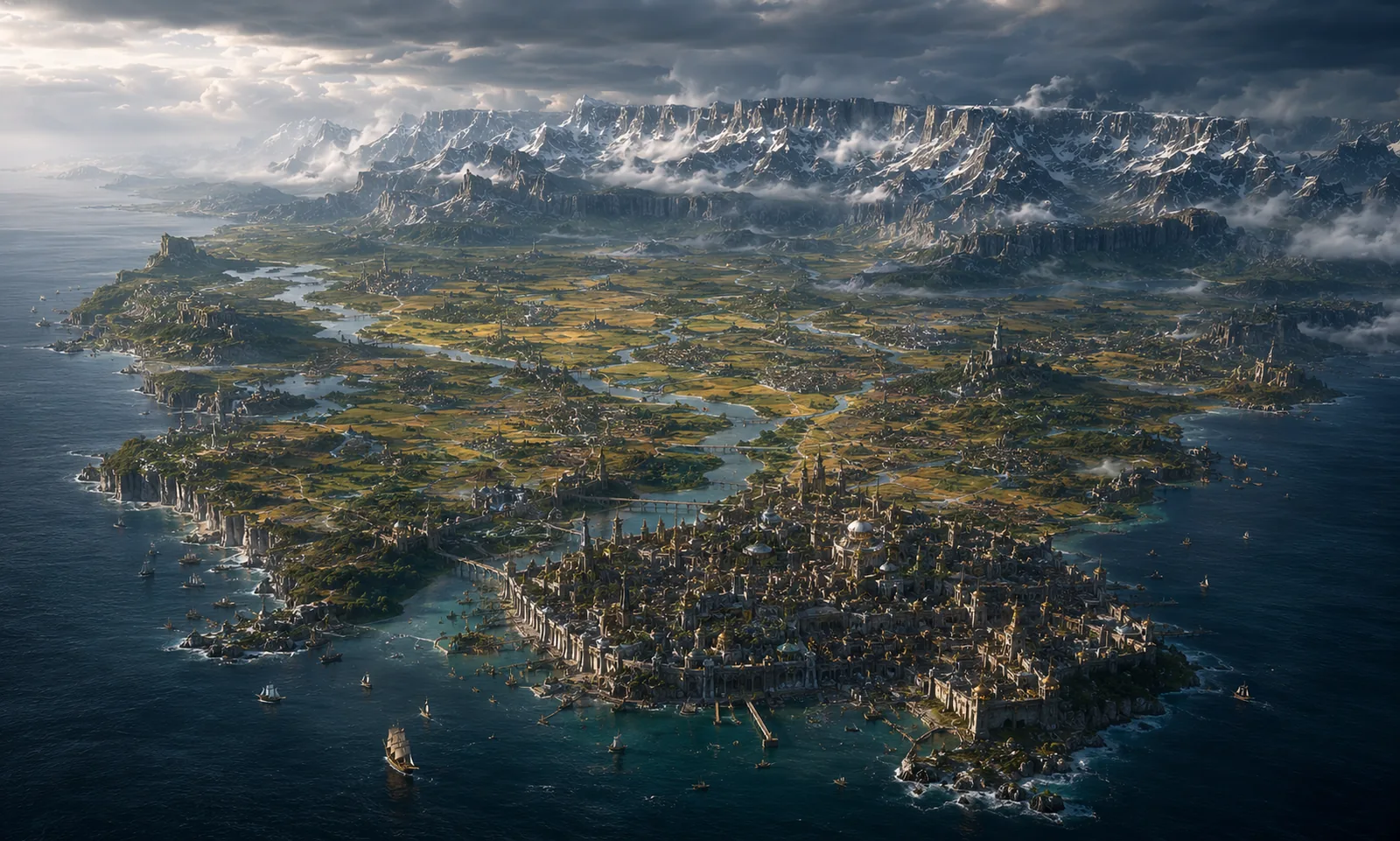 Syara An island town on the western sea-approaches of Baramma, set on a harbour isle between the great island and the Midveil waters. Syara lives by pilotage: its boats know every shoal of the western channels, and charge accordingly.
- Tamyra A north-coast town west of the Yara mouth, a fishing and boatbuilding harbour in the lee of the coastal hills. Tamyra is Nilas's unbothered neighbour: close enough to trade, far enough to stay entirely Bar.
- Syaras A north-coast town east of Tamyra, holding the sheltered bay where the northern path from Elnas meets the sea. Syaras is the north coast's quiet middle harbour, more warehouse than waterfront.
- Imeran The town of Baramma's north-east, where the Eastfold Plain meets the sea at a river-mouth harbour. Imeran ships the plain's grain and takes the first of every east-coast storm.
- Splitwater The cold strait-sea that divides Maanamodilia from the southern continent, a grey channel of hard currents and harder politics. Everything the Maan Republic says to the mainland crosses the Splitwater first, and much of it drowns on the way.
- Deadwater A becalmed reach of sea off the Khaldaaran coast where the currents fail and the winds forget their work. Sailors call any windless day a deadwater day; this is the sea that taught them the word.
- High Sea The great cold lake of the Frozen Highlands, a sheet of dark water lying far above the level of any coast, ringed by stone shores and thin air. The highlanders say it is the sky's own drinking bowl, and they are not entirely joking.
- Sea of Revenge The second great lake of the Frozen Highlands, deeper and darker than its sister, and heavier by far in the mind. According to legend a great number of Iru were drowned in its waters at the beginning of the Chaos, and the name the later peoples gave it does not pretend otherwise.
- Meir Bay The broad western bay south of the Land of Green Shadows, named for the people whose slow ships hold its horizon. What the Meir want with the bay they do not say; what they carry away from it, no customs house has ever weighed.
- Sign Bay The wide southern bay below Khaldaara's west coast, marked from the sea by a run of old Iru channel-pylons that still stand out of the water in a line too straight for nature. Sailors read them like a sentence and steer by it; nobody now alive can read what the sentence says.
- Erg Bay The far-southern bay where the cold coast of Khaldaara bends toward the ice, named in the resettlement years when Erg work-fleets wintered in its lee. The Ergs were moved on long ago, in the empire's way; the name stayed, in the world's way.
- Maanrift Bay A deep-cut southern bay driven into the Khaldaaran coast like an axe wound, its cliffs sheer and its water black with depth. The Maan named it for themselves in the confident years; the bay has outlasted most of the confidence.
- Hollowrun A far-northern river of upper Tarkdaara, running quick and shallow through a country of glacial hollows. It is a cold, clear, stony river that sounds louder than it is, the way empty rooms do.
- Wormflow The braided river of the northern lowlands, a slow silver tangle that splits, wanders, rejoins, and forgets itself across a plain of reeds. Seen from the high ground it lies on the land like something alive, and the name has never needed explaining.
- Mehena A slow northern river whose name is simply the old word for its own nature: gentle, placid, unhurried. The Mehena drains the quiet country east of the Wormflow braid and takes its time about it.
- Swiftflow The Mehena's opposite and neighbour: a fast, cold, quarrelsome river off the northern heights that has drowned more confidence than any water its size. Its fords are timed, not found.
- Kense The long river of the north-eastern uplands, winding out of the Divider Hills country toward the cold coast. An old-named river in a land of renamed things, it keeps its single syllable-and-a-half like a held opinion.
- Thornback A ridge-running river of middle Tarkdaara that follows a hogback of dark stone for most of its length, crossed by thorn-scrub the whole way. Travellers see the ridge and the river braided together from a day off and learn the name before anyone says it.
- Torona One of the great rivers of central Tarkdaara, broad, brown, and patient, gathering the middle north into a single argument and carrying it to the sea. Old cities grew on its banks for the oldest reason there is.
- Abasa The Torona's eastern sister, rising under the Spine of the World and running north-east through terrace country cut in the old world and farmed ever since. The Abasa is the river of inherited work: nothing on its banks was built by the people who use it.
- Cordasa The long south-eastern river of Tarkdaara, born on the flanks of the Spine and reaching the eastern sea by a valley of old bridges. Half the bridges are Iru work and will not fall; the other half are Maan work and are maintained. The river treats both the same.
- Bir The deep short river of the north-east coast, a cold trench of water running from the high moors to the sea with hardly a shallow in it. Bir is the old word for deep, and the name is a measurement, not a poem.
- Ooliel's Blood The great river of the Land of Green Shadows, the dark mother-water into which nearly every stream of the green country empties. Under the unbroken canopy it runs wide, slow, and tea-black, and the forest peoples speak of it as a being rather than a place: the Blood of Ooliel, moving through the land like life through a body.
- Nak River An eastern river of the equatorial belt, running out of the Eldaaran interior to the sea through gallery forest and reed plain. It is a working river with a short name and a long memory of barge poles.
- Kon River A green-country river that gathers the eastern canopy and gives itself to Ooliel's Blood, as nearly all waters do in the Land of Green Shadows. Its lower run is a tunnel of trees where the light arrives second-hand.
- Varna River A western tributary of Ooliel's Blood, falling out of the high rim of the green country in a run of cataracts before it flattens into the canopy dark. It shares its name with a Baramman village and nothing else.
- Pow River The long south-western artery of the green country, winding through the wettest forest in the world to join Ooliel's Blood near the coast. Sixty-nine turns of it are charted; the river peoples say the chart flatters itself.
- Nowin River The river of the far south-west of the green country, reaching the sea at Meir Bay. It is the last river of the forest and the first thing of the coast, and its mouth has watched Meir sails longer than any record kept ashore.
- River of Remorse The cold river that carries the Frozen Highlands' two great lakes toward the southern sea, flowing out of the country of the drowned. The later peoples named it in their own tongue and their own conscience: what began at the Sea of Revenge runs to the ocean as Remorse.
- Remembrance A short highland river that joins the River of Remorse from the east, completing a sentence the land seems to have written on purpose. Pilgrims of several faiths walk its banks upstream, against the current, which is the point.
- Kahdeiin The river-city of the far north-east, standing where the Kense gathers its cold waters below the Divider Hills country. Iru-founded and Maan-kept, it is in AC 50 the empire's last real ledger-post before the moors: a city of granaries, fur-yards, and bridge-tolls whose upper towers have been sealed longer than anyone has been alive.
- Jarabiir The terrace-city of the upper Abasa, cut into a shoulder of the Spine of the World in stepped courts that catch the sun the mountains try to keep. In AC 50 it is a quiet provincial seat of orchard-terraces and thin air, living in perhaps a tenth of itself.
- Rimenno The inland city of the empire's south-east, a long day's ride up the strait-road from the coast that faces sovereign Annilia. In AC 50 it is where the empire actually inspects the island trade: the ports pretend, and Rimenno counts, its road-gates the true customs house of the whole eastern approach.
- Ordon The grey harbour-city of the Wardmere coast, built on a headland the old world chose for reasons the sea still respects: no storm has ever taken a ship inside its moles. In AC 50 it is a working port of middling fortune and excellent masonry.
- Uru The bare-named city of the western plains, carrying the old world's word for beginnings with nothing added. In AC 50 it is a caravan city on the dry roads, its Iru cisterns the only reason the routes converge there, its people the mixture that convergence makes.
- Porkar The sea-city above the Waters of the Ancients, standing on a drowned old-world coast where towers older than the city show at low tide like teeth. In AC 50 it is a diver's and salvager's port, half its economy below the waterline and all of its stories.
- Tanuuru The west-coast city facing the Dravak Tides, built where the old world wanted a window on the largest ocean there is. In AC 50 it is the empire's far-western port of registry, more lighthouse than metropolis, keeping the coastal lamps lit out of pride as much as need.
- Naanas The strait-city of the far north-west, facing the great island called the Heart across cold grey water. In AC 50 it is the empire's end of the world: a garrison port where postings are punishments, the fishing is excellent, and the Heart sits on the horizon meaning whatever the viewer brings to it.
- Hartaara The northernmost city the old world built on the western ocean, above beaches of black stone where the summer never quite arrives. In AC 50 it is a whaling and weather station more than a city, populated by people the north selected and the south does not miss.
- Zilinanas The west-coast city of middle Tarkdaara, on the shore of the Meagre Sea, where the old world kept a harbour and the empire keeps a habit. In AC 50 it is a fishing and coasting city of modest weight, living in the skirts of towers it uses mainly as landmarks.
- Edisanas The lake-country city between Tear's Bay and the Napmeadows, set among waters that change their minds with the seasons. In AC 50 it is a grain and fowl city, prosperous in the small way that outlasts the large ways, its old stones wearing Maan whitewash like a borrowed coat.
- Laaherno The equatorial coast-city where Eldaara meets the warm sea, a place of river-mouth sandbars and heat that arrives before dawn. In AC 50 it is a spice and timber port, loud with cicada-song and barge-men, ruled lightly because it is far from everything that rules.
- Akhata The east-coast city of the equatorial belt, facing the open ocean across a rampart of reef. In AC 50 it is a pearl and reef-harvest city, its channels through the coral cut by the old world with a straightness the sea has spent an age failing to forgive.
- Etaaka The river-mouth city of eastern Eldaara, standing over a delta that rearranges itself yearly and an old-world weir system that quietly disagrees. In AC 50 it is a rice and reed city, wet to the knees and content.
- Upunila The garden-city of inland Eldaara, terraced shallowly across a green plain, famous in AC 50 for fruit, shade-cloth markets, and the largest arag-tree avenue in the east. It is a soft city in a soft country, which the old world apparently also wanted, because it built one here.
- Nakoo The barge-city of the Nak river, middle Eldaara's marketplace, where the river traffic and the plains roads exchange their loads and their rumours. In AC 50 it is the busiest small city in the east: everything passes through Nakoo, and Nakoo takes a little of everything.
- Peroona Nakoo's northern sister on the plains road, a way-city of inns, forges, and caravan yards. In AC 50 it lives by the road as completely as a river town lives by its river, and its people can price a traveller to the copper before the dust settles.
- Meetiso The threshold-city of the green country, standing where the open east gives way to the canopy of the Land of Green Shadows. In AC 50 it is the last town with a horizon: travellers provision here, write letters here, and are watched setting out under the trees with the particular courtesy owed to people who may not write again.
- Huurio A canopy-city of the eastern green country, built by the old world up among the crowns as much as on the ground, its stone piers rising through the forest floor to platforms in the light. In AC 50 its people live in the middle storeys of a vertical ruin, farming shade-gardens and harvesting the crown-flowering vines.
- Raafera The river-fork city of the central green country, standing over the meeting of two of Ooliel's Blood's great side-arms. In AC 50 it is the crossroads of the canopy world: everything the forest trades passes a Raafera landing, and the city's stone keeps the water's appointments.
- Ingaadi The great river-city of Ooliel's Blood itself, standing on stone above the mother-water's widest reach. In AC 50 it is the throne of the forest rivers, if the green country had thrones: the deepest landings, the oldest weirs, and the largest market under any canopy in the world.
- Kaaltino A western green-country city on the high rim, where the canopy thins and the land begins its long fall to the coast. In AC 50 it is a terrace and orchard city in the cooler air, the green country's granary of everything that will not grow in the wet dark below.
- Viilano The south-western forest city, deep in the wettest belt of the green country, where the rain is a season with brief interruptions. In AC 50 it is a stilt-and-stone city of fisher-folk and resin-tappers, its lower streets canals for half the year and its tempers famously mild.
- Konoo The city of the Kon river, standing where that water gathers the eastern canopy's trade before surrendering it to Ooliel's Blood. In AC 50 it is a barge-builder's city: the flat-bottomed hulls that work every river in the green country are launched from Konoo's stone slips.
- Ensoora A deep-forest city of the Pow basin, ringed by flood-meres and reachable in the wet season only by water. In AC 50 it is the green country's quietest city, a place of fowlers, healers, and the herb-trade, spoken of with the slight softness reserved for places that mind their own business.
- Gakufa The upper-Pow city, farthest into the wet south-west, where the forest is oldest and the light arrives pre-owned. In AC 50 it is the end of the navigable water and the head of the portage-paths: whatever leaves the deep forest shoulders its way through Gakufa first.
- Baloorno The bay-city of the south-western coast, on the northern arm of Meir Bay, where the forest's rivers meet the Meir's horizon. In AC 50 it is the strangest market in the west: the one city where the slow ships of the Meir call openly, trade briefly, and depart without explanation.
- Nogiil Baloorno's coastal twin on the north shore of Meir Bay, where the Nowin's mouth-marshes meet the open water. In AC 50 it is a shore-port and salt-garden city, plainer than its sister and busier, handling the forest's bulk trade while Baloorno handles its mysteries.
- Agaduul The far-western cape-city, standing on the last good stone before the coast bends north into emptiness. In AC 50 it is a lonely, handsome place: a weather-station city of light-keepers, kelp-harvesters, and the westernmost shrine of any faith that keeps shrines.
- Anaas The equatorial west-coast city, facing the Dravak Tides across black-sand beaches that steam after rain. In AC 50 it is a warm, salt-bright port serving the green country's western outlets, its markets bilingual in forest and sea.
- Mihiniile The south-western coast-city below the green country, where forest gives way to hard hills and the sea turns cold. In AC 50 it is a boundary town grown citywise: fisheries north, quarries south, and a garrison that mostly polices the difference.
- Sanviin The northern desert-city, on the caravan line where the Endless Desert's dunes first learn to behave like a sea. In AC 50 it is a cistern-city of the crossing trade, its life drawn up nightly from Iru water-works that have never once failed, which the desert peoples find more unsettling than a failure would be.
- Utsuk Amman The deep-desert city, far into the Endless Desert's stone heart, built by the old world around a spring the maps call miraculous and the desert calls Utsuk. In AC 50 it is the last inhabited place on the deep crossing: a walled garden of date-terraces and water-law in an ocean of light.
- Tagaafa The coast-city south of the Endless Desert, where the caravan roads finally smell salt. In AC 50 it is the desert's harbour: everything the sands trade with the sea changes hands on its long stone mole, priced once in water and once in silver.
- Maalavu The eastern shelf-city between the desert's edge and the Khaldaaran coast, a station of the north-south roads. In AC 50 it is a mule-and-granary town at city scale, unglamorous and indispensable, feeding every route that passes and remembering every toll.
- Evoora The north-eastern Khaldaaran coast-city, facing the warm strait toward the equatorial belt. In AC 50 it is a ferry-city: the southern continent's door to the east, its slips busy with the short crossing and its streets with everyone the crossing brings.
- Arafutsu The east-coast city of upper Khaldaara, on a bight of quiet water behind reef and headland. In AC 50 it is a shipbuilder's and rope-walk city, supplying the eastern sea trade with hulls and cordage and its officers with somewhere mild to grow old.
- Useetsu The cliff-city of the eastern Khaldaaran coast, terraced down a sea-face in balconies of stone. In AC 50 it is a fishing and bird-harvest city, its streets stairs and its weather vertical; its people ascend and descend for a living and pity the flat world sincerely.
- Nakaaha The dry inland city of central Khaldaara, on the steppe between the Erg Desert and the highlands. In AC 50 it is a herd and hide city, ringed by wind-pumps, living on the deep water and the long grass in a country that offers nothing else and never has.
- Poorvin The south-western hill-city of Khaldaara, above valleys of cold orchards and slow rivers. In AC 50 it is a cider and wool city, comfortable and unfashionable, of the kind that empires forget to oppress.
- Reerdino The south-western coast-city where Khaldaara's hills meet the cold sea. In AC 50 it is a whaling and deep-water port, its try-yards lit through the dark months, its people famous for endurance and for songs about endurance.
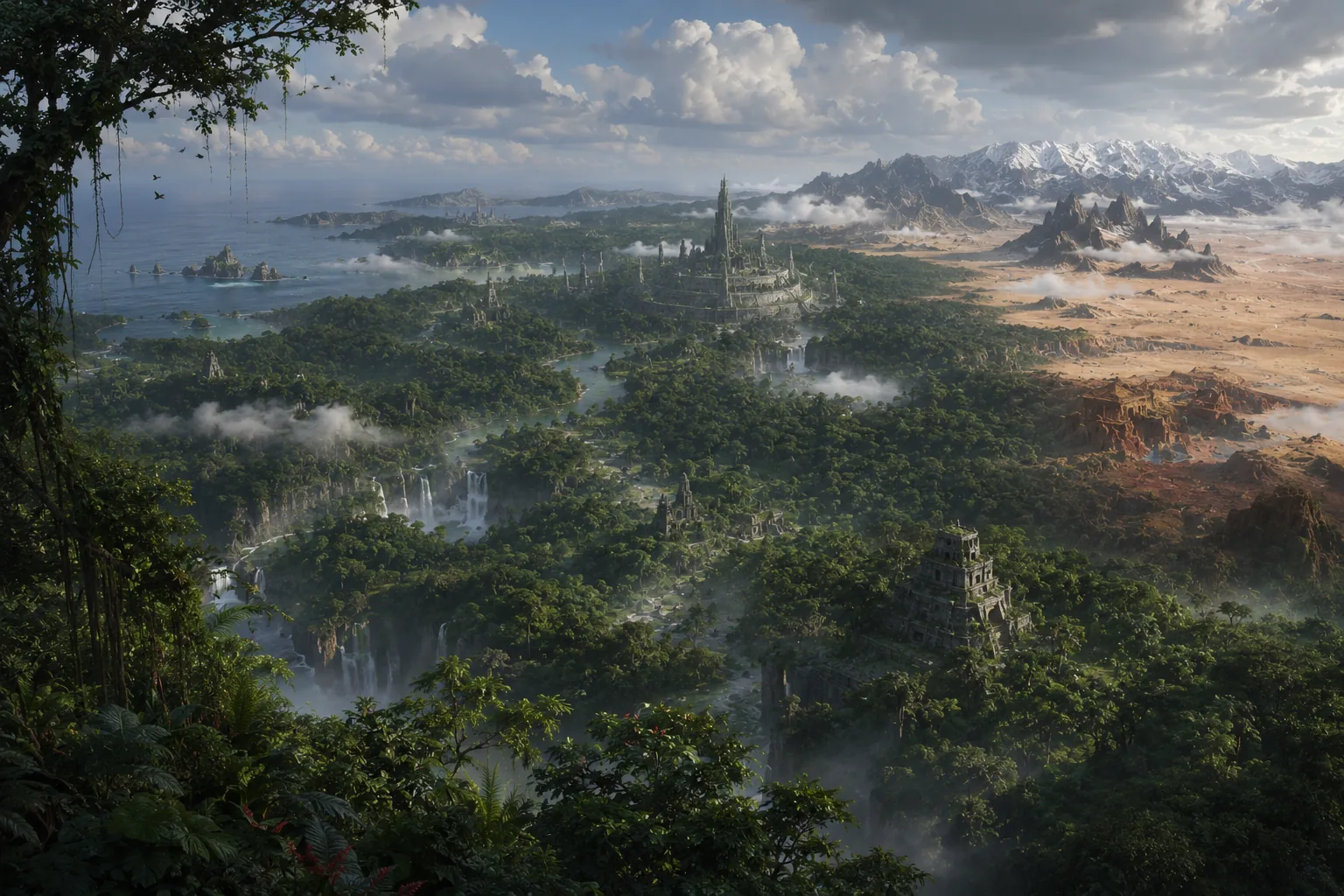 Maaro The harbour-city on the approaches of Sign Bay, keeping the sea-lane that reads the drowned pylons. In AC 50 it is a pilot's city: every hull that runs the Sign takes a Maaro pilot or takes its chances, and the city's fortune is exactly the difference between those two prices.
- Elusea The anchorage-city of Sign Bay, holding the bay's one deep haven under cliffs of dark stone. In AC 50 it is the south-west's safe room: fleets winter there, treaties are signed there, and the bay's cold weather breaks on its headland like a habit.
- Arda Nutsa The northern lake-city of the Frozen Highlands, on the cold shore of the Sea of Revenge. In AC 50 it is a stone town of fisher-herders under thin bright air, living at a respectful angle to a lake whose legend everyone knows and no one retells after dark.
- Pa'Taaka The south-western lake-city of the Sea of Revenge, twin and rival to Paatsuku across the water. In AC 50 it is the herders' city: wool, stone, and lake-fish, and a shore-market where the highland clans price the year.
- Paatsuku The eastern lake-city of the Sea of Revenge, standing closest to the deep water and carrying the lake's legend most heavily. In AC 50 it is a sombre, prosperous place of stone-cutters and lake-priests, where the highlands come to mourn properly: the city's trade, put plainly, is grief done well.
- Siinaer The city of the High Sea, on the eastern shore of the highlands' great cold lake. In AC 50 it is the roof-city of the world as its people reckon it: the highest market, the thinnest air, and a lake horizon at an altitude where horizons feel like administrative errors.
- Zanaliir The pass-city below the southern rim of the Frozen Highlands, keeping the one good road between the high lakes and the southern coast. In AC 50 it is a toll and caravan city in a cold gorge, rich in exactly the way doorkeepers are rich.
- Seniida The far south-western coast-city, on the cold dry shore where Khaldaara runs out of both warmth and argument. In AC 50 it is a sealer's and salt-meat port serving the southern fisheries, tough, small for its walls, and unsentimental about everything except its dogsled races.
- Hanaato The city of Erg Bay, on the sheltered cold-water shore where the Erg work-fleets once wintered in the resettlement years. In AC 50 it is the far south's counting-house: furs, oils, and Republic goods cross its quays, and its ledgers are famously kept in three currencies and one dialect of suspicion.
- Enitsuda The southernmost of the old cities, on the cold coast facing the ice islands, built by the old world at the edge of what even it found reasonable. In AC 50 it is a hard little city of ice-pilots and storm-scientists-by-necessity, the place the far south checks the weather by.
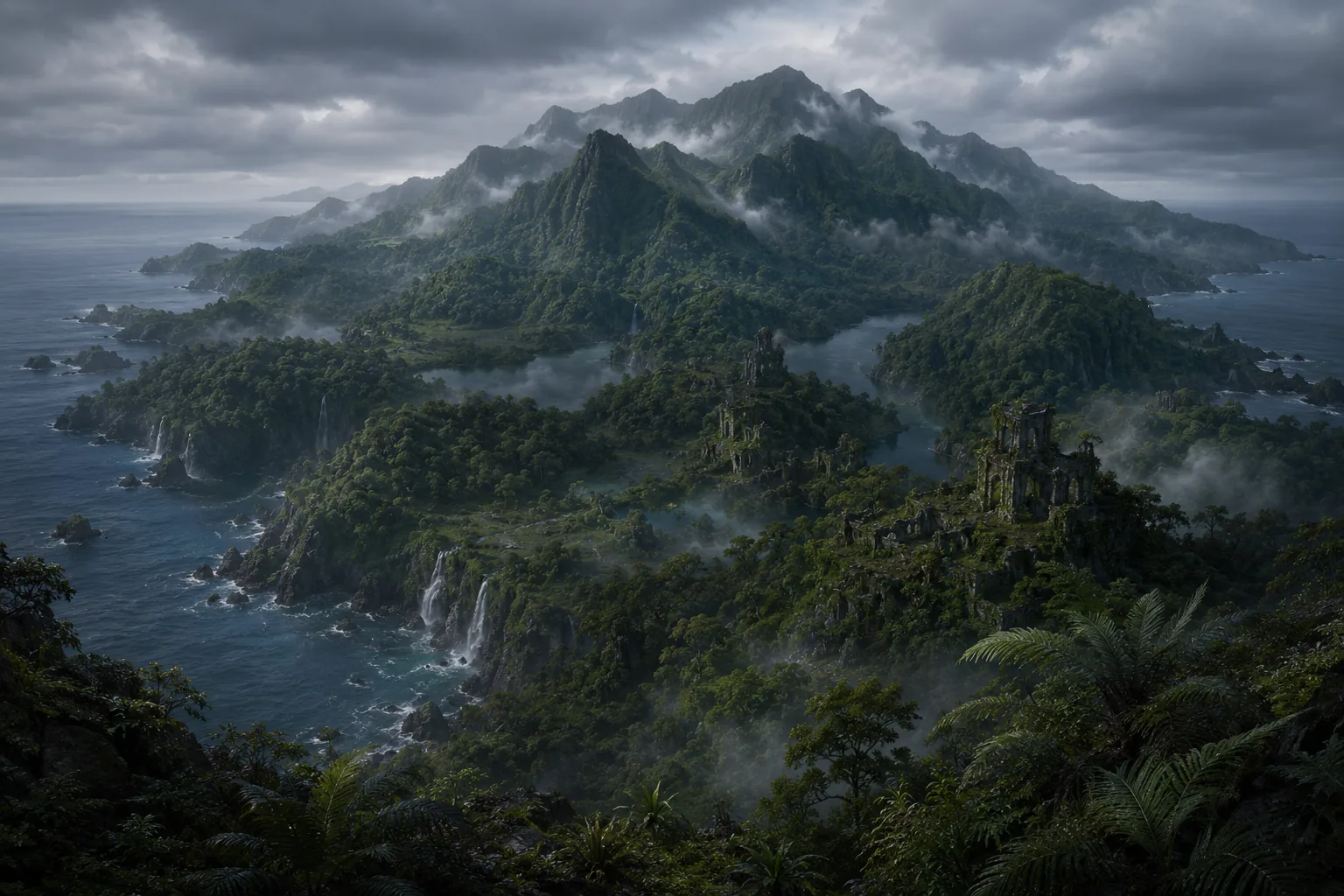 Eyoora The northernmost city of Maanamodilia and the only Iru-founded city on the great island, standing on its north-western coast where the Splitwater opens toward the continent. In AC 50 it is the Maan Republic's inherited stranger: an old-world ferry-gate the Republic uses, taxes, and has never quite considered its own.