Harri hauled himself up with the speed of a man who had just understood the rules. Ten thousand imperial credits was not a balance anymore. It was a line he had crossed, and the payment had shifted to flesh.
The climb stripped the skin from his knees and his broad, spade-like hands. Filth worked its way into every open cut, and the sewage water burned like lye where the concrete had already done its damage, alive with chemical sting and spore-fed slime. His heavy, granite features were masked in black silt, algal residue, and dried blood, and the thick beard that usually framed his jaw with pride now hung wet and matted against his chest. The silver ring in his left ear flashed dimly as he hauled himself over the lip, the only bright thing on a man who looked like he had dredged himself up from oblivion.
A Bar.
The thought came back to him with the persistence of pain. Not the shape of it. Not the weight. The fact of it.
"A Bar does not belong here."
The city did not answer him.
It lay open and abandoned, streets hollow, windows blind. Night pressed flat and still, the air heavy with canal damp and the faint, sour tang of spore growth clinging to concrete.
No sirens. No voices.
He moved through the shadows, a heavy shape hunched against the wind, his grey-green eyes scanning the darkness from beneath a brow permanently furrowed in resentment. He avoided the main thoroughfares, sticking to the service alleys of the Western Ring, where clubmoss-like growths crept from cracks and brittle fern-grass rustled underfoot, until the massive residential complex loomed ahead. It was a monolith of crumbling concrete and glass, punching into the night sky like a rotting finger.
He kept seeing the horns. The surprise in the creature's eyes. The way the blood had come out black and thick, wrong against the concrete, too slow, too heavy.
The last time he had seen a Bar, he had been a child. Five, maybe six. A memory of legs like pillars, skin patterned dark and light, his mother's hand yanking him away too hard, her voice sharp with fear. Bars were already exiles then. Warnings. Stories told to keep children close.
Home. Beer, gun, safety. The Order would not look for him there. Not yet. They were hunting Harri the debtor, not the ghost living in a dead woman's apartment. The door registry still listed Krisel's name. The bureaucracy was slow, the city records decayed, and Harri had ensured the paperwork stagnated. He had inherited the unit, yes, but a formal transfer required inspections, fees, questions.
It was easier to wait. It was easier to let nature file the paperwork.
Once the children were gone, and they would be gone soon, the line of succession would be a simple straight line to him. No custody disputes, no guardianship hearings. Just an empty apartment and silence.
Debt.
That was all it was supposed to be.
He had owed money. He had borrowed too much, drunk too often, signed papers he barely remembered signing. He hadn't killed anyone. Not intentionally. Not that he could remember. And memory was a slippery thing these days. Whole weeks dissolved into alcohol and haze, arguments blurring together, nights ending where they began.
Still.
Debt was not execution. Debt was payment plans. Threats. Warnings. Not priests in the dark. Not Bars with horns charging out of shadows.
Maybe he should have listened to them.
The first time. Maybe if he had gone to the Order when they summoned him. Maybe if he had begged properly. Apologized properly.
Things had escalated too fast. They always did.
The elevator swallowed him, beginning the long, shuddering ascent to the sixtieth floor. The machinery whined, metal fatigue screaming in the shaft. Somewhere deep in the building's bones, twin bells tolled, faint and distorted through sixty floors of ductwork and steel. The sunset rite, hours late reaching him, or on time and he had lost count. Harri stood motionless, staring at the monster reflecting back from the scratched steel doors.
Blood crusted his knuckles. His eyes looked too bright. Too awake.
He reached home just after midnight.
The sunmark was still scratched into the doorframe. A crude circle with four rays, gouged into the metal by a fingernail or a coin. Krisel's work, or the tenant before her. He had never asked. He passed it every time he entered and had never asked.
Thelian was in the bedroom, seated beside his sister, as he had been every night lately. The boy sat next to Elle without moving, small hands folded too carefully in his lap, as if posture itself might hold the room together. The boy's frame was no longer small in the way infants were small but small in the way of a child who had learned to take up less space, his bowed head reaching no higher than Harri's chest. The air in the room was stifling, thick with sickness and old sweat, and faintly sweet in the wrong way fever sometimes made it, illuminated only by the harsh, invasive glare of the city lights bleeding through the window. The sweetness caught at the back of his throat before his nose had finished telling him what it was, and for a half-beat he was not in this room at all but in a different one six months earlier, standing beside another bed, the same sweetness collecting in the same place, and Krisel's hand on the blanket looking already like a thing no one lived in. The ledger lurched on the memory and could not price it. He swallowed. The taste stayed. He filed it under interest and moved his attention to the only column that would close.
Elle was three.
Elle was dying.
There was no mistaking it. Her eyes had sunk deep into her skull, the flesh around them flushed and slick with fever. Each breath cost her something she did not have. A withdrawal from reserves already spent, the sound of a body running on credit it would never repay.
Not that Harri would have known what to do even if there had been. He had laboured through this once already. With Krisel. The long, brutal unwinding. Weeks collapsing into months. Hope stretched thin and crushed slowly, methodically, until it became a habit rather than a belief. He had carried the debt of that hope for six months after the last doctor stopped pretending, and he was still paying interest on it.
What he had felt for Krisel was the only investment that had ever returned a profit. From the moment he first saw her at that table on the market, with fern-fruit piled in baskets around her. The one account that had ever been in the black. And even that went bankrupt.
Krisel's pregnancy with Thelian.
The accusations. The screaming. The fights that circled back on themselves until the air went thin and every word tasted of iron.
He had raised his hands.
He regretted it.
At first.
Or maybe he didn't.
How could she do that to him? After everything. After all the years, the compromises, the things they had swallowed together and called life. She never admitted anything. It was magic, she said. An accident of fate.
Children are not born from magic.
They endured it anyway. Because endurance is what people call cowardice when it lasts long enough.
Then Krisel became pregnant again.
Something in him broke for good.
His temper came faster after that, and stayed longer. He did not regret it. Not really. He looked at the children now not as people, but as artifacts of a lie. Living proof of his own gullibility. He hated them with a thick, heavy nausea that sat in his gut, and he hated himself for the feeling, which only made the hatred sharper.
What did I do wrong? Why is this happening? Why like this?
He never spoke to them about it. There were no words that could survive being said aloud. But they felt it. Of course they did. Thelian looked at him with eyes that knew too much, eyes that judged him.
What did that matter now?
Elle was dying.
He knew how this would end. He had always known. Even if he had wanted to stop it, there was nothing left to reach for. He had tried with Krisel. Taken out a loan large enough to ruin him. Found the best doctors money could still buy. Promises. Treatments. Delays.
All of it for nothing.
He had nearly died tonight.
For ten thousand imperial credit?
To settle debt with blood? To remind him that even owing too much made you dangerous now? Or was it something else, something he couldn't remember because memory had rotted alongside everything else?
A Bar did not hunt debtors.
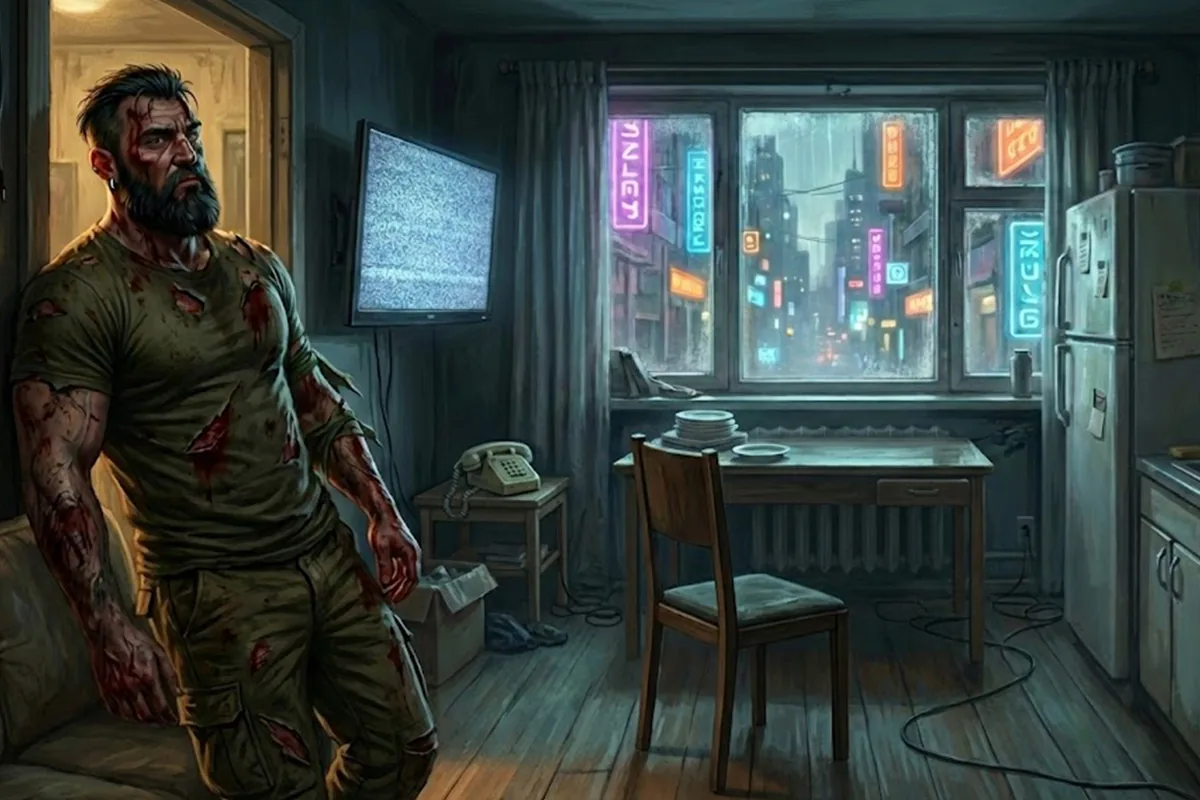
Harri took his gun from the cupboard and a beer from the fridge. The gun had cost more than the last three months of Krisel's treatment. He had bought it the day she died. The cold silver sat right in his hand. Just in case. The cold beer eased his ruined throat as he sat on the sofa, head still pounding, joints aching, and drank without tasting it. He placed the gun next to himself. Through the window, sixty floors up, the city stared back at him, dark and indifferent, neon scattered across the skyline like careless wounds.
He found it almost amusing.
He was still alive. Still standing. Still working the problem, which was what a man did. A man carried his load or he lay down. Harri had not lain down.
And Thelian, the boy who was not his, sat in the next room keeping vigil over a body that was not yet finished spending itself. The boy's back was straight, his hands still folded, his whole posture an exercise in a discipline that no child of eight should have needed to learn, and something about the stillness of him, the way he held himself as though holding was all that was left, cost Harri more to look at than it should have.
He looked away.
The pain dulled. The room softened.
His head tipped forward. He had worked. He had endured. He had earned this much.
And without ceremony, without forgiveness or resolution, Harri fell asleep.