Thelian stepped out into the street and the heat filled his mouth.
The receipt square in his pocket pressed into his ribs with each step. Paper against the crude knot in the torn seam. The knot was thick and wrong, a lump that kept reminding him he had fixed damage with his own hands and it had held, barely.
His palm slid over it once, flattening it hard until it hurt.
Harri would wake up now.
That thought arrived as an image, not words. A thumb on a screen. A quiet room. Harri’s eyes narrowing the way they narrowed on a bent tool that had stopped working right.
At the corner, a public payment kiosk blinked with a cracked screen, the kind people used when they wanted to see a balance without stepping into a real bank hall. Thelian slowed without meaning to. His fingers twitched toward it, then froze in the air.
He walked past.
Traffic hissed along Inner Road. He crossed without looking up. Tires cut thin water sheets and the spray cooled his shins for a breath. Someone shouted something at him. He did not turn. Turning meant faces. Faces meant eyes.
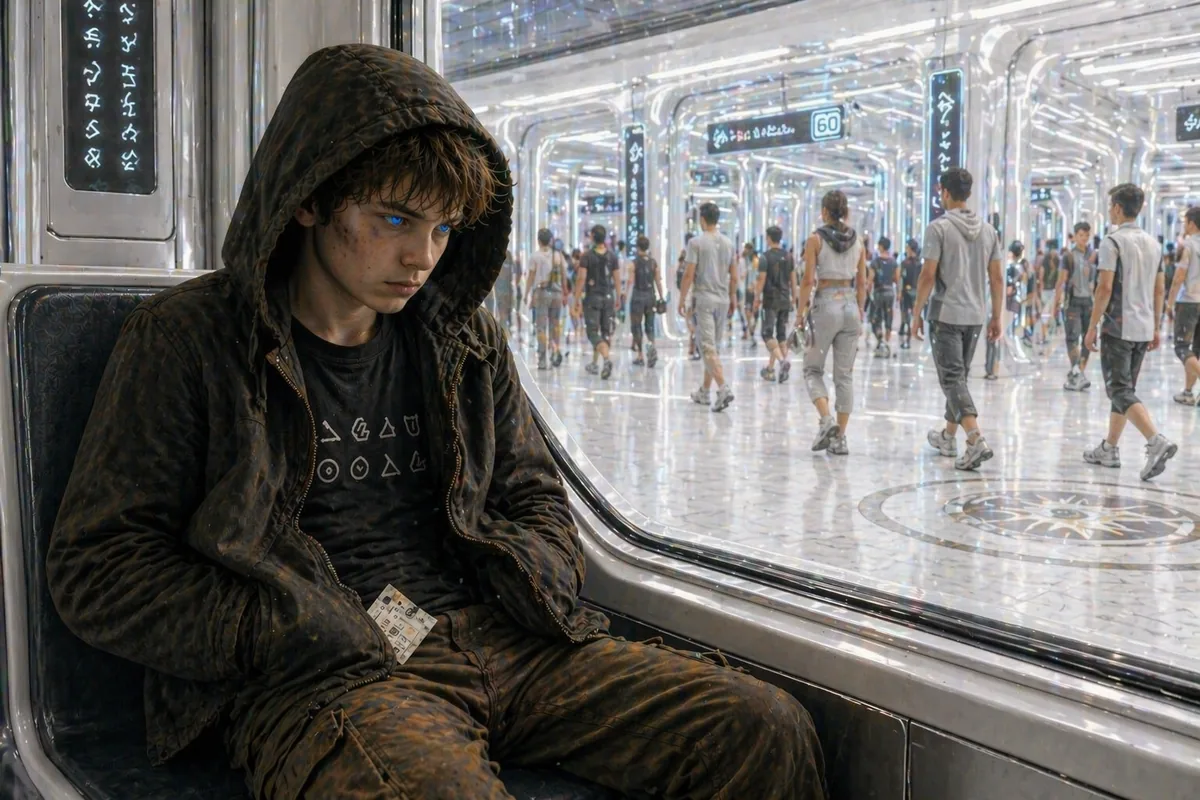
His hood sat low. He adjusted it carefully. He knew what was waiting in the reflection—the defect in his irises, the blue ring. Iru eyes. Demon eyes. Two chips of the frozen sky that did not belong in a maan’s face.
His ankle kept a dull pulse. The old twist answered each step like a metronome. He smoothed his gait by force, making the limp smaller, the way he made everything smaller.
Thelian’s mind kept trying to step backward.
A bed. A small forehead under his. Heat that did not belong in a child. His own breath fogging against her skin. A smile that had lasted the length of a blink and then gone out like a lamp.
Hours ago.
His mouth tried to form the old lie, the one that had kept him moving through the night watch. Just fever. The words stuck in his throat, his tongue pressing hard to the back of his teeth until the thought went blunt.
He had kept going to practice in the weeks before because practice paid a little, because the shift gave structure to hours that otherwise became a room with a dying child in it. Because working meant you did not have to sit and listen for a breath that came late.
The tunnels talk had been noise. Doors nobody used. Stairs that went down. Cold air that did not smell like canal. He had heard it and kept it against his ribs without naming it, the way he kept everything that might matter later, because naming it made it real, and real meant you could not pretend.
Now later had arrived and his mind grabbed at anything that looked like a direction.
Baramma rose up as Mother’s voice, thin with fatigue but still trying to keep a child’s fear from chewing through the night.
Stories about Baramma. Stories about Randen.
Thelian had given all those stories to Elle the past weeks. He remembered the weight of her small, hot hand in his. He had whispered to her about the giants, the Bar people, double the height of any Maan, with skin like spotted iron and horns growing from their arms. He told her they worshipped metal and fire, that they were strong enough to break the Empire.
Where did they go? she had asked, her voice a dry rattle.
To the forest, he had lied. To the red trees. To wait for us.
But Red was not here. Blue was, and Blue had failed.
His chest tightened.
Elle’s face, slack and still, and his own voice saying I will bring it, like words were medicine.
His jaw set.
Harri’s voice rose out of memory, not drunk, not shouting, the worst kind. It arrived in his sternum, a low pressure under his collarbone.
“Dreaming idiot. You live in a fable because you are too weak for the real world.”
Thelian’s shoulders rounded without permission.
His eyes slid to the curb edge. A dark gap under a service ramp. A drop the city would not bother to count.
His fingers flexed once. Twice. Three times.
He made them stop.
Not yet.
The capsule station rose ahead. Thelian kept his gaze on the tiles, on anything but a face.
Canal-block rat. Sixtieth floor. Demon eyes.
His stomach clenched.
A voice snapped at him, close.
“Meir’pass!”
Thelian flinched so hard his shoulder sent pain down his arm. He bit the inside of his cheek to keep from making a sound.
Matti already stood by the gate, coat hanging off him like it belonged to someone who had not been whittled down by hunger. Pale hair. Sharp eyes. That stubborn smile he wore like armor, always a little too bright, always a little too fast.
He held a small cloth bundle in one hand, tied with string.
“You’re late,” Matti said, and the words were casual, but he did not step closer into the light. He stayed half in shadow, watching the turnstiles the way you watched a Draven that might bite if you moved wrong. “I brought pik tree bark tea for her. It’s bitter, but it holds the shaking down.”
Thelian’s throat tightened. His mouth opened and nothing came out.
Matti lifted the bundle a little, a small shake of the wrist.
“I’ll sit outside your corridor like always,” Matti said. “If he leaves her alone, I go in. Same as before. Hand over the keys.”
The word keys hit Thelian’s body before it hit his mind. His hand went to the pocket where the apartment key sat on a bent ring. He stopped himself by force. His fingers curled tight inside the cloth.
Matti watched him.
Thelian tried to find a sentence that placed the keys in Matti’s hand without placing anything else in the air. He stared at the tile seam between their shoes. A small smear of mud sat there, drying into a half-moon. His thumb twitched, wanting to wipe it.
Matti’s voice dropped, sharper.
“Elle?” he said.
Thelian’s breath came in and caught high. He swallowed once, hard enough to hurt.
“The Traveller took her,” he said.
Matti did not answer right away.
The cloth bundle sagged in his hand. His fingers tightened on the string until the knot bit into skin. His mouth opened and shut again. His gaze flicked past Thelian, not at him, not at the guards, at something empty, like he was trying to find a place to put his eyes that did not burn.
Then his jaw set.
His nostrils flared once. He looked down at the bundle and tied the string tighter, too tight, a fast, violent motion that made the cloth crease hard.
Thelian felt his own body react, small and automatic. Shoulders drew in. Chin tucked. He waited for the blast.
Matti’s voice came out low.
“When,” he said.
”She asked about you…” said Thelian. They stood in silence. Thelian could not manage more words. He pressed his palm once against his pocket knot until the paper edge cut his ribs, then let his hand drop.
Matti stared at the bruise under Thelian’s eye, at the scrape on his cheek, and lifted his own hand to his cheekbone in the same place, a mirror motion that was careful enough to hurt.
“He did that,” Matti said.
Thelian shook his head fast.
“No,” he said, too sharp, then tried to fix it immediately. ”I fell a few hours ago. At the Medika. I slipped.”
”More like yesterday morning…”
”Really, it was not Harri this time.” It came out too eager, to sharp.
Matti’s eyes stayed hard.
“This time,” Matti said, and the words were flat. He did not finish the sentence. He did not need to. He looked at Thelian’s face like he had been looking at it for months.
Thelian’s mouth worked once. He made himself speak, because this silence made things louder.
“This time, The words felt wrong the moment he said it. ”He came home quiet now, he tried to be nice…” he said. “Last night.”
Matti’s lip curled like he tasted something sour.
“He was too drunk to stand.”
Thelian flinched at the cruelty of it, not because it was false, because it landed too close.
“He kept a roof,” Thelian said. “He bought food when he had it.”
Matti looked away.
Thelian reached into the pocket and slid out the razor, holding it in his palm. Harri’s thing.
He extended his hand.
“For you,” he said.
Matti blinked, looking at it, then at Thelian.
He extended his hand.
“For the past month. For the tea. For not leaving.”
Matti took the razor. “You stole it.”
Thelian nodded.
Matti tucked it into his coat. “Sixty credits. More if I polish it.”
Thelian’s chest eased.
“That’s Harri’s fault,” Matti said, and now the anger found a channel because it needed one. “If he’d taken her to Jarabiir, to the Protector’s of the Grël, they would’ve fixed it. Protectors got cures. People say they can fix anything if you have credits.”
Thelian shook his head once, slow.
“There is no cure,” he said.
Matti’s fingers tightened on the bundle string again.
“There is,” Matti said. “The Protectors…”
Thelian cut him off, quiet, and it came out hard because soft would have cracked. “People say anything when they want to keep walking. Blue Ïsuulë is everywhere, Matti. It makes fever pills. It does not touch this. Harri took a loan for Mother. It bought time and pain and nothing else.”
Matti’s mouth shut. He stared at the tiles as if he could make the words un-said by looking away from them.
He swallowed. His throat bobbed.
“I’m just saying,” he muttered. “He always has credits for drink.”
Thelian’s fingers curled inside his sleeve. Nails bit skin.
“He did what he could,” he said, and the sentence tasted like ash as it left him.
Matti’s gaze flicked to the turnstiles again.
“And you working? After what happened?” he asked, like work was the only thing left that made time move.
Thelian nodded.
“What else could I do, besides…” he hesitated.
The curb edge came back in his mind. The gap under the service ramp. The clean, simple drop.
He swallowed it.
“Only till afternoon,” he said. “Then I leave.”
“Leave where?”
Thelian’s mouth pulled tight. The answer was not a sentence—it was a task big enough to hold him so he did not have to look at what he had done and not done.
“Doesn’t matter,” he said. “It’s silly.”
“It’s not,” Matti said, and the words came out too loud, then he pulled them back inside himself and lowered his voice. “You can’t just go. How am I supposed to find you? Comms got banned last month. Public terminals are dead. They cut the block lines or they never fix them.”
Thelian glanced at the fern-grass corner by the retaining wall, the soft place the city still tolerated. A loose brick sat there, dark with moisture.
“I’ll write,” he said. “Loose brick. Same spot as last year.”
Matti opened his mouth.
Thelian stepped back before the word could become a goodbye. He wanted to, but he hated when people turned and left.
It was safer to leave first.
He walked toward the turnstiles.
A guard stood there scanning passes. Not a Medika guard, different uniform, different face, but Thelian’s body did not care. Uniform meant light. Light meant attention. Attention meant a beam steadying on his face and a voice that stopped searching.
His heart kicked hard enough to make the pocket knot bite deeper. He lowered his head until his hood nearly covered his nose. He kept his gaze on the tiles, on the dirt in the seams, on anything but a face.
His fingers closed around his worker card inside his pocket.
Plastic. Cheap. Warm from his skin. A token that let him pass, even as the body beneath the clothes betrayed him.
He held it out without looking up.
The scanner beeped. Green light flashed.
He moved through before the guard could decide to look longer.
His ankle tried to catch, out of habit more than pain. The joint answered with a dull memory and then nothing, as if it had already decided it was done being hurt. The twist from the chute should have stayed sharp. It did not. He set his foot again and the limp shrank, smoothed down by force and by something in him that did not behave like other people’s bodies.
His shoulder gave a small warning when he swallowed. The twinge was there and then it slid away, retreating into heat and muscle like an animal ducking into a crack. Even the scrape on his cheek, the thin raw line from metal, had stopped stinging every time the air touched it. It was still there, he knew it was, but the pain did not cling.
His mother used to call it a gift.
She had said it in a voice that tried to make the word kind. She had said it before the paper on the table, before the number on the bottom line, before Harri’s mouth got quiet and hard. Before her hand started stopping halfway to his hair. Before her smiles landed on him and then began to slide past him as if looking at him too long would cost her something she could not afford to lose.
Back when he was still Harri’s son.
Not the blue-eyed bastard.
The escalator carried him down. A taste rose at the back of his tongue as the step fell away under his boot, faint as a rinsed cup, the thin, green bitterness of pik tree bark cooled and set down beside him on a table whose wood he could no longer picture. It did not belong to this station. It belonged to a kitchen that did not exist anymore. The taste stayed for three breaths, then the escalator carried that too away. It hummed low and tired, a machine that still did its job even when nobody thanked it. He gripped the rail and felt grit under his palm. His thumb wanted to wipe it clean. He kept his hand still because wiping would take time, and time meant his eyes might drift upward and catch something reflective.
The platform opened.
Capsules hovered in the tunnel lanes, long glass bodies held above a magnetic track. The glass was clouded, smeared with spore-dust and old fingerprints. Once, they said, this glass had been clear as air, Inarin glass that let you feel like you were flying through stone. Now it was just another window you couldn’t see through. The hover-coils whined thin, a tooth-ache sound, like the system was holding itself together by habit.
A flicker of reflection slid along the capsule skin as he passed. Hood shadow. Bruise. A flash of blue he did not look at directly.
He found a corner seat before the train even fully arrived, because corners were safer. He folded his hands tight in his lap so they would not climb to his hood again. He pressed his palm once to the pocket knot, then forced his hand down because pressing did not change anything, it only proved he was still trying.
People filed in around him, eyes down, bodies bent with the same tired posture. Nobody looked long enough to see anything. The Empire did not want you looking. It wanted you working, and it wanted you clean.
The capsule doors hissed open.
He boarded with the flow. He sat. He made himself small.
The train sealed. The hum deepened. Lights strobed once and steadied.
He closed his eyes because keeping them open meant glass, meant chrome, meant the bright places that caught him.
He did not sleep. The ride was only a few stations. His body tried anyway. His head dipped once, a heavy jerk, like a hand had pushed his neck down. He snapped back up and swallowed air, tasting hot metal and his own sweat.
Summer burned.
The tunnel lights blinked past in white pulses through his vision until they blurred into a line.
His eyes shot. His mind drifted on purpose, away from the morning, away from the bed, away from the small forehead under his.
Snow. Silence. Wind.
“ISEMH Square. Please disembark.”
Thelian’s eyes opened on the announcement. The train was emptying. He rose last and stepped onto the platform as the doors hissed shut. The central station loomed above, 133 floors of glass and steel.
On the surface, he did not spend credits on anything. He took the trainee ration strip from his pocket and fed it into the vending slot. A sandwich slid out. Uhiel warm. Bread and stew. He ate without tasting as he crossed the Square of Life, chewing because stopping meant thinking.
At the foot of the arcology, the line had already formed.
Dozens of trainees waited at the checkpoint, jackets zipped high like armor, eyes dulled by routine. Most were younger than him. Some barely ten. He joined the line without thinking. Habit had replaced choice long ago.
“Thelian! Hold my place!”
Ranord came jogging across the lot, already sweating, breath loud and dramatic.
“May the Meir pass you by, Ranord.”
“Yeah, yeah. Meir’pass. Whatever. I can’t be late today,” he panted, slipping in behind Thelian. “You get any sleep?”
“No.”
“At least you won’t be late. Light day too. I saw the board.”
Thelian nodded, eyes forward.
“Who am I with?” he asked, already hoping for a familiar answer.
“Aeron. Old guy. Looks like he’s carved out of gristle and bad decisions. Probably been working here since the Hundred Year War.”
Something eased in Thelian’s chest. Aeron. The man who did not shout, who looked at the pale things in the pods and just did the job.
“I’ve worked with him before,” he said. “He’s fine.”
Ranord snorted. “That guy is sick, but whatever. You’re on sixtieth.”
That number landed wrong inside Thelian.
Sixtieth floor.
He felt his ankle answer it with a dull pulse, as if the body remembered being named.
“That floor’s empty,” Thelian said, and his voice came out too careful.
“They moved the bodies to the yard,” Ranord said. He jerked his chin upward, toward the glare of the sky. “The outer promenade. The terrace outside the glass. But the sheet still says sixtieth. Classic.”
Thelian felt the thought like a sunburn. The promenade was naked concrete sixty floors up, no roof, no shade. It would be an oven.
The line crept forward. The checkpoint fence rose ahead.
Thelian angled his body a fraction, keeping the hood shadow where it needed to be. He kept his gaze on the guard’s hands, not the face. Hands were safer. Hands did not judge your eyes.
“Meir’pass,” Thelian said, and handed over his ID.
The scanner chirped.
The guard didn’t let go.
“You’ve got a message.”
Thelian’s stomach tightened. “Yeah?”
“Your father’s been calling. On the emergency line.”
“He says your name,” the guard said, leaning forward, looking at Thelian with a mix of suspicion and genuine confusion. “Then he just… stops. Goes silent. I can hear him breathing, wet and heavy, like he’s forgotten he made the call. Then the line cuts. Three times this morning.”
Thelian felt the blood drain out of his face.
Harri did not do silent. Harri was noise. Harri was certainty.
If he was calling and not speaking, it was because he was holding something back.
The wallet.
The thought hit Thelian like a slap. Harri must have woken up. He must have reached for the coat. He must have seen the empty slot where the plastic used to be.
“He wants his card,” Thelian said. The words came out brittle, a guess that felt like a verdict.
The guard frowned, checking the monitor again. “I don't know what he wants. He sounds... wrong. Drunk, maybe. Just tell him to stop blocking the emergency line.”
Thelian’s fingers flexed inside his sleeve. One, two, three. Stop. He felt the need to defend himself against the accusation the guard hadn’t even made.
“I used it,” he said, his voice dropping to a whisper. “To pay for my sister’s burial.”
The guard stared at him for a beat, the boredom returning, erasing the confusion. He didn't care about the drama. He just wanted the line clear.
“Just deal with it,” the guard grunted. “Sorry about your sister. Office 3614. Call him back.”
He waved Thelian through.
Ranord swaggered after him, grinning like the world had never refused him anything.
“She’s really dead?” he asked.
“She is.”
“Damn. Sorry, man. My Kirrut died last year. I get it.”
Thelian stopped and looked at him.
Just looked.
For one long, empty second. He looked at Ranord’s brown eyes, clean and accepted. He looked at the soft skin of a boy who had never had to hate his own reflection.
“Thanks,” he said. “I’m sure it was just as hard.”
Ranord smiled, oblivious. “Yeah, but I got over it. Dad bought me a new pet. Draven. They grow huge.”
He turned his back.
“I have to go,” Thelian said, walking away fast before Ranord could tell him the new pet’s name.
“Chin up, man! My dad says life always moves forward.”
Of course he did, Thelian thought. People like him were the reason it had to. They were the Maan. They were the future. And Thelian was just here to help them bury the past.
He waited until Ranord was gone, then turned for the stairs. Sixty floors. No lift today. He welcomed it. The first flights burned. Breath rasped. Sweat ran down his ribs under the t-shirt and cooled in the draft between landings. His ankle gave a small, angry pulse on the turns, then quieted, as if it had already decided the complaint was finished. The shoulder that had shouted in the chute earlier only tugged now when he hauled himself up by the rail.
By the time he reached the upper levels his lungs should have been tearing. They were not. The burn thinned. The air found its place.
He pushed through the heavy fire doors and the smell hit him, antiseptic and ozone, the scent of the Inarin ghosts. The long hall stretched out, lined with the glass pods of the Sleepers.
Most were dark now. Empty.
But at the far end, a single figure moved among the shadows, checking gauges that no longer mattered.
Aeron looked up, his face lined and weary, eyes finding Thelian’s across the distance. He didn’t smile. He just nodded, a small, sharp motion that meant come here.
Thelian walked toward him, head down, hood forward, ready to do the only thing he was good for, putting pale bodies back into stillness so the world could keep calling itself clean. His hands hung loose at his sides. They should have been ready. They usually were. But the thought of what waited on the promenade, the dragging, the scanning, the stacking, made his fingers curl inward, pull back, as if the tendons remembered a rule his mind could not name. Aeron's hands would be steady. Aeron's hands always were. They did not look like him, not really, not with their white skin and sharp ears and wrong quiet, but some of them had the same deep blue in their eyes, and that was enough to make his stomach turn every time the glass caught the light.