Desert Horsetail
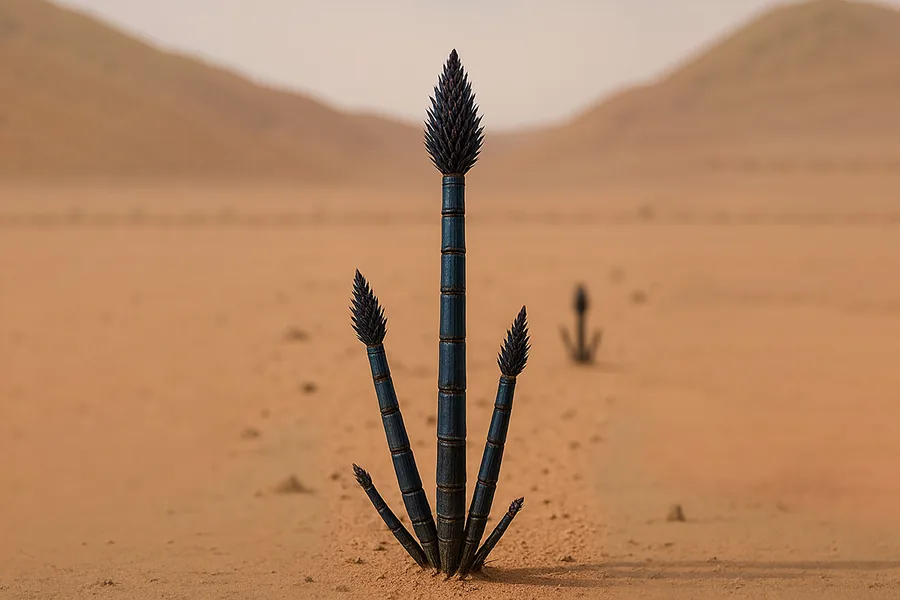
The Desert Horsetail rises starkly from barren desert floor, its unmistakably columnar and modular form composed of rigid repeating nodes alternating between steel-blue and obsidian black with faint copper banding, each stem reaching up to 1.2 metres and terminating in a dark violet-black bristle-like apical cone. It occupies arid, high-radiation environments alongside the Desert Fern Natural History Desert Fern The Desert Fern is a ground-hugging radial rosette with twelve to sixteen lanceolate, deeply serrated fronds extending outward in a near-perfect spiral, their surface micro-crys..., reaching skyward where the Fern harvests low and wide, together filling complementary spatial niches in the same marginal ecosystems. The surface of every segment is matte-metallic and finely striated, suggesting silica-reinforced tissue built for structural strength and low reflectivity under harsh sunlight.
Key traits
- Rigid, silica-reinforced segments provide mechanical resilience and metabolic efficiency in conditions of extreme heat and aridity.
- Terminal cone structures serve dual roles as photosensors and dew condensers, capturing atmospheric moisture during cool nighttime hours.
- The tall, columnar growth pattern maximises exposure to early morning dew and the cooler air strata above ground level.
- The modular node structure allows damaged sections to be shed without compromising the entire plant.
- Dew collected by the apical cones may drip to the base, feeding the plant's own roots and nearby ground-level species.